Syllabus
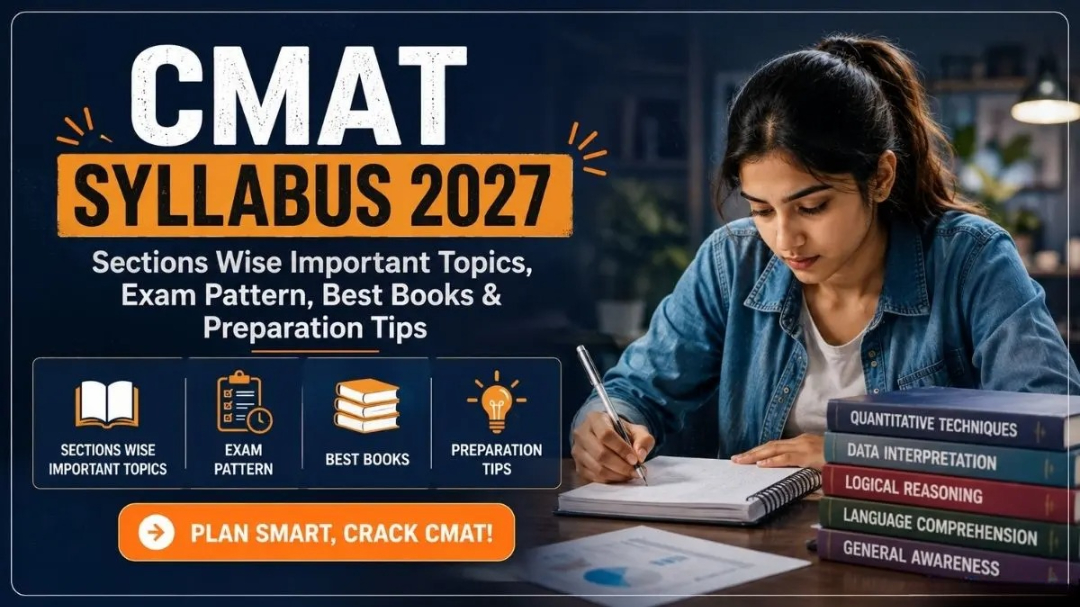
Full pageThe CMAT Syllabus 2027, prescribed by the National Testing Agency (NTA), comprises 5 sections that assess candidates' quantitative ability, reasoning, and language skills. It also evaluates general awareness and entrepreneurial aptitude.
The CMAT 2027 Syllabus is expected to remain largely unchanged, with no major revisions announced so far. Candidates can follow the existing syllabus while preparing for the exam.
Quantitative Techniques & Data Interpretation carries 20% weightage, with 20 questions for 80 marks. It tests arithmetic, algebra, geometry, modern mathematics, and data interpretation, making calculation speed and accuracy important.
Logical Reasoning also carries 20% weightage, with 20 questions for 80 marks. Questions generally cover arrangements, puzzles, coding-decoding, blood relations, series, directions, and other analytical reasoning topics.
Language Comprehension accounts for 20% of the total score, comprising 20 questions for 80 marks. Reading comprehension, vocabulary, grammar, sentence correction, and verbal ability form the core of this section.
General Awareness has 20 questions carrying 80 marks and covers current affairs as well as static GK. Questions may span business, economy, awards, sports, national and international events, and other areas of general knowledge.
Innovation & Entrepreneurship is the distinctive fifth section of CMAT, with 20 questions for 80 marks. It focuses on entrepreneurship concepts, business fundamentals, innovation, startups, and related terminology.
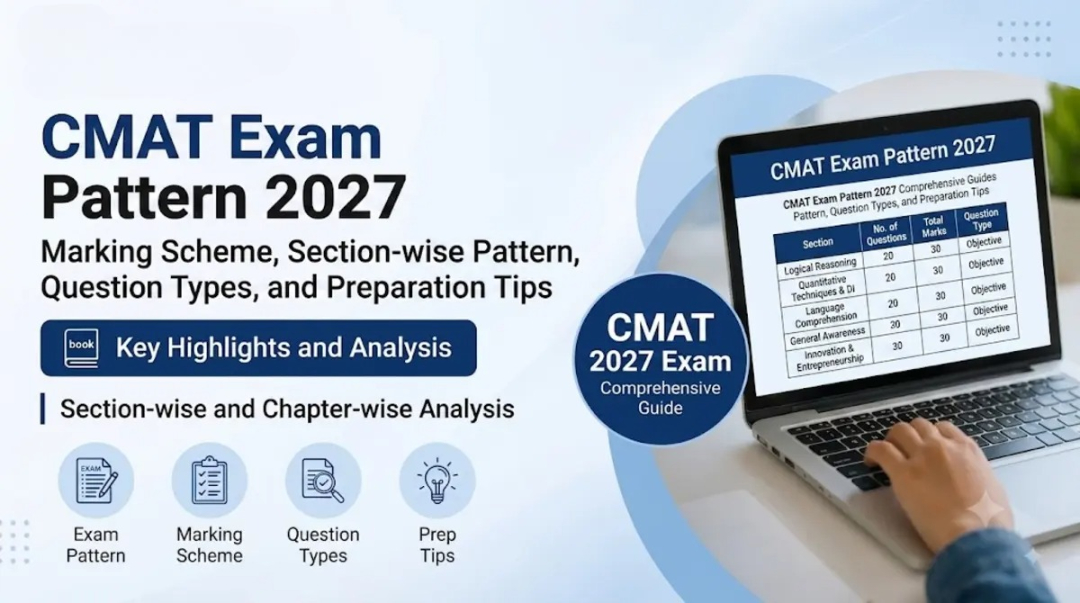
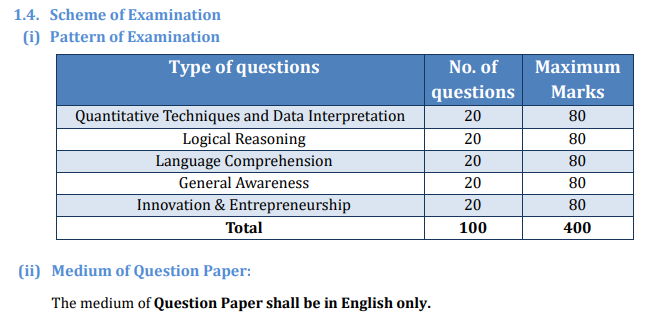
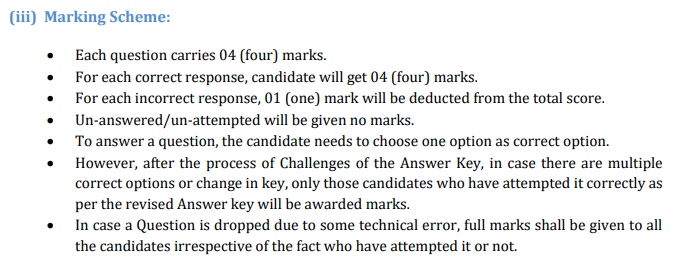
CMAT Exam Pattern follows a 100-question, 400-mark structure, with 4 marks awarded for every correct answer and 1 mark deducted for every incorrect answer. Unattempted questions carry no marks or penalty.
Since all 5 sections carry equal weightage, candidates should avoid preparing only for Quantitative Techniques or Logical Reasoning.
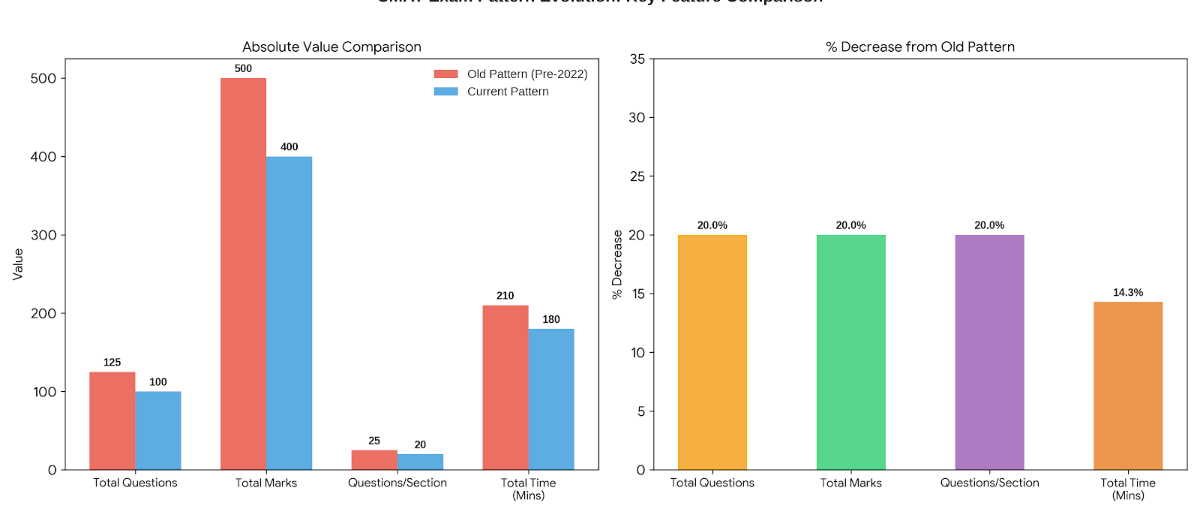
Related Link:CMAT Exam Pattern 2027: 125 Questions, 500 Marks, Marking Scheme and Section-wise Breakdown
CMAT Syllabus 2027 Overview
Particulars | Details |
|---|---|
Conducting Body | National Testing Agency (NTA) |
Exam Level | National Level MBA Entrance Exam |
Mode of Exam | Computer-Based Test (CBT) |
Total Sections | 5 |
Sections | Quantitative Techniques & Data Interpretation, Logical Reasoning, Language Comprehension, General Awareness, Innovation & Entrepreneurship |
Total Questions | 100 |
Questions per Section | 20 |
Maximum Marks | 400 |
Marks per Correct Answer | +4 |
Negative Marking | -1 for each incorrect answer |
Unattempted Questions | No marks deducted |
Section-wise Weightage | 20% per section |
Duration | 180 minutes |
Question Type | Multiple Choice Questions (MCQs) |
Main Focus | Quantitative ability, reasoning, language proficiency, general awareness, and entrepreneurship & innovation |
Also Read:
Section-wise CMAT Syllabus 2027
The CMAT Syllabus 2027 follows a stable five-section structure that has remained largely unchanged since 2023.
In CMAT 2024, 2025 and 2026, each section had 20 questions for 80 marks, making a 100-question, 400-mark paper.
The Innovation & Entrepreneurship section has remained compulsory.
So candidates should prepare for all 5 areas rather than prioritising only Quantitative Techniques or Logical Reasoning.
Section | Questions | Marks | Key Areas |
|---|---|---|---|
Quantitative Techniques & Data Interpretation | 20 | 80 | Arithmetic, Algebra, Geometry, Number System, Data Interpretation |
Logical Reasoning | 20 | 80 | Puzzles, Arrangements, Coding-Decoding, Series, Blood Relations, Syllogism |
Language Comprehension | 20 | 80 | Reading Comprehension, Grammar, Vocabulary, Para Jumbles, Verbal Ability |
General Awareness | 20 | 80 | Current Affairs, Business & Economy, Static GK, Sports, Awards |
Innovation & Entrepreneurship | 20 | 80 | Entrepreneurship, Startups, Innovation, Business Fundamentals, Government Initiatives |
Also Read: CMAT Paper Analysis 2027: Expected Easy to Moderate, Good Attempts and Shift-Wise Difficulty
CMAT Syllabus 2027: Section-wise Weightage
In 2026, Quantitative Techniques & DI and Logical Reasoning were rated easy, while Language Comprehension was easy to moderate.
General Awareness and Innovation & Entrepreneurship were comparatively tougher at the moderate level.
In 2025, Quantitative Techniques, Logical Reasoning and Language Comprehension were easy.
Whereas General Awareness and Innovation & Entrepreneurship were moderate, making them relatively more challenging sections.
In 2024, the difficulty varied more across sections, with Logical Reasoning being moderate and lengthy.
Language Comprehension ranged from moderate to difficult in some analyses, while General Awareness was moderately tough.
CMAT 2027 Section | No. of Questions | Marks | Weightage |
|---|---|---|---|
Quantitative Techniques & Data Interpretation | 20 | 80 | 20% |
Logical Reasoning | 20 | 80 | 20% |
Language Comprehension | 20 | 80 | 20% |
General Awareness | 20 | 80 | 20% |
Innovation & Entrepreneurship | 20 | 80 | 20% |
Total | 100 | 400 | 100% |
CMAT Syllabus 2027: Section-wise Important Topics
Recent CMAT papers indicate that Arithmetic remains one of the most frequently tested areas in Quantitative Techniques, while puzzles, arrangements, and analytical reasoning are important in Logical Reasoning.
Language Comprehension continues to emphasise Reading Comprehension, vocabulary and grammar, making reading speed and contextual understanding important.
General Awareness and Innovation & Entrepreneurship can be more unpredictable, with questions covering current affairs, business awareness, startups, innovation and core entrepreneurship concepts.
Section | Important Topics | Preparation Priority |
|---|---|---|
Quantitative Techniques & DI | Percentages, Ratio & Proportion, Averages, Profit & Loss, Time & Work, Time-Speed-Distance, Number System, Algebra, Geometry, Probability, Permutation & Combination, Data Interpretation | Arithmetic & DI |
Logical Reasoning | Arrangements, Puzzles, Coding-Decoding, Series, Blood Relations, Direction Sense, Syllogism, Statement & Conclusion, Analogy, Ranking | Puzzles & Arrangements |
Language Comprehension | Reading Comprehension, Vocabulary, Grammar, Para Jumbles, Sentence Correction, Fill in the Blanks, Idioms & Phrases, Synonyms & Antonyms | RC & Vocabulary |
General Awareness | Current Affairs, Business & Economy, Banking & Finance, Government Schemes, Awards, Sports, Books & Authors, History, Geography, Science & Technology | Current Affairs & Business GK |
Innovation & Entrepreneurship | Entrepreneurship Concepts, Startups, Innovation, Business Fundamentals, Types of Entrepreneurs, Funding, Government Initiatives, IPR, Business Terminology | Entrepreneurship & Innovation concepts |
CMAT Syllabus 2027: Quantitative Techniques
The Quantitative Techniques & Data Interpretation section of CMAT has consistently carried 20 questions for 80 marks.
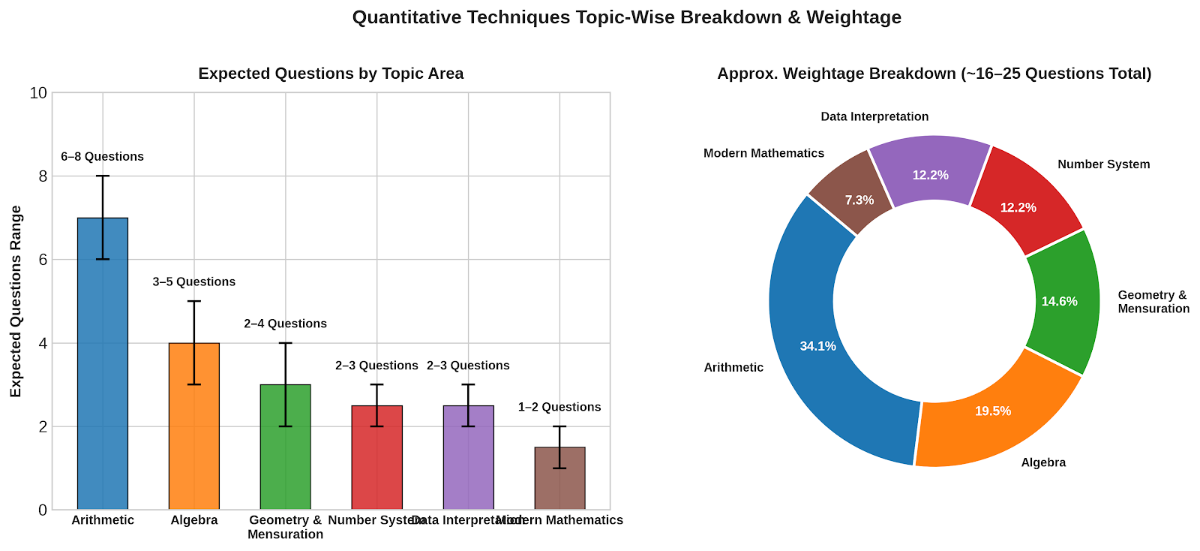
Across the last three years (2024–2026), Arithmetic emerged as the most frequently tested area, contributing roughly 7–10 questions per year.
In 2026, the section had 7 Arithmetic and 3 DI questions, while 2025 had around 10 Arithmetic questions.
Overall, Arithmetic accounted for approximately 35–50% of the 20-question section in these papers, making it the highest-priority topic.
Data Interpretation contributed around 3–5 questions (15–25%), while Number System, Algebra, Geometry and Modern Mathematics made up the remaining share.
Topic | Important Areas to Cover |
|---|---|
Arithmetic | Percentages, Profit & Loss, Ratio & Proportion, Averages, Simple & Compound Interest |
Time & Work | Work Efficiency, Pipes & Cisterns, Work & Wages |
Time, Speed & Distance | Relative Speed, Trains, Boats & Streams |
Number System | Divisibility, HCF & LCM, Remainders, Unit Digit |
Algebra | Linear Equations, Quadratic Equations, Inequalities, Functions |
Geometry & Mensuration | Lines & Angles, Triangles, Circles, Area, Volume |
Modern Mathematics | Permutation & Combination, Probability, Set Theory |
Data Interpretation | Tables, Bar Graphs, Line Graphs, Pie Charts and Caselets |
Key Areas to Prioritise
Arithmetic should be given priority during preparation because its concepts are applicable across several question types.
Percentages, ratios, averages, profit and loss, time-work, and time-speed-distance are useful areas to practise extensively.
Algebra and Number System can also contribute to scoring opportunities once the basic concepts and calculation methods are clear.
For Data Interpretation, practise extracting information from tables, graphs and charts while working on approximation and calculation speed.
CMAT Syllabus 2027: Logical Reasoning
The Logical Reasoning section carries 20 questions for 80 marks.
In 2026, 16 of 20 questions were Non-Verbal Reasoning and 4 were Verbal Reasoning.
2025 had 14 Non-Verbal and 6 Verbal, while 2024 also had a strong focus on Critical Reasoning, Family Tree and Arrangements.
Overall, Non-Verbal Reasoning accounted for about 70–80% of the section in 2025–26, making topics such as family tree, coding, arrangements, directions, series and visual reasoning high-priority areas for CMAT 2027.
Topic | Important Areas to Prepare |
|---|---|
Analytical Reasoning | Seating Arrangements, Puzzles, Sequencing, Matrix Arrangements |
Verbal Reasoning | Statements & Arguments, Statements & Assumptions, Statements & Conclusions, Cause & Effect, Inferences |
Non-Verbal Reasoning | Number Series, Figure-Based Questions, Analogy, Pattern Completion |
Coding-Decoding | Letter Coding, Number Coding, Symbol-Based Problems |
Blood Relations | Family Trees, Relationship-Based Problems |
Direction & Distance | Direction Sense, Distance-Based Questions |
Ranking & Ordering | Ranking Tests, Order & Sequence |
Syllogisms | Statements, Conclusions, Venn Diagram-Based Questions |
Miscellaneous | Clocks, Calendars, Venn Diagrams, Counting Figures |
CMAT Syllabus 2027: Language Comprehension
Language Comprehension has remained a 20-question, 80-mark section in recent CMAT papers.
The section shifted from 5 RC questions in 2024 to just 2 in 2025 and 2026, with greater emphasis on grammar and vocabulary.
It was rated easy in 2026, compared with moderate-to-difficult in 2024.
Topic | Important Areas to Prepare |
|---|---|
Reading Comprehension | Main Idea, Central Theme, Inference, Tone, Fact-Based Questions |
Vocabulary | Synonyms, Antonyms, One-Word Substitution, Idioms & Phrases |
Grammar | Tenses, Parts of Speech, Prepositions, Subject-Verb Agreement, Voice, Speech |
Sentence Correction | Error Identification, Sentence Improvement, Correct Usage |
Para Jumbles | Sentence Rearrangement, Logical Sequence |
Sentence Completion | Fill in the Blanks, Context-Based Completion |
Cloze Test | Contextual Vocabulary, Grammar-Based Blanks |
Para Completion | Identifying the Most Appropriate Ending |
CMAT Syllabus 2027: General Knowledge
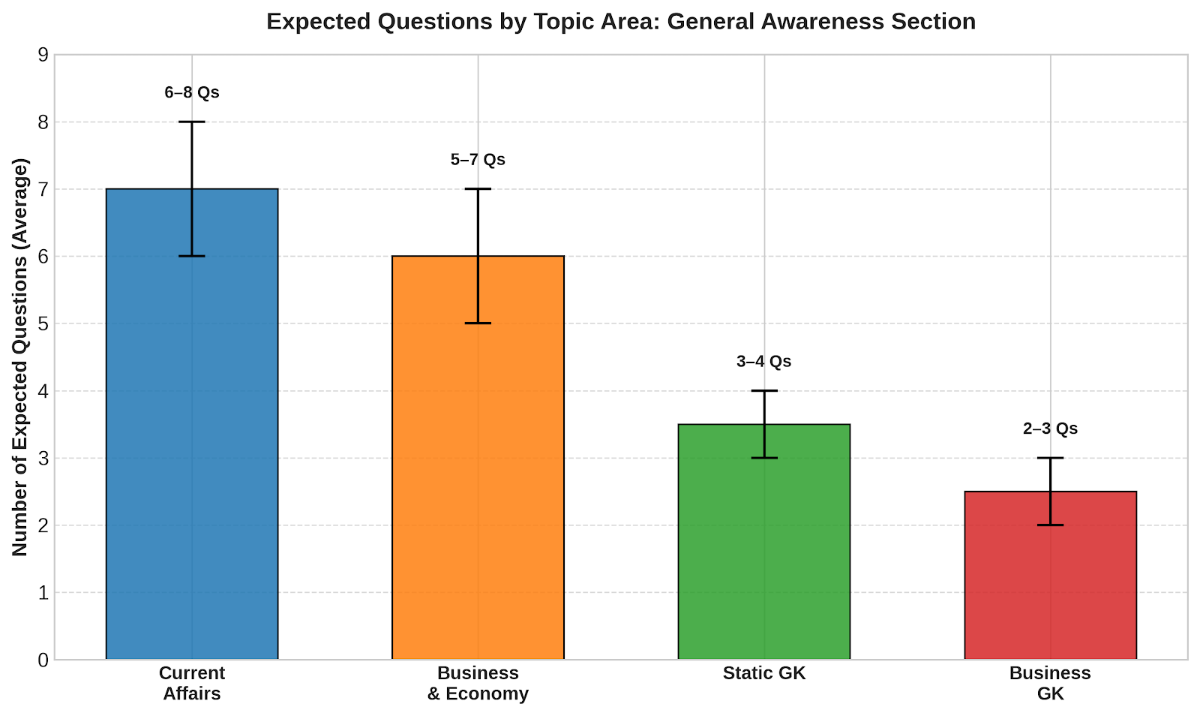
The General Awareness (GK) section of CMAT 2027 covers both static knowledge and current affairs, with questions generally drawn from Indian polity, history, geography, economy, science, sports, awards, books and important events. The section contains 20 questions for 80 marks.
Topic | Important Areas to Prepare |
|---|---|
History | Ancient & Medieval India, Modern History, Freedom Movement, Important Events & Personalities |
Indian Polity & Constitution | Fundamental Rights, Constitutional Articles, Parliament, Judiciary, Amendments, Elections |
Geography | Indian Geography, Rivers, Mountains, States & Capitals, National Parks, World Geography |
Economy & Banking | Indian Economy, RBI, Banking Terms, Budget, Inflation, GDP, Financial Institutions |
Science & Technology | Basic Science, Space Missions, Defence Technology, Scientific Discoveries, Emerging Technologies |
Sports | Major Tournaments, Sports Personalities, Records, Awards, Cups & Trophies |
Art & Culture | Indian Dance Forms, Music, Literature, Heritage Sites, Festivals, UNESCO-related topics |
Awards & Honours | Bharat Ratna, Padma Awards, Nobel Prize, International & Sports Awards |
Books & Authors | Important Books, Authors, Literary Awards and Famous Works |
Business & Corporate Affairs | Companies, Brands, CEOs, Mergers, Start-ups and Major Business Developments |
Current Affairs | National & International Events, Government Initiatives, Appointments, Summits, Important Reports |
International Organisations | UN, IMF, World Bank, WTO, WHO, G20, Headquarters and Key Functions |
CMAT Syllabus 2027: Innovation & Entrepreneurship
Across 2024–2026, the section consistently had 20 questions (80 marks), with 16/20 questions in 2024, 19/20 in 2025, and 17/20 in 2026.
The questions were focused on Business & Entrepreneurship concepts rather than Business GK.
The difficulty stayed around easy-to-moderate to moderate.
Highlighting the importance of core concepts such as startup funding, valuation, entrepreneurship theories, innovation and business models for CMAT 2027.
Topic | Important Areas to Prepare |
|---|---|
Entrepreneurship Basics | Entrepreneur, Entrepreneurship, Types of Entrepreneurs, Entrepreneurial Traits |
Entrepreneurship Theories | Theories of Entrepreneurship, Entrepreneurial Motivation, Role of Entrepreneurs |
Startup Fundamentals | Startup Ecosystem, Startup Valuation, Unicorns, Feasibility Analysis |
Business Models | Business Model, Revenue Model, Business Plan, Market Analysis |
Startup Funding | Bootstrapping, Angel Investment, Venture Capital, Seed Funding |
Innovation | Types of Innovation, Technological Innovation, Product & Process Innovation |
Design Thinking | Design Thinking Process, Problem Identification, Ideation, Prototyping |
Lean Startup | MVP, Build-Measure-Learn Cycle, Customer Validation |
Intellectual Property | Patents, Copyrights, Trademarks, Intellectual Property Rights |
Government Initiatives | Startup India, Government Schemes, Policies Promoting Entrepreneurship |
Business & Market Concepts | Market Factors, Competition, Business Risk, Ambidexterity |
Business Personalities | Famous Entrepreneurs, Indian & Global Business Leaders |
Business GK | Companies, Brands, CEOs, Major Business Developments and Terminology |
CMAT Syllabus 2027: High-weightage Topics
Across 2024–2026, Arithmetic remained the strongest Quant area, rising from 7–8 questions in 2024 to 8–9 in 2025 and 2026.
While Vocabulary and Grammar consistently contributed about 7–8 questions each in Language Comprehension.
In 2026, 19 of 20 GK questions were from Static GK, while recurring LR topics such as coding-decoding, syllogisms, and blood relations.
And series appeared across all three years, making these priority areas for CMAT 2027.
Section | High-Weightage Topics | Expected Focus |
|---|---|---|
Quantitative Techniques & DI | Arithmetic, Number System, Data Interpretation, Algebra | Arithmetic remained dominant, with 8–9 questions in 2025 and 2026; DI contributed around 3–5 questions. |
Logical Reasoning | Coding-Decoding, Syllogism, Blood Relations, Series & Analogy, Direction Sense, Seating Arrangement | Coding-Decoding, Syllogisms, Blood Relations and Direction Sense appeared consistently across 2023–2026. |
Language Comprehension | Vocabulary, Grammar, Reading Comprehension, Para Jumbles, Fill in the Blanks | Vocabulary and Grammar were particularly prominent, with around 7–8 vocabulary and 7 grammar questions in 2025–2026. |
General Awareness | Static GK, Business GK, Economy, History & Polity | Static GK dominated in 2025 and 2026; the 2026 paper reportedly had 19 of 20 questions from static GK. |
Innovation & Entrepreneurship | Startup Terminology, Government Schemes, Angel Investors, Venture Capital, Business Models | These topics appeared consistently from 2023 through 2026, making them reliable preparation areas. |
CMAT Syllabus 2027: Difficulty Level of Each Section
In 2026, Logical Reasoning and Language Comprehension were among the easiest sections.
While General Awareness remained the most unpredictable, Quantitative Techniques & DI were generally easy to moderate.
The 2024–2026 trend shows that LR and Language Comprehension have become relatively more scoring.
Whereas GK and Innovation & Entrepreneurship consistently require stronger factual/conceptual preparation.
CMAT Section | Expected Level for 2027 | 2026 Difficulty | 2025 Difficulty | 2024 Difficulty |
|---|---|---|---|---|
Quantitative Techniques & DI | Easy–Moderate | Easy–Moderate | Easy–Moderate | Moderate |
Logical Reasoning | Easy–Moderate | Easy | Easy | Moderate |
Language Comprehension | Easy | Easy | Easy | Easy–Moderate |
General Awareness | Moderate–Difficult | Moderate | Moderate | Moderate |
Innovation & Entrepreneurship | Moderate | Moderate | Moderate | Moderate |
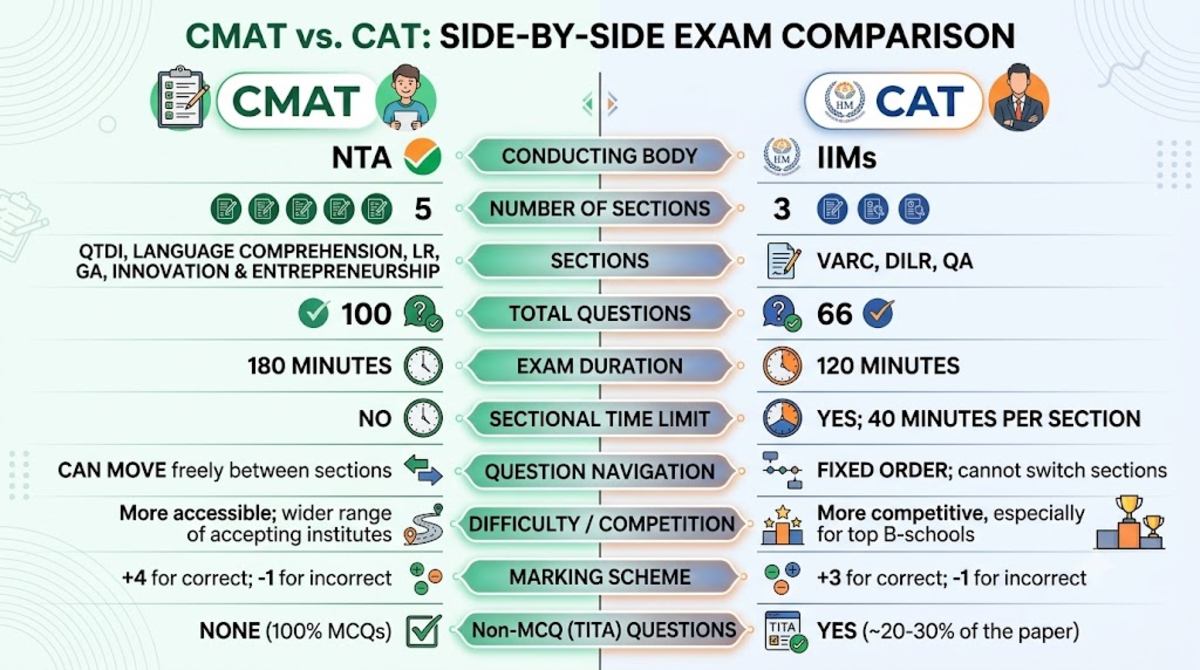
CMAT Syllabus 2027 vs CAT Syllabus 2027
CMAT requires preparation across five distinct areas, while CAT allows candidates to concentrate on three core aptitude sections.
The CMAT syllabus is therefore broader, whereas CAT generally demands greater depth and problem-solving intensity in its core sections.
Parameter | CMAT Syllabus 2027 | CAT Syllabus 2027 |
|---|---|---|
Exam Sections | Quantitative Techniques & DI, Logical Reasoning, Language Comprehension, General Awareness, Innovation & Entrepreneurship | VARC, DILR, Quantitative Ability |
Quantitative Aptitude | Arithmetic, Algebra, Geometry, Number System, Modern Mathematics, Data Interpretation | Arithmetic, Algebra, Geometry, Number System, Modern Mathematics |
Logical Reasoning | Coding-Decoding, Blood Relations, Series, Syllogism, Directions, Arrangements, Puzzles | Seating Arrangements, Puzzles, Games & Tournaments, Venn Diagrams, Networks, Logical Sets |
Data Interpretation | Tables, Charts, Graphs, Data Comparison and Interpretation | Tables, Bar Graphs, Line Graphs, Pie Charts, Caselets, Data Sufficiency |
English/Verbal | Reading Comprehension, Grammar, Vocabulary, Para Jumbles, Sentence Correction, Idioms | Reading Comprehension, Para Jumbles, Para Summary, Odd Sentence Out, Sentence Completion |
General Awareness | Included: Static GK, Current Affairs, History, Polity, Geography, Economy, Sports, Awards | Not included |
Innovation & Entrepreneurship | Included: Startup Ecosystem, Entrepreneurship, Innovation, Funding, Business Models, Government Schemes | Not included |
Difficulty Focus | Balanced across five sections; GK and Entrepreneurship require additional factual/conceptual preparation | Greater emphasis on advanced problem-solving, RC interpretation and DILR sets |
Overall Syllabus Breadth | Broader, because of GK and Innovation & Entrepreneurship | More concentrated, with greater depth in QA, DILR and VARC |
Also Read:
CMAT Syllabus 2027 vs XAT Syllabus 2027
CMAT 2027 is more straightforward in structure but requires preparation across 5 distinct areas, including the unique Innovation & Entrepreneurship section.
XAT 2027 places greater emphasis on Decision Making, critical reasoning and analytical thinking, with 26 VALR, 21 DM, 28 QA & DI and 20 GK questions in the current pattern.
Parameter | CMAT Syllabus 2027 | XAT Syllabus 2027 |
|---|---|---|
Total Sections | 5 | 4 |
Sections | Quantitative Techniques & DI, Logical Reasoning, Language Comprehension, General Awareness, Innovation & Entrepreneurship | Verbal Ability & Logical Reasoning, Decision Making, Quantitative Aptitude & DI, General Knowledge |
Quantitative Aptitude | Arithmetic, Algebra, Geometry, Number System, Modern Mathematics, Percentages, Profit & Loss | Arithmetic, Algebra, Geometry, Mensuration, Number System, Modern Mathematics, Probability, P&C |
Data Interpretation | Tables, Bar Graphs, Pie Charts, Graphs, Data Comparison | Tables, Charts, Graphs, Data Analysis, Comparison and Interpretation |
Logical Reasoning | Coding-Decoding, Blood Relations, Syllogism, Series, Directions, Arrangements, Puzzles | Critical & Analytical Reasoning, Analogy, Blood Relations, Seating Arrangement, Logical Sequences, Assumptions & Conclusions |
Verbal Ability / English | Reading Comprehension, Grammar, Vocabulary, Sentence Correction, Para Jumbles, Idioms & Phrases | Reading Comprehension, Vocabulary, Grammar, Para Jumbles, Cloze Tests, Sentence/Paragraph Completion, Critical Reasoning |
Decision Making | Not included | Dedicated section: Situational Caselets, Problem-Solving, Prioritisation, Ethical & Managerial Decisions |
General Awareness | Included: Static GK, Current Affairs, History, Polity, Geography, Economy, Sports, Awards, Business GK | Included: Static GK + Current Affairs, including Business, Economy, Politics, Science, Sports and Awards |
Innovation & Entrepreneurship | Included: Startups, Innovation, Entrepreneurship, Funding, Business Models, Government Schemes, IPR | Not included |
Total Questions | 100 | 95 |
Maximum Marks | 400 | 95 |
Unique Focus | Innovation & Entrepreneurship | Decision Making |
Overall Syllabus | Broader, with an additional business/entrepreneurship component | Broader than CAT, with a strong emphasis on situational decision-making |
Best Books for CMAT Syllabus 2027
Word Power Made Easy, R.S. Aggarwal’s Quant & Reasoning, and Arun Sharma’s CAT books are widely preferred by CMAT aspirants.
The Complete Reference Manual for CMAT offers comprehensive coverage.
Combine books with PYQs, sectional practice & mock tests.
CMAT Section | Recommended Book | Author/Publisher | Best For |
|---|---|---|---|
Quantitative Techniques & DI | Quantitative Aptitude for Competitive Examinations | R.S. Aggarwal | Arithmetic, Algebra, Geometry & Number System |
Quantitative Techniques & DI | How to Prepare for Data Interpretation for CAT | Arun Sharma | DI sets, charts, tables & data-based questions |
Logical Reasoning | A Modern Approach to Logical Reasoning | R.S. Aggarwal | Coding, series, arrangements, syllogisms & analytical reasoning |
Logical Reasoning | Analytical Reasoning | M.K. Pandey | Analytical and critical reasoning practice |
Language Comprehension | Word Power Made Easy | Norman Lewis | Vocabulary, word usage & verbal ability |
Language Comprehension | High School English Grammar & Composition | Wren & Martin | Grammar and sentence correction |
Language Comprehension | How to Prepare for Verbal Ability & Reading Comprehension for CAT | Arun Sharma | RC, para jumbles & verbal practice |
General Awareness | Manorama Yearbook | Malayala Manorama | Static GK and general awareness |
General Awareness | Lucent's General Knowledge | Lucent Publication | History, Geography, Polity, Science & other static GK |
Innovation & Entrepreneurship | Innovation and Entrepreneurship | Peter F. Drucker | Innovation and entrepreneurship concepts |
Innovation & Entrepreneurship | The Innovator's Dilemma | Clayton M. Christensen | Innovation concepts and business disruption |
All Sections | The Complete Reference Manual for CMAT | S.K. Sinha, S. Satyanarayan & J.S. Rana | Comprehensive CMAT-specific preparation |
Practice | CMAT Previous-Year Papers & Mock Tests | NTA / reputed test providers | Exam-level practice, time management & revision |
How to prepare based on CMAT Syllabus 2027?
Keep your preparation syllabus-driven and practice-heavy. Focus on high-weightage topics first, strengthen concepts, and gradually shift from topic-wise practice to timed tests and full-length mocks.
Focus Area | What to Do |
|---|---|
Know the Syllabus | Divide all 5 sections into topics and identify weak areas. |
Build Concepts | Strengthen basics in Quant, LR, Language and Innovation & Entrepreneurship. |
Prioritise Topics | Focus on Arithmetic, DI, core LR, Vocabulary, Grammar, Static GK and Entrepreneurship. |
Practise Daily | Solve topic-wise questions and previous-year questions regularly. |
Improve GK | Revise Static GK alongside current affairs and business-related updates. |
Take Mocks | Attempt sectional tests first, then full-length CMAT mocks. |
Analyse & Revise | Track mistakes, revise formulas/concepts and improve speed and accuracy. |