


Syllabus
Exam Pattern
CMAT is conducted as a 3-hour CBT with 100 MCQs carrying 400 marks, with +4 for every correct answer and -1 for an incorrect response. The exam has 5 mandatory sections: Quantitative Techniques & Data Interpretation, Logical Reasoning, Language Comprehension, General Awareness, and Innovation & Entrepreneurship.
Each section carries 20 questions and 80 marks, with no sectional time limit.
Some of the high-weightage topics across sections are Arithmetic (6–8 questions) in Quant & DI; Verbal Reasoning (8–10 questions) in Logical Reasoning; Reading Comprehension (6–7 questions) in Language Comprehension; and Current Affairs (6–8 questions) in General Awareness.
Unlike CAT, CMAT is 100% single-correct MCQs, applying the same +4/-1 marking scheme uniformly across every question and every section.
General Awareness is considered the toughest and most unpredictable section by recent test-takers, while Logical Reasoning is consistently called the easiest and most scoring.
Innovation & Entrepreneurship was made a mandatory fifth section in 2022, and questions per section were reduced from 25 to 20 to keep total exam time fixed at 180 minutes.
Related Links:
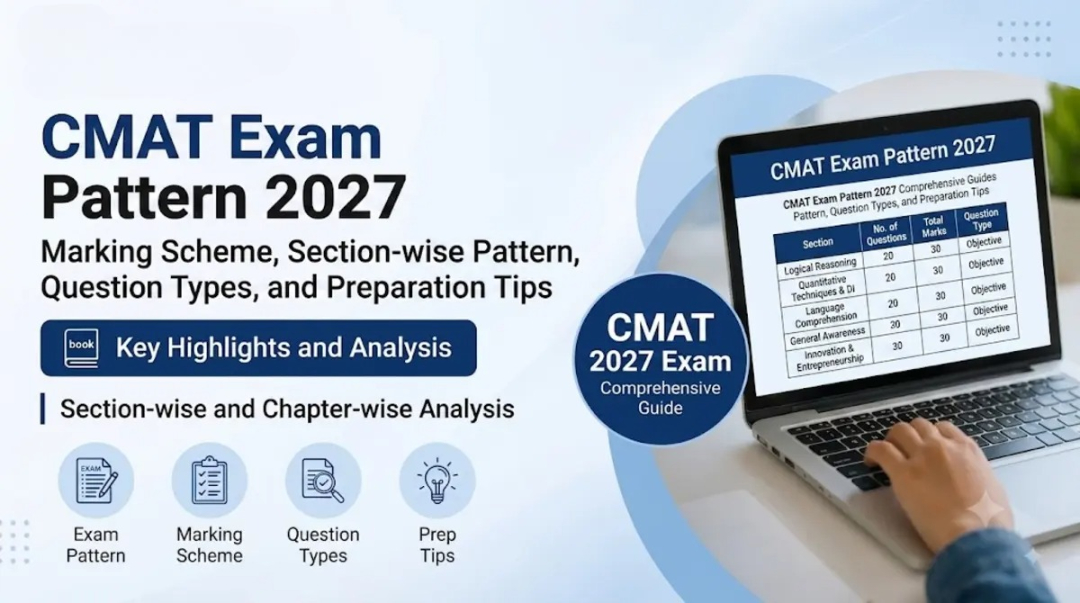
CMAT Exam Pattern 2027: Overview
The CMAT exam is conducted as a 3-hour CBT with 100 MCQs carrying 400 marks.
It has 5 sections, with 20 questions and 80 marks per section, including Innovation & Entrepreneurship.
Each correct answer earns +4 marks, while each wrong answer carries −1 mark; there is no negative marking for unattempted questions.
The exam is conducted by NTA in English, with no sectional time limit.
Parameter | Correct Details |
|---|---|
Exam Mode | Computer-Based Test (CBT) |
Exam Duration | 3 hours (180 minutes) |
Total Questions | 100 |
Total Marks | 400 |
Number of Sections | 5 |
Sections |
|
Questions per Section | 20 |
Marks per Section | 80 |
Question Type | Multiple Choice Questions (MCQ) |
Marks per Correct Answer | +4 |
Negative Marking | –1 per wrong answer |
Unattempted Questions | 0 marks |
Medium of Exam | English only |
Number of Sessions | Usually single |
Accepting Institutes | AICTE-approved MBA/PGDM institutes across India |
CMAT Exam Pattern 2027: Past Year Trends
CMAT exam pattern has been consistent for the past 4 years, with the last major change made in 2022:
The 2021 Change: NTA added Innovation & Entrepreneurship as an optional 5th section and gave candidates an extra 30 minutes to complete it.
The 2022 Change: NTA permanently changed the format by making the Innovation & Entrepreneurship section mandatory. To keep the total exam time at exactly 3 hours (180 minutes), they reduced the number of questions in every section from 25 to 20.
Since 2022, the exam pattern has remained unchanged and follows the standard structure, which is expected to continue in 2027 as well.
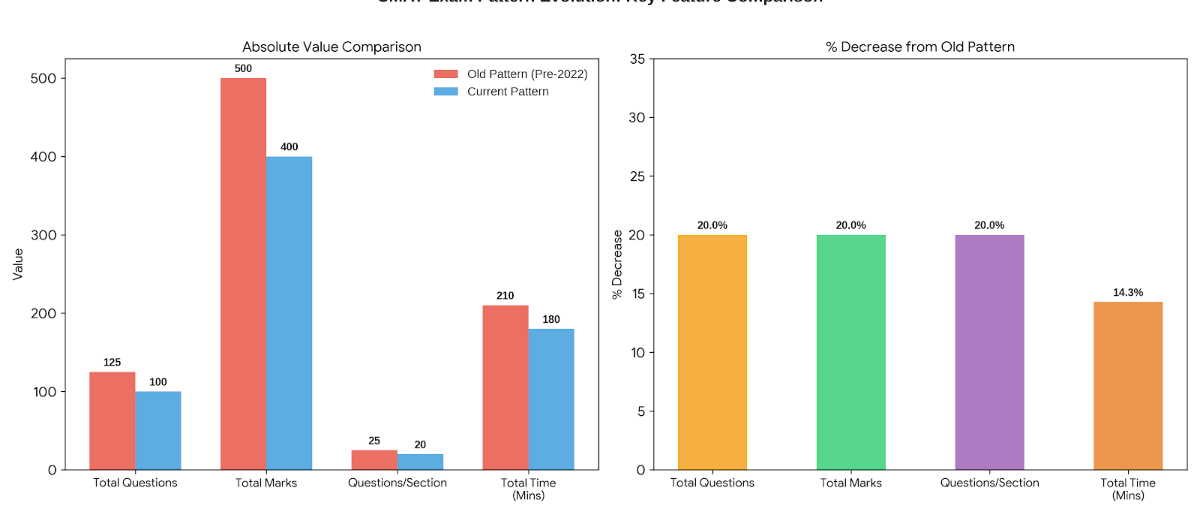
Feature | Old Pattern (Pre-2022) | Current Pattern |
|---|---|---|
Total Questions | 125 MCQs | 100 MCQs |
Total Marks | 500 Marks | 400 Marks |
Questions Per Section | 25 Questions | 20 Questions |
Status of 5th Section | Optional (Innovation & Entrepreneurship) | Mandatory for all candidates |
Total Time Allowed | 180 mins + 30 mins extra | 180 minutes flat (No sectional limits) |
CMAT 2027: Detailed Exam Pattern
The CMAT 2027 detailed exam pattern divides the test into five sections. Each section contains exactly 20 MCQ questions, worth 4 marks each, for a total of 80 marks per section.
CMAT doesn’t involve any sectional time limits, whereas CAT enforces section-wise 40-minute time limits. CMAT allows candidates to navigate all 100 questions freely within 180 minutes.
Each section has a total of 80 marks constituted by 20 questions. Overall, the exam has 5 sections of 80 marks each, making the total score of 400 marks.
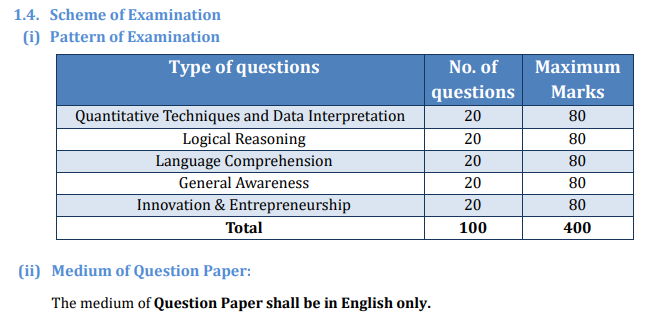
Source: CMAT Information Bulletin 2026
Section | Subject / Stream | Number of Questions | Marks per Question | Total Section Marks |
|---|---|---|---|---|
Section 1 | Quantitative Techniques & Data Interpretation | 20 | 4 | 80 |
Section 2 | Logical Reasoning | 20 | 4 | 80 |
Section 3 | Language Comprehension | 20 | 4 | 80 |
Section 4 | General Awareness | 20 | 4 | 80 |
Section 5 | Innovation & Entrepreneurship | 20 | 4 | 80 |
TOTAL | 100 | — | 400 Marks | |
Also Check: CMAT Books 2026: Check Section-wise Best Books for CMAT Preparation, Other Study Materials
CMAT Exam Pattern: Marking Scheme 2027
In the CMAT 2027 marking scheme, every correct answer earns +4 marks, and every wrong answer deducts 1 mark. Questions you leave unattempted carry no penalty.
There is no partial marking, multiple-correct selection, or numerical-type question in CMAT 2027; the marking rules are the same for every single question on the paper.
Unlike CAT, where 20-30% of questions are TITA-based with no negative marking, CMAT only includes MCQ-type questions
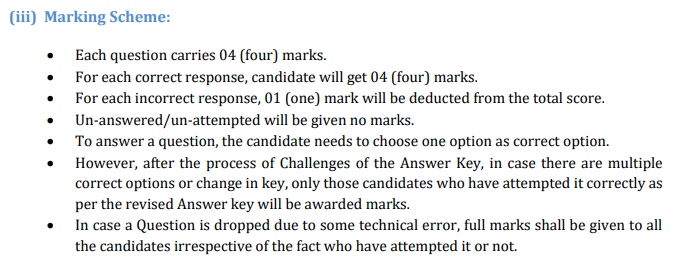
Source: CMAT Information Bulletin 2026
Question Type | Marks for Correct Answer | Marks for Wrong Answer | Marks for Unattempted |
|---|---|---|---|
MCQ (Single Correct) | +4 | -1 | 0 |
CMAT Section-wise Exam Pattern 2027
The CMAT 2027 subject-wise exam pattern spans five knowledge areas — each carrying equal weightage of 25 questions and 100 marks. Understanding the topic distribution within each section lets you identify high-yield areas and allocate study time efficiently.
Section 1: Quantitative Techniques & Data Interpretation
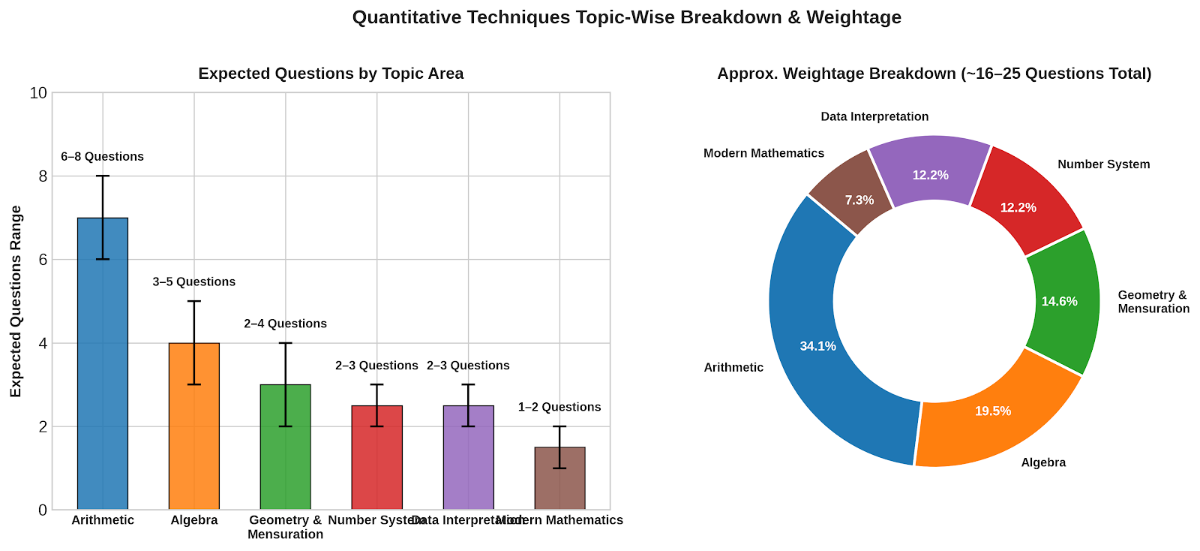
This section is heavily dominated by Arithmetic (Percentages, Profit & Loss, SI/CI, Ratios) and Data Interpretation (Tables, Bar Charts, Pie Charts), which consistently make up 45–55% of the section.
Recent CMAT papers have introduced calculation-heavy, multi-layered DI sets that consume time.
Topic Area | Key Sub-Topics | Expected Questions |
|---|---|---|
Arithmetic | Percentages, Profit & Loss, Simple & Compound Interest, Ratio & Proportion, Time & Work, Time, Speed & Distance, Mixtures & Alligations and Averages | 6-8 Questions |
Algebra | Linear Equations, Quadratic Equations, Inequalities, Functions, Progressions, Logarithms | 3-5 Questions |
Geometry & Mensuration | Lines, Angles, Triangles, Circles, Areas of 2D Shapes, Volumes of 3D Solids | 2-4 Questions |
Number System | LCM & HCF, Divisibility Rules, Factors, Remainders, BODMAS | 2-3 Questions |
Data Interpretation | Bar Charts, Pie Charts, Line Graphs, Tables, Caselets, Mixed DI Sets | 2-3 Questions |
Modern Mathematics | Permutation & Combination, Probability, Set Theory, Venn Diagrams, Statistics | 1-2 Questions |
Section 2: Logical Reasoning
The Logical Reasoning section evaluates your analytical and deductive ability. This is typically the most time-intensive section, so practising under timed conditions is essential.
This section is heavily dominated by Puzzles, Seating Arrangements, Coding-Decoding, Series, and Blood Relations, which form the core of the section across recent CMAT papers.
Recent CMAT papers continue to make LR a relatively easy and high-scoring section compared to CAT, allowing candidates with strong fundamentals to solve questions quickly and save time for tougher sections.
Topic Area | Key Sub-Topics | Expected Questions |
|---|---|---|
Verbal Reasoning | Syllogisms, Statements & Conclusions, Cause & Effect, Assumptions, Inferences, Course of Action | 8-10 Questions |
Analytical Reasoning | Blood Relations, Puzzles, Seating Arrangements, Direction Sense, Scheduling, Coding-Decoding, Clocks & Calendars and Order & Ranking | 5-7 Questions |
Non-Verbal Reasoning | Series Completion, Pattern Recognition, Analogy, Odd One Out | 2-4 Questions |
Critical Reasoning | Argument Evaluation, Strengthening/Weakening Arguments, Inference-Based Questions | 1-2 Questions |
Section 3: Language Comprehension
Language Comprehension assesses your English reading and language skills. NTA has capped Reading Comprehension passages at exactly 20 total questions.
The exam typically features 1 or 2 short RC passages (of around 200–300 words each), yielding a total of 4–7 questions.
The remaining 13–16 questions in the section are distributed across direct, stand-alone questions from Grammar, Vocabulary, and Verbal Ability.
Recent CMAT papers have kept the section easy to moderate, with short passages and relatively direct questions that can be attempted quickly.
Topic Area | Key Sub-Topics | Expected Questions |
|---|---|---|
Reading Comprehension | Long Passages, Inference Questions, Tone & Theme, Fact vs Opinion, Title of Passage | 6-7 Questions |
Vocabulary | Synonyms, Antonyms, Idioms & Phrases, Word Usage in Context, One-Word Substitution | 5-6 Questions |
Grammar | Error Spotting, Sentence Correction, Fill in the Blanks, Spotting the Error | 4-6 Questions |
Verbal Ability | Para Jumbles, Para Completion, Summary Writing, Sentence Sequencing | 2-3 Questions |
Section 4: General Awareness
The General Awareness section covers current affairs and static GK with a strong business and management focus. NTA typically tests events from approximately the 8-12 months before the exam date, making consistent daily reading the most effective preparation strategy.
Unlike IIFT or XAT, which sometimes feature highly dense, complex global economic trivia questions, CMAT GK is fact-focused and direct.
For Current Affairs, focus heavily on Major National News, Government Schemes (like PM-Jan Dhan, Mudra, PM-AY), and Awards & Honours (Nobel Prizes, National Film Awards, Padma Awards).
Topic Area | Key Sub-Topics | Expected Questions |
|---|---|---|
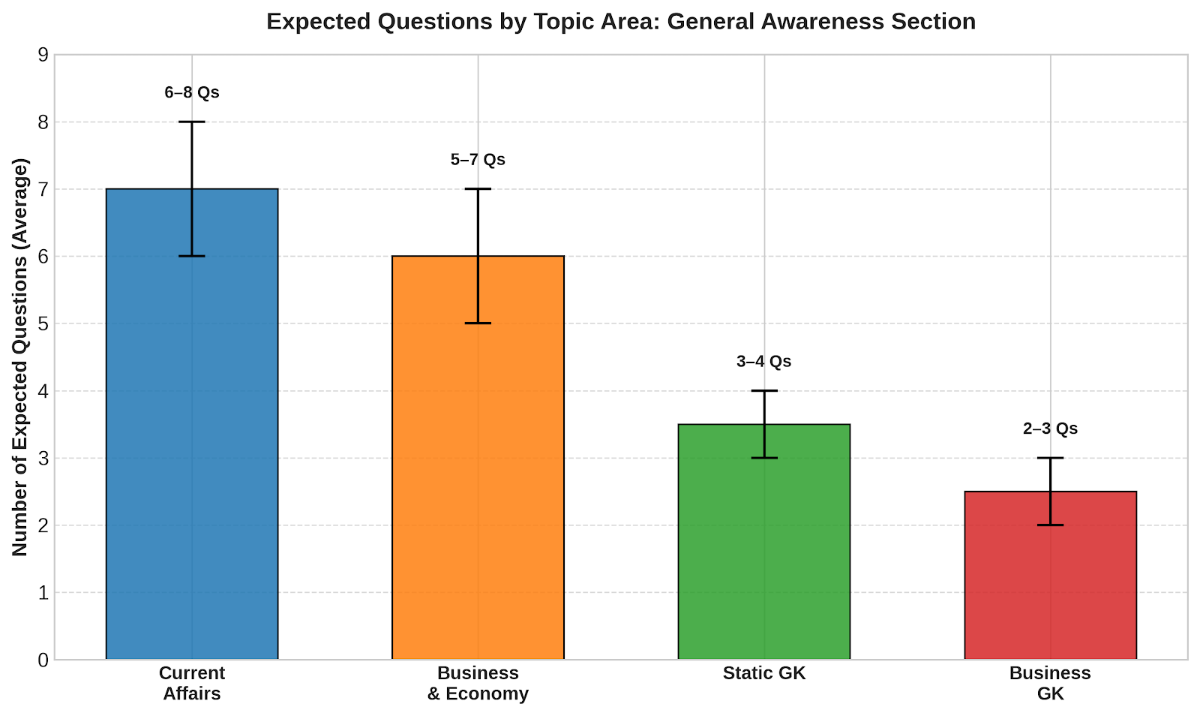
Current Affairs | National & International News, Government Schemes, Sports, Science & Technology, Awards & Honours | 6-8 Questions |
Business & Economy | Indian Economy, Banking & Finance, RBI Policies, Economic Survey, Union Budget Highlights | 5-7 Questions |
Static GK | Indian History, Geography, Polity, Indian Constitution, Famous Personalities, International Organizations & Headquarters (e.g., UN, WTO, IMF, ASEAN) and Important Days & Themes | 3-4 Questions |
Business GK | Famous CEOs & Companies, Brand Taglines, Headquarters of Companies, Mergers & Acquisitions, Parent Companies and Books & Authors | 2-3 Questions |
Section 5: Innovation & Entrepreneurship
Innovation & Entrepreneurship includes the following key topics such as Startup Ecosystems, Entrepreneurship Concepts, Venture Capital, Business Frameworks, and Government Startup Initiatives such as Startup India.
For Government Initiatives, remember which ministries administer which funding schemes and their specific loan windows.
Know your traditional business frameworks (SWOT, PESTEL, Porter's Value Chain, and the BCG Matrix).
Recent CMAT papers have maintained a moderate difficulty level, with questions often testing familiarity with concepts such as Angel Investors, Bootstrapping, Incubators, and Startup Funding.
Topic Area | Key Sub-Topics | Expected Questions |
|---|---|---|
Innovation & Creativity | Types of Innovation, Design Thinking, Creative Problem Solving, Disruptive Innovation, Intellectual Property Rights (IPR) | 5-6 Questions |
Entrepreneurship Concepts | Startup Ecosystem, Business Models, Venture Capital, Angel Investors, Incubators, Startup Terminology, Types of Entrepreneurs | 4-5 Questions |
Business Environment | SWOT Analysis, Market Research, Competitive Advantage, Business Plan Components, Government Schemes & Regulatory Bodies | 4-5 Questions |
Social Entrepreneurship | CSR, Sustainable Business Practices, NGOs, Impact Investments, B-Corp Concepts | 2-3 Questions |
Notable Case Studies | Famous Indian Startups, Unicorn Companies, Business Turnarounds, IPO Milestones, Prominent Founders & Corporate Mergers | 1-2 Questions |
CMAT Question Types 2027
CMAT 2027 uses only one question type across all sections: single-correct Multiple Choice Questions (MCQs). Each question presents four answer options (A, B, C, D) with exactly one correct answer.
There are no subjective, numerical-type, or integer-entry questions in CMAT 2027, every answer is selected from the four given options.
Question Type | Description | Actual Modern Count (Out of 100) |
|---|---|---|
MCQ – Single Correct | 4 options per question. No numerical inputs or multi-select options. | 100 Questions |
Passage-Based MCQ | A reading passage followed by related MCQs based on the given text. | 4–7 questions per exam |
Data Set / Caselet MCQ | A table, chart, or caselet followed by MCQs requiring data interpretation and calculations. | 3–5 questions per exam |
Puzzle / Arrangement MCQ | A scenario or set of conditions followed by multiple questions based on the given information. | 3–5 questions per exam |
What is the Difficulty Level of the CMAT Exam?
Section-Wise Difficulty Breakdown
Logical Reasoning (LR): Generally the easiest and most scoring section, with straightforward puzzles, coding-decoding, and blood-relation questions.
Language Comprehension: Usually easy to moderate, with short RCs, vocabulary, and basic grammar-based questions.
QTDI, GK: QTDI is moderate and formula-based, while GK is the most unpredictable and generally the toughest section.
Section | Difficulty Level | Core Characteristics |
|---|---|---|
Logical Reasoning (LR) | Easy |
|
Language Comprehension | Easy to Moderate |
|
Quant Techniques & DI | Moderate |
|
Innovation & Entrepreneurship | Moderate | It is easy if you are well-versed in startup frameworks (like SWOT/BCG matrix) and government loan schemes, but difficult if you try to guess blindly. |
General Awareness (GK) | Moderate to Hard | The ultimate rank decider. Because static GK and current affairs are vast and completely unpredictable, this section is universally rated as the toughest to master. |
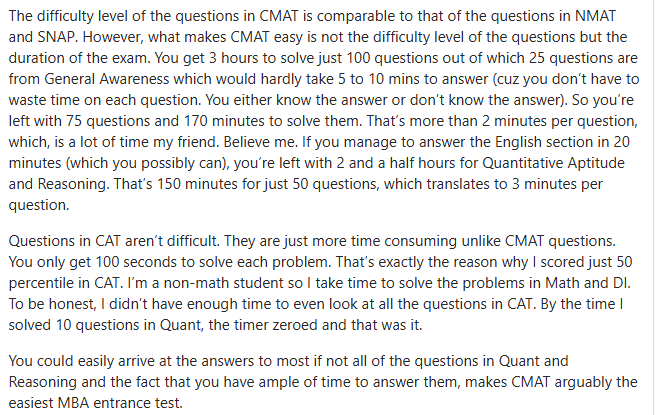
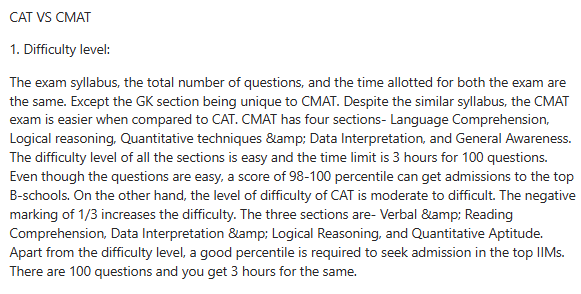
Based on Quora discussions, below is the difficulty level analysis of the CMAT exam:
Question Complexity: CMAT questions are easy to moderate and straightforward to solve, while CAT questions are moderate to difficult, tricky, and time-consuming.
Sectional Constraints: CAT enforces strict sectional time limits that prevent moving between sections, whereas CMAT allows candidates to manage their overall time flexibly across sections.
Target Percentiles: CMAT requires a high percentile (98–100%) for top B-schools due to easier questions, whereas CAT's difficulty and 1/3 negative marking make strategic question selection more critical than high attempt counts.
Source: Quora
Also Check: CMAT 2026 Paper Analysis (Available): Download the Question Paper, Check the Difficulty level & Weightage
CMAT Exam Pattern vs CAT Exam Pattern
Below are the key differences between CMAT and CAT exam patterns:
CAT: The strict 40-minute sectional limits make question selection, time management, and accuracy more important than attempting every question.
CMAT: With 180 minutes for 100 questions and no sectional limits, the focus shifts from speed to careful question selection, accuracy, and avoiding negative-marking mistakes.
Time Allocation: CMAT offers ample time (over 2 to 3 minutes per question for Quant and Reasoning), whereas CAT imposes severe time pressure with only ~100 seconds per question.
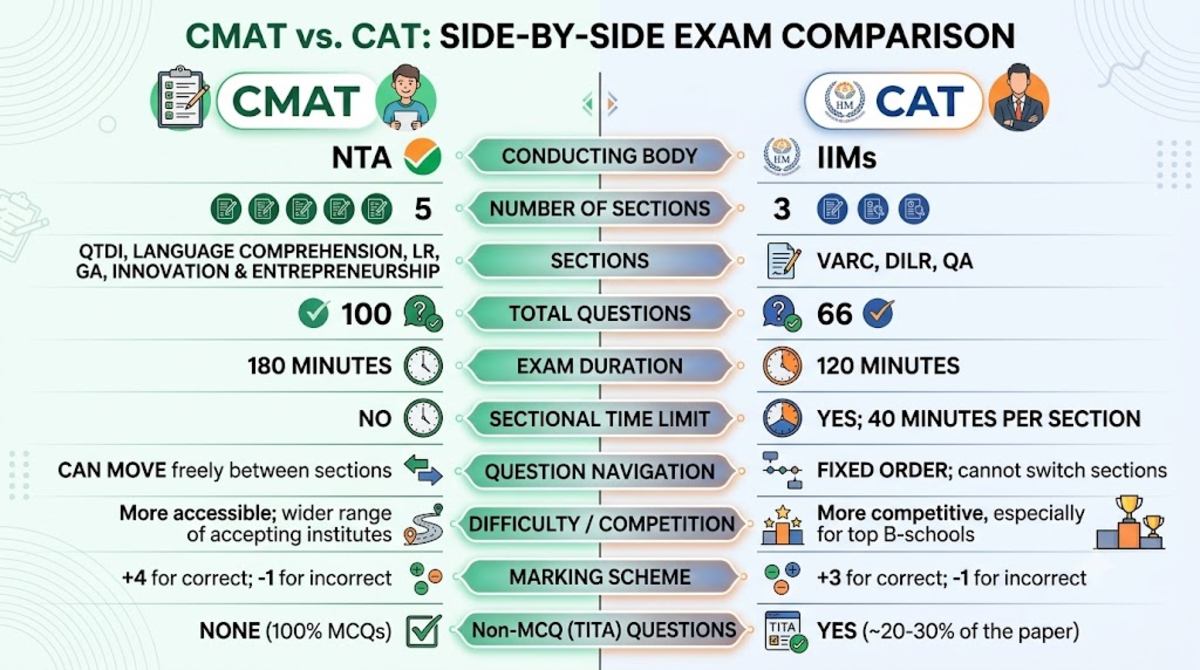
Parameter | CMAT | CAT |
|---|---|---|
Conducting Body | NTA | IIMs |
Number of Sections | 5 | 3 |
Sections | QTDI, Language Comprehension, LR, GA, Innovation & Entrepreneurship | VARC, DILR, QA |
Total Questions | 100 | 66 |
Exam Duration | 180 minutes | 120 minutes |
Sectional Time Limit | No sectional time limit | Yes; 40 minutes per section |
Question Navigation | Can move between sections and use time freely | Fixed section order; cannot switch sections |
Difficulty / Competition | Generally more accessible with a wider range of accepting institutes | More competitive, especially for top B-schools |
Marking Scheme | +4 for correct; -1 for incorrect | +3 for correct; -1 for incorrect |
Non-MCQ (TITA) Questions | None (100% Multiple Choice Questions) | Yes (~20-30% of the paper has no negative marking) |
Source: Quora
How to Prepare Based on CMAT Exam Pattern
Use the following tips to prepare for the CMAT exam:
Plan Time Strategically: Use the flexible 180-minute window to prioritize QTDI and LR, while quickly completing GA and I&E and keeping a buffer for revision.
Focus on High-Scoring Areas: Build strong fundamentals in Arithmetic, LR basics, vocabulary, business concepts, and current affairs instead of trying to cover every topic equally.
Maximize Accuracy Through Mocks: Take regular full-length mocks, target 85%+ accuracy, avoid blind guessing, and use post-mock analysis to improve question selection and reduce careless errors.
Focus Area | Key Strategy |
|---|---|
QTDI | Build a formula sheet for Arithmetic and Mensuration, improve calculation speed, and practice approximation techniques for DI. |
Logical Reasoning | Focus on high-scoring topics such as Blood Relations, Direction Sense, Coding-Decoding, Clocks & Calendars, and basic puzzles. |
Language Comprehension | Strengthen vocabulary, practice RCs regularly, and revise grammar topics like Subject-Verb Agreement and Prepositions. |
Innovation & Entrepreneurship | Learn business frameworks (SWOT, PESTEL, BCG Matrix), startup concepts, government schemes, and IPR basics. |
General Awareness | Cover current affairs from the last 8–12 months, focusing on business, economy, awards, government schemes, and important national/international events. |
Mock Test Strategy | Maintain 85%+ accuracy, avoid blind guessing, and practice full-length mocks to improve section-switching and question selection. |
Review & Analysis | Use the final buffer time to revisit doubtful questions, verify calculations, and analyze mistakes after every mock test. |