Eduspray
BITSAT
Entrance Exam

BITSAT

Birla Institute of Technology and Science (BITS), Pilani

BITSAT (Birla Institute of Technology and Science Admission Test) is a national-level online entrance examination conducted by BITS Pilani for admission to Integrated First Degree programs such as B.E., B.Pharm, and M.Sc. courses offered at BITS Pilani campuses located in Pilani, Goa, and Hyderabad. The exam is highly popular among engineering aspirants due to its flexible admission process, modern curriculum, excellent placement opportunities, and world-class infrastructure.

BITSATBITS PilaniEngineering Entrance ExamB.Tech Entrance ExamNational Level ExamBITS Admission TestBITS GoaBITS HyderabadBITS Pilani AdmissionEngineering Exam 2026

Last updated: 6 Oct 2026

Syllabus

Full page

BITSAT Syllabus 2027 covers Physics, Chemistry, Mathematics/Biology, English Proficiency and Logical Reasoning based on the NCERT Class 11 and 12. BITS Pilani officially does not release the chapter-wise weightage. Based on trends, the BITSAT Syllabus 2027 chapter-wise weightage is 60% from Class 12 and approx. 35 - 40% from Class 11.

Direct Link to BITSAT 2027 Syllabus (To be updated)

  • BITSAT Physics Syllabus 2027 includes heat and thermodynamics, current electricity, wave optics, modern physics, and electricity and magnetism. These topics have around 55% weightage.

  • The important units from BITSAT Chemistry Syllabus are Chemical Bonding, Chemical Kinetics, Coordination Compounds, Block Elements, and Organic Reactions. These units contribute around 45- 50% weightage in Chemistry.

  • Calculus, Coordinate Geometry, Algebra, Probability, and 3D Vectors are the most important units from the BITSAT Maths Syllabus. These units contribute nearly 80% of the weightage.

  • BITSAT English syllabus focuses on Grammar, Reading Comprehension, Vocabulary, and Verbal and Nonverbal Reasoning having 30% weightage.

BITSAT Biology is an alternative to Maths for students from a PCB background. The core topics of the BITSAT Biology syllabus are Genetics and Evolution, Human Physiology, and Cell Structure and Function.

Related Articles:

Key Summary

  • Candidates should equally prioritise Class 11 and Class 12 but start preparing from the NCERT Class 12 syllabus.

  • Based on previous years' trends, BITSAT difficulty level is balanced, depending on speed, accuracy, and conceptual clarity.

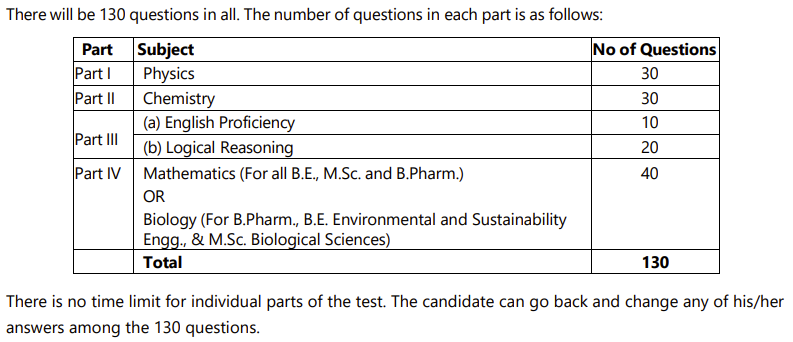
  • The BITSAT exam consists of a total of 130 questions: 30 from Physics, 30 from Chemistry, 40 from Mathematics/Biology, and 30 from English & Logical Reasoning

  • BITSAT Mathematics is rated hard by students, so prepare strategically from high-weightage topics, practice mixed numericals and have a proper understanding of formulas.

BITSAT 2027 Syllabus Highlights

The BITSAT Syllabus key highlights are tabulated below:

Particular

Details

Conducting Body

BITS Pilani

Mode of Exam

CBT

BITSAT 2027 Syllabus

NCERT Class 11 and 12

BITSAT Syllabus Weightage

  • Approx. 60- 65% Class 12

  • Approx. 35- 40% Class 11

Total Subjects

  • Physics, Chemistry, English Compulsory

  • Maths/ Biology depends on the chosen stream

Total Marks

390

Also Check: BITSAT Paper Analysis: Check Subject-wise Exam Analysis, Difficulty Level, Question Paper

How to Download the BITSAT 2027 Syllabus

  • Step 1: Visit the official BITS Pilani admissions portal at bitsadmission.com.

  • Step 2: Click the BITSAT link on the homepage.

  • Step 3: Search for BITSAT Syllabus or “BITSAT Brochure”.

  • Step 4: Press Ctrl + S (Windows) or click the download option to save the BITSAT Syllabus PDF to your device.

BITSAT Syllabus 2027 Subject-wise Weightage

The BITSAT syllabus subject-wise weightage is tabulated below. Each correct answer fetches 3 marks, while each incorrect answer has a penalty of 1 mark. The time duration is 3 hours, comprising the following subjects.

Subjects

Questions

Marks

Physics

30

90

Chemistry

30

90

Maths/ Biology

40

120

English Proficiency +Logical Reasoning

30

90

BITSAT Syllabus 2027 Subject-wise Weightage

Source: admissions.bits-pilani.ac.in

BITSAT Physics Syllabus 2027

A detailed BITSAT 2027 Syllabus subject wise is discussed below, along with the topics covered in each unit. Check out below as per your stream.

BITSAT Syllabus for Physics includes both Class 11 and 12 NCERT.

  • It covers both theoretical and numerical-based questions.

  • Students should be clear on formulas, definitions, and problem-solving techniques.

  • Thermodynamics, Electrostatics & Current Electricity, Optics and Modern Physics are important for BITSAT 2027 Physics Syllabus.

BITSAT Exam Syllabus for Physics Topics

Sub Topics

Approx Weightage (%)

Units & Measurement

Different systems of units, SI units and derived units, dimensional analysis, significant figures, Vernier callipers, screw gauge, physical balance

2- 3

Kinematics

Properties of vectors, position, velocity, acceleration vectors, motion with constant acceleration, projectile motion, circular and relative motion

3- 4

Newton’s Laws of Motion

Newton’s laws, free body diagrams, resolution of forces, motion on inclined planes, pulley systems, centripetal force, inertial and non-inertial frames

3- 5

Impulse and Momentum

Impulse and momentum definitions, conservation of momentum, collisions, momentum of a system, centre of mass

3- 4

Work and Energy

Work done by force, kinetic energy, work-energy theorem, power, conservative forces, potential energy, conservation of mechanical energy

4

Rotational Motion

Angular displacement, velocity, acceleration, rotation with constant angular acceleration, moment of inertia, parallel and perpendicular axes theorems, torque, angular momentum, conservation laws, rolling motion

4- 5

Gravitation

Newton’s law, gravitational potential energy, escape velocity, Kepler’s laws, satellite motion

3

Mechanics of Solids and Fluids

Elasticity, pressure, density, Archimedes’ principle, viscosity, surface tension, Bernoulli’s theorem

3- 5

Oscillations

SHM, spring-mass system, pendulums, forced and damped oscillations, resonance

4- 5

Waves

Progressive waves, standing waves in strings and pipes, beats, superposition of waves, Doppler Effect

4- 5

Heat and Thermodynamics

Kinetic theory of gases, thermal equilibrium, temperature, specific heat, conduction, convection and radiation, thermal conductivity, Newton’s law of cooling, first and second laws of thermodynamics, Carnot engine, efficiency and COP

8- 10

Electrostatics

Coulomb’s law, electric fields (discrete and continuous), electrostatic potential and energy, Gauss’s law, electric dipole, capacitance and dielectrics, parallel plate capacitor, series and parallel capacitors

4- 5

Current Electricity

Ohm’s law, Joule heating, DC circuits, resistors and cells, Kirchhoff’s laws, potentiometer, Wheatstone bridge, resistivity and its temperature dependence

5- 6

Magnetic Effect of Current

Biot-Savart’s law, Ampere’s law, Lorentz force, force on conductors, magnetic moment, torque on current loops, galvanometer to voltmeter and ammeter conversion

8- 10

Electromagnetic Induction

Faraday’s law, Lenz’s law, eddy currents, self and mutual inductance, transformers, generators, AC (peak and RMS values), LCR circuits

2- 3

Optics

Laws of reflection and refraction, lenses and mirrors, optical instruments (telescope, microscope), interference (Huygen’s principle, Young’s double slit), thin film interference, diffraction (single slit), electromagnetic waves and spectrum (qualitative), polarisation

4- 5

Modern Physics

Dual nature of light and matter, photoelectric effect, de Broglie wavelength, Rutherford’s model, Bohr’s model, hydrogen atom spectrum, radioactivity, nuclear fission and fusion, binding energy

6- 8

Electronic Devices

Energy bands, conductors, insulators, semiconductors, diode, rectifier, LED, photodiode, solar cell, Zener diode, junction transistor, transistor as amplifier and oscillator, logic gates, transistor as a switch

2- 4

Important Physics Topics for BITSAT 2027

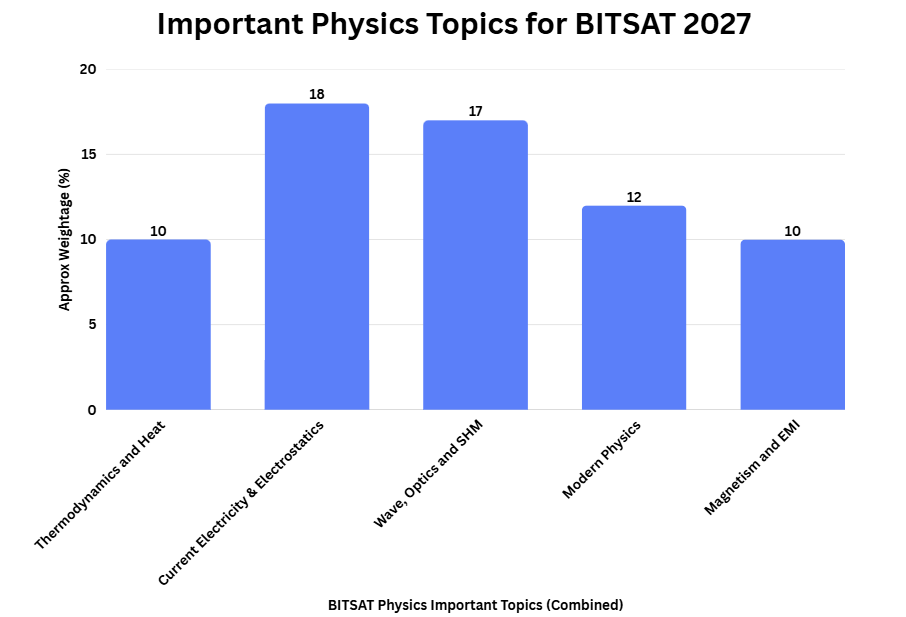
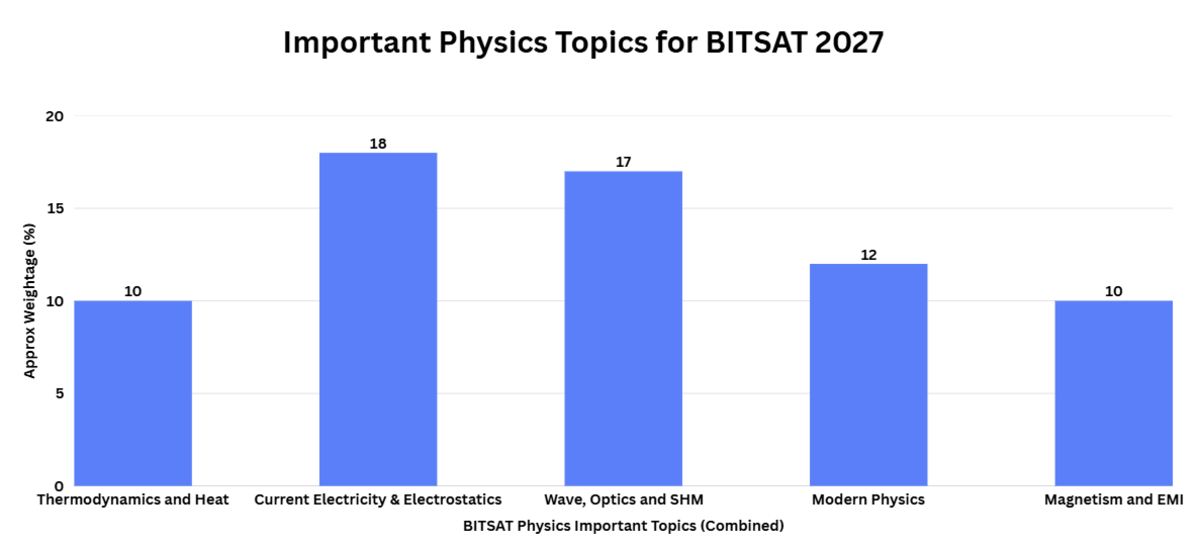
BITSAT 2027 important chapters from Physics along with weightage are tabulated below. As per expert analysis, these topics in Physics help you cover more than half of BITSAT Physics Syllabus 2027.

BITSAT Physics Important Topics (Combined)

Approx Weightage (%)

Thermodynamics and Heat

8- 10

Current Electricity & Electrostatics

18

Wave, Optics and SHM

13- 17

Modern Physics

10- 12

Magnetism and EMI

8- 10

Important Physics Topics for BITSAT 2027

BITSAT Chemistry Syllabus 2027

BITSAT exam Syllabus for Chemistry includes NCERT Class 11 and 12 Physical, Organic and Inorganic Chemistry.

  • Understand each topic well, as it tests how well you can apply the concepts in solving problems.

  • BITSAT Chemistry Syllabus covers theoretical concepts, equations, reactions, practical-based knowledge, and applications.

As per trends, your BITSAT 2027 Syllabus for Chemistry includes:

  • 35- 40% Physical Chemistry

  • 35% Organic Chemistry

  • 32- 35% Inorganic Chemistry

BITSAT Exam Syllabus for Chemistry Topics

Sub Topics

Approx Number of Questions from each topic

States of Matter

Laws of chemical combination, mole concept, states of matter, gas laws, ideal gas equation, liquefaction of gases, van der Waals equation, vapour pressure, surface tension, viscosity, solid-state classification, unit cell, density, crystal structures, defects, band theory

1- 2

Atomic Structure

Subatomic particles, atomic models, hydrogen spectrum, Bohr's model, quantum numbers, orbitals, electronic configuration, periodic table trends

1- 2

Periodicity and Bonding

Valence electrons, Ionic Bond, Types of elements: s, p, d, and f blocks, Molecular Structure, Covalent Bond: Valence Bond Theory, Dipole moments; Hydrogen Bond

2- 4

Thermodynamics

Basic Concepts, First Law of Thermodynamics, Second Law of Thermodynamics, Third Law- Introduction

2

Physical and Chemical Equilibria

Solutions and concentration units, Raoult’s law, colligative properties, equilibrium constant, Le Chatelier’s principle, acids and bases, solubility product, buffer, pH, ionic equilibria

1

Electrochemistry

Redox reactions, electrochemical cells, electrode potentials, Nernst equation, batteries, electrolysis, Faraday’s laws, conductance, corrosion

2- 3

Chemical Kinetics

Rate of reaction, order and molecularity, half-life, effect of temperature and concentration, collision theory, activation energy

1- 2

Hydrogen and s-block elements

Properties and uses of hydrogen, heavy water, hydrogen peroxide, alkali and alkaline earth metals, important compounds like NaOH, CaCO₃, and their uses

3- 6

p-, d-, and f-block elements

Properties of elements in groups 13-18, uses of compounds, preparation of industrial chemicals, transition metals, lanthanides and actinides, coordination compounds

Principles of Organic Chemistry and Hydrocarbons

Functional groups, types of reactions, alkanes, alkenes, alkynes, aromatic compounds, haloalkanes and haloarenes, reaction mechanisms

3- 5

Stereochemistry

Isomerism, conformations of ethane, geometrical isomerism in alkenes

Organic Compounds with Functional Groups Containing Oxygen and Nitrogen

Alcohols, phenols, ethers, aldehydes, ketones, carboxylic acids, amines, diazonium salts, cyanides, reaction mechanisms, preparation and uses

3

Biological, Industrial and Environmental Chemistry

Carbohydrates, proteins, vitamins, nucleic acids, hormones, polymers, pollution, green chemistry, chemistry in medicines and food

1- 3

Theoretical Principles of Experimental Chemistry

Volumetric analysis, qualitative and quantitative analysis, purification methods, organic preparations, chromatography, basic lab techniques, physical chemistry experiments

Important Chemistry Topics for BITSAT 2027

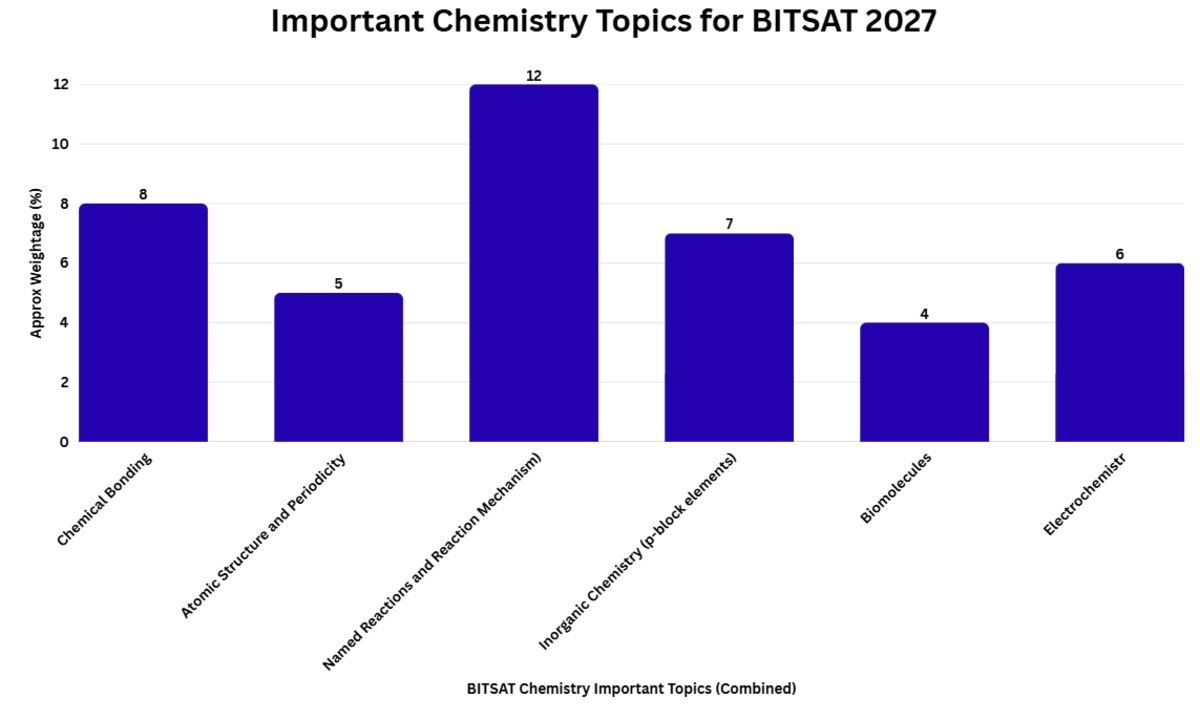
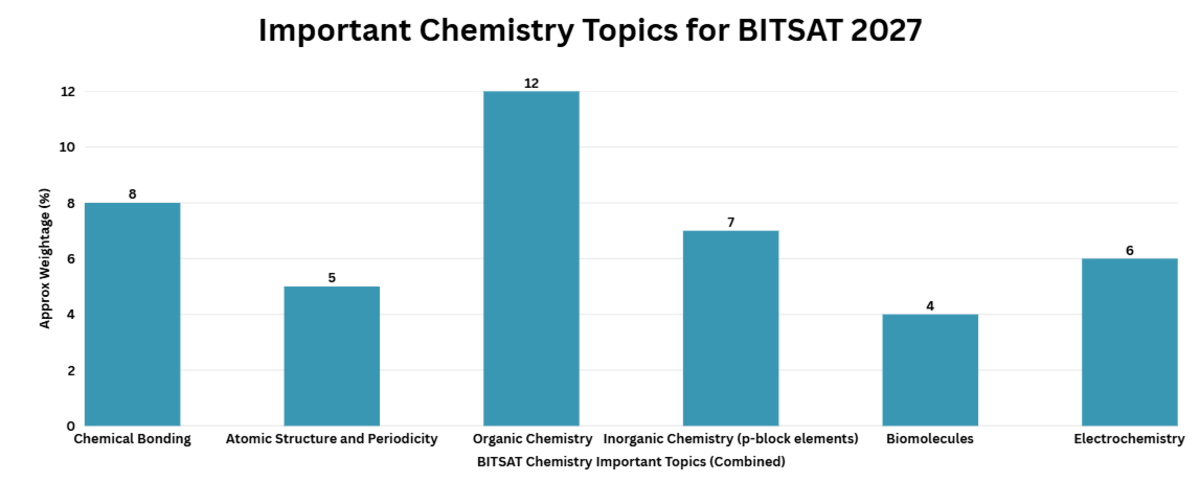
BITSAT 2027 important chapters for Chemistry along with weightage are tabulated below. Covering these topics in Chemistry is crucial to score maximum marks in BITSAT Chemistry section.

BITSAT Chemistry Important Topics (Combined)

Approx Weightage (%)

Chemical Bonding

8

Atomic Structure and Periodicity

4- 5

Organic Chemistry (Named Reactions and Reaction Mechanism)

12

Inorganic Chemistry (p-block elements)

6- 7

Biomolecules

3- 4

Electrochemistry

5- 6

Important Chemistry Topics for BITSAT 2027

Related Links:

Ques. Which chapters are most important in Physics for BITSAT?

BITSAT Maths Syllabus 2027

BITSAT syllabus for Maths includes major units such as Algebra, Trigonometry, Calculus, Geometry, and Probability.

  • You should prepare each topic well and understand all formulas and concepts clearly.

  • BITSAT Maths syllabus focuses on logical thinking, problem-solving, and application-based understanding.

BITSAT Exam Syllabus for Maths Topics

Key Topics

Approx Number of Questions per Topics

Algebra

Complex numbers, quadratic equations, progressions, exponential series, logarithms, binomial theorem, permutations and combinations, sets, relations and functions, types of matrices, determinants, linear equations, mathematical induction, linear inequalities, mathematical reasoning

10- 12

Trigonometry

Measurement of angles, trigonometric identities, equations, inverse trigonometric functions, graphs of trigonometric functions

6- 8

Two-dimensional Coordinate Geometry

Cartesian coordinates, distance, section formula, straight lines, pair of lines, angle between lines, bisectors, circles, parametric form, parabola, ellipse, hyperbola

4- 7

Three-dimensional Coordinate Geometry

Coordinate planes and axes, distance between points, direction ratios and cosines, equation of a line and plane, angle between lines and planes, shortest distance, coplanarity

2- 3

Differential calculus

Domain and range, limits, continuity, differentiability, derivatives of different functions, chain rule, tangents and normals, increasing/decreasing functions, maxima and minima, Rolle’s and Mean Value Theorems

6- 8

Integral calculus

Indefinite integrals, standard formulas, integration by parts, substitution, partial fractions, trigonometric identities, definite integrals and properties, area under curves

6- 7

Ordinary Differential Equations

Order and degree, forming differential equations, solving first-order and first-degree equations

1- 2

Probability

Basics of probability, addition and multiplication rules, conditional probability, Bayes' theorem, independent events, discrete random variables, mean and variance

2- 3

Vectors

Direction ratios/cosines, vector addition, scalar multiplication, position vectors, dot and cross product, scalar triple product

2- 3

Statistics

Measures of dispersion, frequency distribution, comparing variances

1- 2

Linear Programming

Formulation of LPP, graphical method, feasible region and solution, optimal solutions

1- 2

Mathematical modeling

Real-life problem solving using matrices, calculus, and linear programming

1

Important Maths Topics for BITSAT 2027

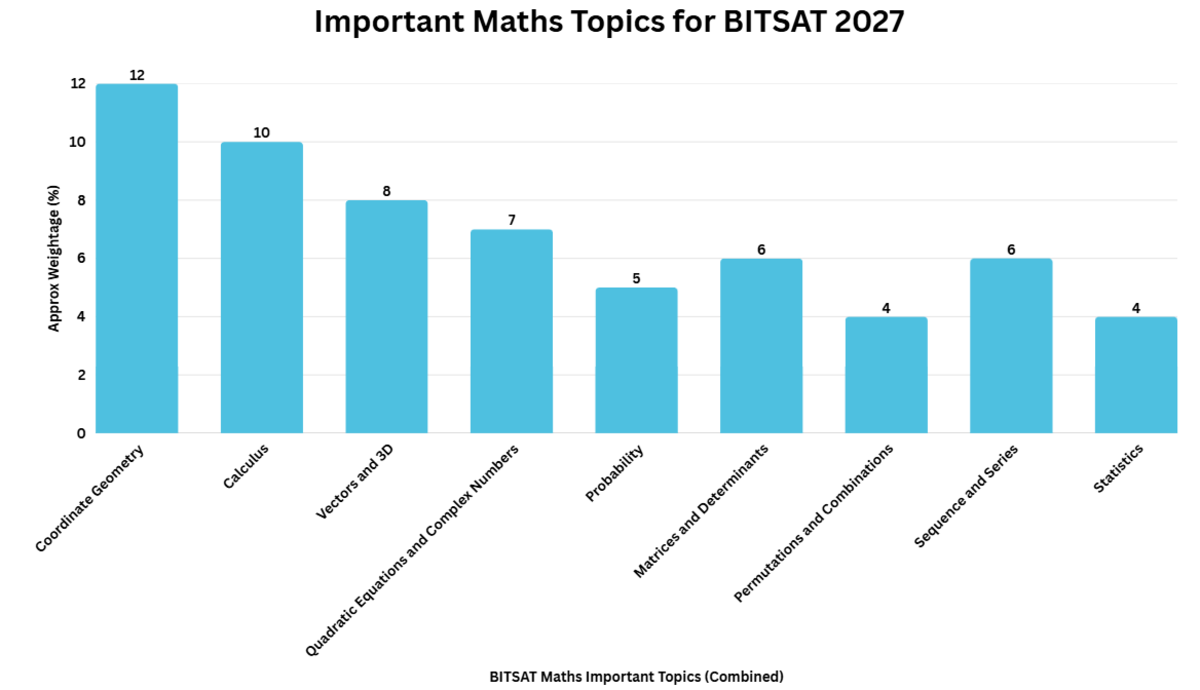
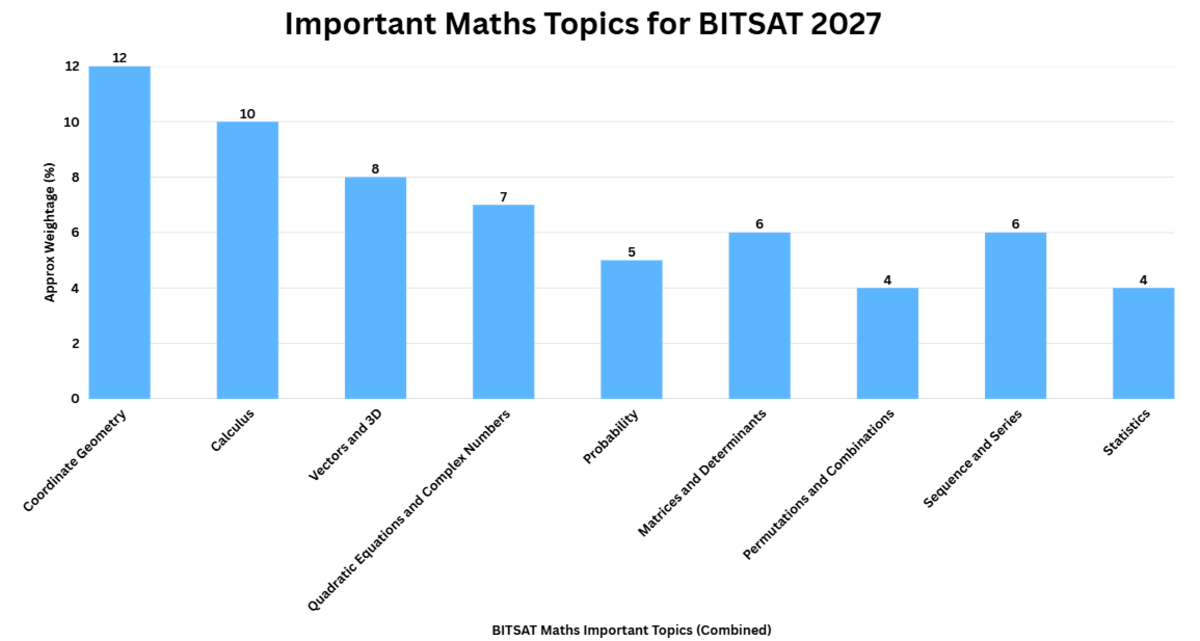
BITSAT 2027 important chapters for Maths along with weightages are tabulated below.

BITSAT Maths Important Topics (Combined)

Approx Weightage (%)

Coordinate Geometry

10- 12

Calculus

8- 10

Vectors and 3D

7- 8

Quadratic Equations and Complex Numbers

6- 7

Probability

4-5

Matrices and Determinants

6

Permutations and Combinations

3- 4

Sequence and Series

5- 6

Statistics

3- 4

Important Maths Topics for BITSAT 2027

Related Links:

Ques. Can I prepare for BITSAT using JEE Main preparation?

BITSAT Biology Syllabus 2027

Candidates opting for BPharm or MSc Biological Sciences must prepare Biology in place of Mathematics. The BITSAT Biology syllabus is based on NCERT.

  • According to trends, the paper difficulty is moderate.

  • BITSAT Biology focuses on core life science concepts, applied biological knowledge, and real-world biological applications.

  • Cell Structure, Genetics, Biotechnology and Physiology are core Biology concepts in the BITSAT 2027 syllabus.

BITSAT Exam Syllabus for Biology Topics

Key Topics

Diversity in Living World

Meaning and relevance to mankind, Introductory classification of living organisms, Plant and Animal kingdom

Cell: The Unit of Life; Structure and Function

Cell wall, Cell membrane, Endomembrane system, Centrosome and Centriole, Nucleus, Microbodies, Structural differences between prokaryotic and eukaryotic, Biomolecules and Enzymes

Genetics and Evolution

Mendelian inheritance, Chromosome theory of inheritance, Inheritance patterns of haemophilia and blood groups in humans, DNA, Gene expression and regulation and Theories and evidence of evolution

Structure and Function- Plants

Morphology of a flowering plant, Absorption and movement of water, Mineral nutrition, Photosynthesis, Respiration

Structure and Function - Animals

Human Physiology, Body fluids and circulation, Excretion system, Locomotion and movement, Control and co-ordination

Reproduction, Growth and Movement in Plants

Asexual and Sexual methods of reproduction, types of growth regulators and their role in seed dormancy, germination and movement, Apical dominance

Reproduction and Development in Humans

Male and female reproductive systems, Gamete production, Fertilisation;

Ecology and Environment

Meaning of ecology, environment, habitat and niche, Ecological levels of organization, Energy flow, Biodiversity and Environmental Issues

Biology and Human Welfare

Animal husbandry, Cancer, AIDS, Basic concepts of immunology, Plant Breeding and Tissue Culture in crop improvement.

Biotechnology and its Applications

Microbial technology in food processing, industrial production, Steps in recombinant DNA technology, Applications of R-DNA technology in human health, Applications in Industry and Agriculture

BITSAT 2027 Important Chapters from Biology

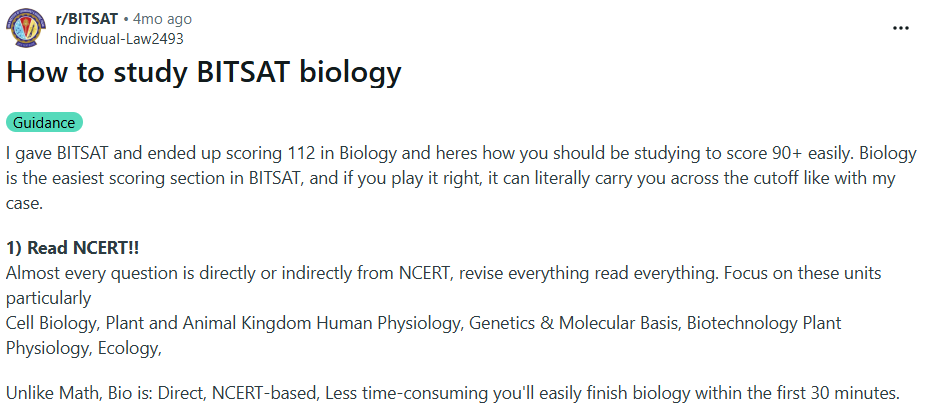
Cell Biology, Plant and Animal Kingdom, Human Physiology, Genetics & Molecular Basis, Biotechnology, Plant Physiology and Ecology are important Biology topics for BITSAT 2027. Users on Reddit claim that BITSAT Biology is directly NCERT-based and less time-consuming. Around 60- 70% is straight-up NCERT lines, definitions, and examples.

reddit

Source: Reddit

Related Links:

Ques. Is the Class 12 syllabus enough for BITSAT?

BITSAT English Syllabus

BITSAT English Syllabus is divided into two parts, which include English Proficiency and Logical Reasoning. Unlike Physics and Chemistry, the BITSAT English syllabus does not require deep knowledge. It is the easiest and fastest section to complete.

Check out the BITSAT English Syllabus below.

BITSAT English Proficiency Syllabus 2027

A total of 10 questions are asked from English Proficiency in BITSAT English.

BITSAT English Proficiency Syllabus Topics

Key Topics

Grammar

Determiners, Prepositions, Modals, Adjectives, Relative Pronouns, Agreement, Time and Tense, Parallel Construction, Voice, Transformation, Question Tags, Relative Clauses

Vocabulary

Odd Word, One Word, Spelling & Word Formation, Definitions, Academic Vocabulary, Connotation, Synonyms, Antonyms, Collocations, Phrasal Verbs & Idioms

Reading Comprehension

Content/Ideas, Vocabulary, Summary, Referents and Reorganisation of Information

Composition

Rearrangement, Paragraph & Unity and Linkers/Connectives

BITSAT Logical Reasoning Syllabus 2027

A total of 20 questions are asked from Logical Reasoning in BITSAT English 2027.

BITSAT Logical Reasoning Syllabus Topics

Key Topics

Verbal Reasoning

Analogy, Classification, Series Completion, Logical Deduction and Chart Logic

Non- Verbal Reasoning

Pattern Perception, Figure Formation and Analysis, Paper Cutting, Figure Matrix, Rule Detection

Watch the YouTube video by “ Harshal BITS Pilani” regarding the BITSAT Syllabus 2027 subject wise topics to score 300+ marks in your Exam. The video describes a complete list of chapters for each section.

Related Links:

Best Books for BITSAT 2027

The best study resources for BITSAT 2027 are tabulated below:

Subject

Book

Author/ Publication

Physics

NCERT Physics Book Class 11 and 12

-

Concepts of Physics- Vol. 1 and Vol. 2

H.C. Verma

Understanding Physics Series

D.C. Pandey (Arihant)

Chemistry

NCERT Chemistry Book Class 11 and 12

-

Advanced Problems in Organic Chemistry

Himanshu Pandey

Advanced Problems in Physical Chemistry

Dr P Bahadur

Maths

NCERT Maths Book Class 11 and 12

-

BITSAT Prep Guide

Arihant

Objective Mathematics

RD Sharma

Biology

NCERT Biology Book Class 11 and 12

-

Objective Biology

R K Gupta

English

High School English Grammar and Composition

Wren and Martin

Verbal and Non-Verbal Reasoning

RS Aggarwal

Related Article: BITSAT Important Books: Check Subject-wise Books, Preparation Resources, Best Books, Mock Papers & PYQs

BITSAT 2027 Syllabus Preparation Tips

The BITSAT Syllabus preparation tips 2027 are listed below:

BITSAT Syllabus: Physics Preparation Tips

  • Complete NCERT Class 11 and 12 Physics fully before picking up any reference book

  • Prioritise high-weightage chapters such as Current Electricity, Electrostatics, Heat & Thermodynamics, and Modern Physics.

  • Prepare a one-page formula sheet per chapter and revise it daily.

  • After completing the syllabus, practice PYQs and mock tests to increase your time management skills ana analyze them for accuracy.

BITSAT Syllabus: Chemistry Preparation Tips

  • Complete NCERT Class 11 and 12 Chemistry fully.

  • Focus on important units: Chemical Bonding, Chemical Kinetics, Coordination Compounds, Block Elements, and Organic Reactions first.

  • Memorise named reactions and practise Electrochemistry and Equilibrium numericals every week.

  • Many users on Reddit claim that reading the NCERT book 2- 3 times a week helps you score well, as questions are direct.

BITSAT Syllabus: Maths Preparation Tips

  • Focus on high-weightage topics like Calculus, Coordinate Geometry, Algebra, Probability, and 3D Vectors.

  • Prepare a separate notebook for formulas for quick revision

  • Focus on practising numericals daily under timed conditions to increase your speed, which matters in BITSAT.

  • Solve full-length, chapter-wise mocks per week and analyze it to increase your accuracy.

BITSAT Syllabus: Biology Preparation Tips

  • Start your preparation with your NCERT book only, as questions are direct NCERT-based.

  • Memorise the definitions line by line; practice diagrams and labelling.

  • Solve chapter-wise mocks weekly to increase your speed.

Exam Pattern

Full page

BITS Pilani is the conducting body of BITSAT 2027. BITSAT exam is conducted in CBT mode. The official notification for BITSAT 2027 is not yet released. But it is expected to follow the latest BITSAT exam pattern.

BITSAT sections comprise four parts: Physics, Chemistry, Maths/Biology/ English. Candidates appearing for Pharm or MSc Biological courses need to choose Biology as an alternative to Maths.

  • As per the BITSAT paper pattern, Biology/ Mathematics section consists of 40 questions.

  • Candidates need to attempt 30 questions each from the Physics and Chemistry sections.

  • BITSAT English is split into two: English Proficiency and Logical Reasoning, and together they account for 30 questions.

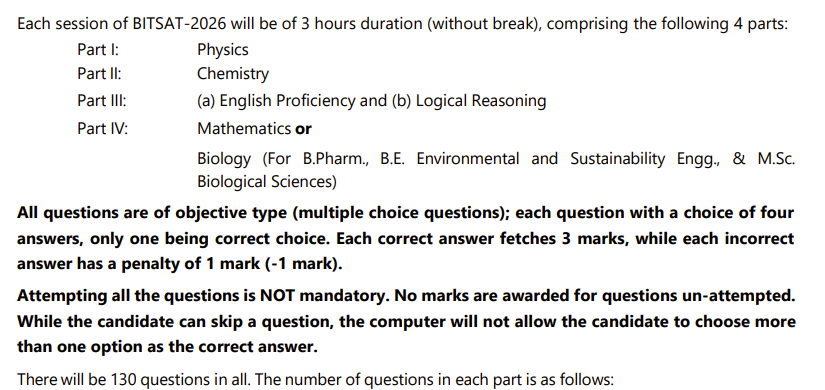
  • According to the BITSAT marking scheme, each correct answer fetches 3 marks, while 1 mark will be deducted for every incorrect answer.

  • BITSAT exam time is 3 hours for 130 questions, and there is no sectional time limit.

Related Articles:

Key Summary

  • If there is still time left after completing 130 questions without skipping any, you will have a chance for 12 bonus BITSAT questions.

  • The BITSAT questions are designed in such a manner that good students can attempt all within the time limit.

  • All the instructions and questions related to BITSAT exam will be in English only.

  • It is not compulsory to attempt every question in BITSAT.

BITSAT Exam Pattern 2027 Quick Overview

The BITSAT Paper pattern is expected to be the same, following the latest structure. You are advised to check the official website once the information brochure is released for 2027.

Particulars

BITSAT 2027 Exam Pattern

Mode of Exam

Computer-Based Test (online)

BITSAT Exam Duration

3 hours (180 minutes), no sectional time limits

Total Questions (Without Bonus)

130

Total Maximum Marks (Without Bonus)

390

BITSAT Marking Scheme

+3 for correct, minus 1 for incorrect, 0 for unattempted

Medium of Exam

English

Sessions

Two sessions a year; the best score is considered

Source: admissions.bits-pilani.ac.in

What is the BITSAT Exam Pattern 2027?

The BITSAT Exam Pattern 2027 consists of multiple-choice questions from Physics, Chemistry, English Proficiency, Logical Reasoning and Mathematics or Biology.

  • BITSAT 2027 Exam Pattern for PCM includes Physics, Chemistry, Maths and English sections. Candidates appearing for PCM will get admission to the BE domain.

  • BITSAT 2027 Exam pattern for PCB comprises Physics, Chemistry, Biology and English sections. Candidates applying to PCB will be admitted only to the Pharm and MSc Biological Science courses.

BITSAT Exam Pattern Section-wise Question Distribution

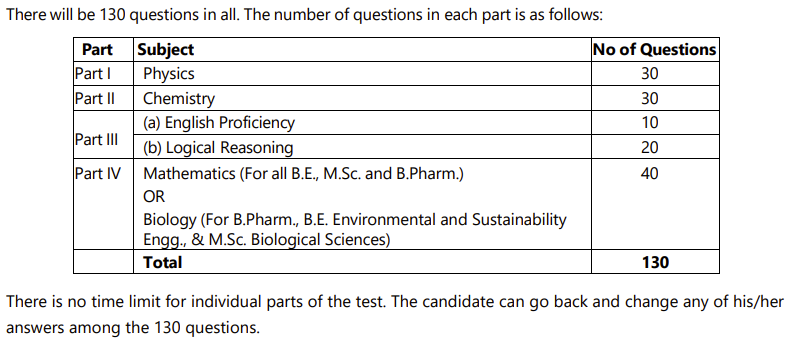
BITSAT Exam Pattern section-wise question distribution for the four parts is tabulated below. The 130 questions in BITSAT are split into four parts.

Part

Subject

Number of Questions

Marks per question

Total Marks

Part I

Physics

30

+3

90

Part II

Chemistry

30

+3

90

Part III

English Proficiency (10) + Logical Reasoning (20)

30

+3

90

Part IV

Mathematics or Biology

40

+3

120

Note: Engineering students must choose Maths in Part 4. Pharmacy students should choose Biology in place of Maths.

BITSAT Exam Pattern Section-wise Question Distribution

Source: admissions.bits-pilani.ac.in

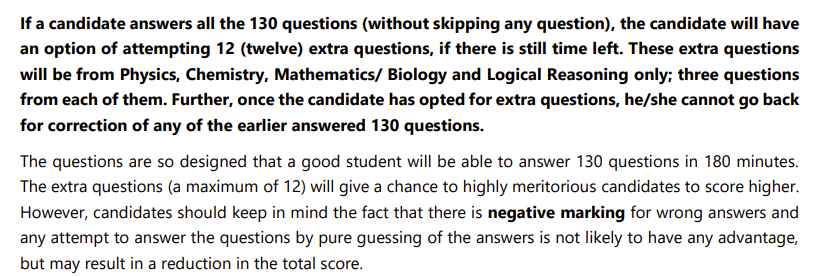
BITSAT Bonus Question: How Extra 12 Marks Work

  • If a candidate answers all the 130 questions, the candidate will have the option of attempting 12 (twelve) extra questions, if there is still time left.

  • Three questions will be from Physics, Chemistry, Mathematics/ Biology, and Logical Reasoning.

  • Further, once the candidate has opted for extra questions, he/she cannot go back to correct any of the 130 questions already answered.

  • No extra time is given for the bonus set.

BITSAT Bonus Question: How Extra 12 Marks Work

Source: admissions.bits-pilani.ac.in

Also Check: BITSAT Total Marks Including Bonus Questions

Ques. What are the subjects in BITSAT 2027?

BITSAT Subject-Wise Exam Pattern 2027

The BITSAT subject-wise exam pattern for PCM and PCB candidates is as follows.

BITSAT 2027 PCM Exam Pattern

The BITSAT PCM exam pattern is expected to cover questions from:

Subject

Question

Physics

30

Chemistry

30

  • English Proficiency

  • Logical Reasoning

  • 20

  • 10

Mathematics

40

BITSAT 2027 PCB Exam Pattern

The BITSAT PCB exam pattern is expected to cover questions from:

Subject

Question

Physics

30

Chemistry

30

  • English Proficiency

  • Logical Reasoning

  • 20

  • 10

Biology

40

Source: admissions.bits-pilani.ac.in

Related Article:

Ques. How many questions are asked in each subject in BITSAT 2027?

BITSAT Marking Scheme 2027

The BITSAT marking scheme is important because the examination includes negative marking. The maximum score for 130 questions is 390 marks. The expected marking scheme is:

BITSAT Paper Pattern

Marks

Correct Answer

+3 marks

Incorrect Answer

-1 mark

Unattempted question

0

Is there any Negative Marking in BITSAT?

BITSAT negative marking deducts 1 mark for every incorrect answer. Therefore, candidates should avoid making random guesses when they have little or no idea about the answer.

BITSAT Exam Pattern: Exam Time

The BITSAT exam time is 3 hours.

  • Candidates need to complete the entire question paper within the prescribed time.

  • There is no separate time limit expected for individual sections.

  • The candidate can go back and change any of his/her answers among the 130 questions.

BITSAT Exam Pattern: Mode of Exam

BITSAT exam mode is a computer-based test (CBT). Since the test is computer-based, students should practise solving mock tests before the examination.

BITSAT Exam Pattern: Total Marks

The total number of BITSAT questions is 130. BITSAT Total Marks is 390. As per BITSAT, negative marking is -1 mark for an incorrect answer.

BITSAT Total Marks= Total Questions (130) x 3 (Correct Answer)

BITSAT Exam Pattern: Total Marks

Source: admissions.bits-pilani.ac.in

Related Link: BITSAT Question Paper: Download Question Paper with Solutions PDF

Ques. Is BITSAT conducted online?

BITSAT Exam Syllabus: Section-Wise Must-Do Chapters

The BITSAT exam syllabus section wise must do chapters are tabulated below. You should follow this first to cover the majority of the BITSAT syllabus.

Subject

Must Do Chapters in BITSAT 2027

Physics

Thermodynamics, Current Electricity, Mechanical Effects of Current and Modern Physics

Chemistry

Chemical Bonding, Coordination Compounds, p-Block/s-Block Elements, Chemical Kinetics, Electrochemistry, Chemical Thermodynamics, Atomic Structure and Biomolecules

Maths

Statistics and Probability, Calculus, Linear Programming, 3D Geometry, Coordinate Geometry, Vectors, Application of Derivatives

Biology (For PCB)

Human Physiology, Genetics & Evolution, Biotechnology, Cell Structure & Function, and Ecology & Environment

English and LR

Vocabulary, Sentence Completion, Basic Grammar, Rearrangement, Statement-Based Logical Reasoning, Blood Relations and Analogy

Also Check:

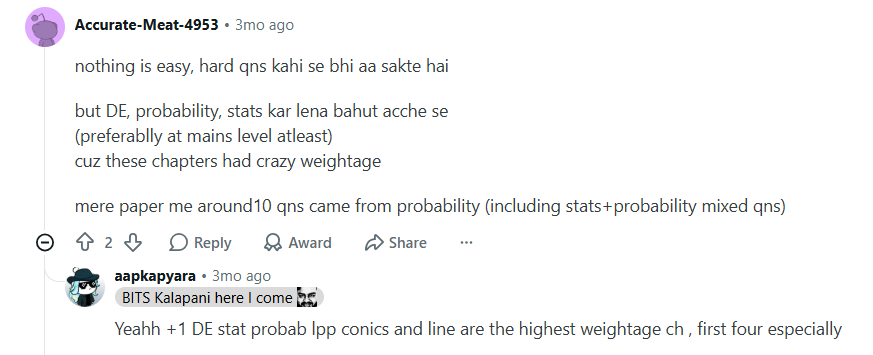
According to a Reddit post, a user wanted to know what are the easy chapters in BITSAT Maths. As per the discussion, many users commented that maths questions are comparatively harder. But you should prepare DE, probability, and stats as they have high weightages. Along with it, other must-do chapters in Maths are Linear Programming, Conics and Lines. Practice these at JEE Main level.

Reddit

Source: Reddit

BITSAT Paper Pattern Important Topics from Last 5 Years

BITSAT exam pattern topic-wise weightage for each subject is tabulated:

Important Physics Topics for BITSAT 2027

BITSAT Physics Important Topics (Combined)

Approx Weightage (%)

Thermodynamics and Heat

8- 10

Current Electricity & Electrostatics

18

Wave, Optics and SHM

13- 17

Modern Physics

10- 12

Magnetism and EMI

8- 10

Important Physics Topics for BITSAT 2027

Important Chemistry Topics for BITSAT 2027

BITSAT Chemistry Important Topics (Combined)

Approx Weightage (%)

Chemical Bonding

8

Atomic Structure and Periodicity

4- 5

Organic Chemistry (Named Reactions and Reaction Mechanism)

12

Inorganic Chemistry (p-block elements)

6- 7

Biomolecules

3- 4

Electrochemistry

5- 6

Important Chemistry Topics for BITSAT 2027

Important Maths Topics for BITSAT 2027

BITSAT Maths Important Topics (Combined)

Approx Weightage (%)

Coordinate Geometry

10- 12

Calculus

8- 10

Vectors and 3D

7- 8

Quadratic Equations and Complex Numbers

6- 7

Probability

4-5

Matrices and Determinants

6

Permutations and Combinations

3- 4

Sequence and Series

5- 6

Statistics

3- 4

Important Maths Topics for BITSAT 2027

Important English Topics for BITSAT 2027

BITSAT English Important Topics

Approx Weightage

Synonyms / Antonyms

10

Sentence Completion / Rearrangement

Grammar / Vocabulary / One-Word Substitution

Figure Formation / Matrix

20

Series & Analogy

Coding-Decoding / Blood Relations

Statements

Related Articles:

Watch the YouTube video by “Harshal BITS Pilani- 10Q Challenge”, in which he has mentioned the high-weightage topics along with some tricks to score 330+ marks in BITSAT 2027.

Ques. Can I opt for bonus questions before completing 130 compulsory questions?

BITSAT Exam Pattern Difficulty Trend

The last 5-year subject-wise difficulty trend based on the BITSAT paper pattern is tabulated below.

  • The maths section is the toughest in BITSAT because it includes multi-step calculations under time pressure.

  • BITSAT Physics paper is formula-driven but requires speed. It is slightly easier than JEE Main.

  • The chemistry in BITSAT is directly related to reactions and statements based on NCERT.

  • BITSAT English section tests candidates' basic grammar knowledge.

  • Biology is NCERT-based, and BITSAT questions are line by line from the textbook. So candidates should focus on completing NCERT first, practise diagrams, labelling and memorise definitions.

Year

Maths Difficulty

Physics Difficulty

Chemistry Difficulty

English + LR Difficulty Trend

Biology (For PCB only)

2022

Tough

Moderate

Moderate

Easy

Moderate

2023

Tough

Moderate

Easy

Easy

Moderate

2024

Tough

Moderate

Moderate

Easy

Easy to Moderate

2025

Tough

Moderate

Easy to Moderate

Easy

Easy to Moderate

2026

Tough and Lengthy

Moderate

Easy to Moderate

Easy

Easy to Moderate

2027 (Expected)

Tough and Lengthy

Moderate

Easy to Moderate

Easy

Easy to Moderate

Also Check: BITSAT Paper Analysis: Check Subject-wise Exam Analysis, Difficulty Level, Question Paper

Ques. Can I edit answers to questions in BITSAT?

BITSAT Exam Pattern vs JEE Main Exam Pattern

Aspirants need to understand the BITSAT exam pattern vs JEE Main exam pattern. Speed matters far more in BITSAT than in JEE Main. The table outlines the comparative analysis of the exam pattern

Aspect

BITSAT

JEE Main

Mode

CBT

CBT

Duration

3 hours

3 hours

Total Questions

130

75

Subjects

Physics, Chemistry, Mathematics, English, Logical Reasoning

Physics, Chemistry, Mathematics

Question Distribution

Physics: 30 Chemistry: 30 Mathematics: 40 English Proficiency: 10 Logical Reasoning: 20

Physics: 25 Chemistry: 25, Mathematics: 25 (Per subject: 20 MCQs + 5 Numerical)

Marking Scheme

+3 correct, -1 incorrect

MCQs: +4 correct, -1 incorrect; Numerical: +4 correct, 0 incorrect

Total Marks

390

300

Negative Marking

Yes

Yes (MCQs only)

Also Check: BITSAT vs JEE Main: Which Score Gets Better Colleges

Ques. What is the BITSAT exam pattern for BTech?

BITSAT Paper Pattern Preparation Tips

Follow these preparation strategies while preparing according to the BITSAT paper pattern:

  • Understand the complete syllabus before starting preparation.

  • Divide preparation time among all BITSAT sections.

  • Start with high-weightage and frequently tested topics.

  • Solve previous years' BITSAT questions and sample papers.

  • Take regular mock tests and analyse mistakes

  • Work on calculation speed and accuracy.

  • Revise formulas and important concepts regularly.

Related Articles:

Paper Analysis

Full page

The BITSAT Session 2 exam is ongoing from May 24 to May 26, 2026. Based on the early students' reactions, the BITSAT May 24 exam was moderate in difficulty, with Maths being tougher compared to other subjects. We will update the analysis here as soon as the exam is over. You can also check and download the BITSAT 2026 May session 2 question paper along with the answer key here. 

The BITSAT session 1 was already over. As per the students, the exam was moderate. You can check the paper analysis below:

  • In the BITSAT 2026 session 1 April 16 shift 2, the weightage of class 11th and class 12th was almost equal. 

  • The Physics section was moderate, with more calculation -based and formula-based questions. 

  • The Chemistry section was tricky and moderate, with questions mostly based on the NCERT. Organic chemistry was less compared to Inorganic and Physical Chemistry. 

  • The Maths section was a little tough and lengthy due to multi-step calculations. Questions were asked on topics such as Linear Programming, Vector & 3D Geometry, Sequence & Series.  

  • The English and the Logical Reasoning sections were moderate due to good vocabulary questions. Candidates with decent preparation found them doable.  

  • Those candidates who completed all 130 questions got 12 extra questions, which can help them get an advantage over others. 

In this article, we will provide live shift-wise paper analysis, difficulty level, subject-wise review, good attempts for each day of the exam from May 24 to May 26, 2026.

BITSAT 2026 Session 2 Shift-wise Paper Analysis (May 24 - 26)

You can check the BITSAT 2026 May Session (Session 2) paper analysis below:

BITSAT Session

Paper Analysis

BITSAT 2026 Session 2 May 24 Shift 1 Paper Analysis

To Be Updated Soon

BITSAT 2026 Session 2 May 24 Shift 2 Paper Analysis

To Be Updated Soon

BITSAT 2026 Session 2 May 25 Shift 1 Paper Analysis

To Be Updated Soon

BITSAT 2026 Session 2 May 25 Shift 2 Paper Analysis

To Be Updated Soon

BITSAT 2026 Session 2 May 26 Shift 1 Paper Analysis

To Be Updated Soon

BITSAT 2026 Session 2 May 26 Shift 2 Paper Analysis

To Be Updated Soon

BITSAT 2026 Session 1 Shift-wise Paper Analysis (April 15-16)

Check the shift-wise BITSAT 2026 Session 1 (April 15-16) paper analysis below, with updates after every shift based on students' reactions and feedback.

BITSAT 2026 Session 1 April 16 Shift 2 Paper Analysis

  • The paper was moderate in difficulty, slightly easier than JEE Main, but required more speed. Students said that the deleted syllabus and extra topics should also be prepared. 

  • Physics was formula-based with a focus on Modern Physics and Current Electricity. Questions were more calculative, but doable.  

  • Chemistry was NCERT-based and relatively easy, with questions asked from Organic chemistry, such as Isomerism.

  • Mathematics was lengthy, with around 4 questions asked from Linear Programming, which made time management the key factor.

  • Overall, a good attempt was around 105–115 questions with high accuracy.

BITSAT 2026 Session 1 April 16 Shift 1 Paper Analysis

  • Based on the early students' reactions, the BITSAT April 16 Shift 1 was moderate in difficulty and was similar to yesterday’s shifts. 

  • The Physics section was moderate with a balanced mix of both formula-based and theory questions. The questions were asked on topics such as Laws of Motion, Kinematics, Current Electricity, Units and Dimensions, Electromagnetism, Work, Power and Energy, and Thermodynamics.

    • There were around 2-3 unusual questions, which most students had not attempted. 

  • The Chemistry section was moderate with mostly NCERT-level questions. However, the Organic Chemistry weightage was less compared to Physical and Inorganic Chemistry. There were questions from deleted chapters also.

    • The questions were asked on topics such as Nomenclature, Biomolecules, States of Matter, Polymers, Chemistry in everyday life, GOC, Periodicity, Chemical Binding, and Coordination Compounds. 

  • The Maths section was much easier than the JEE Main 2026. There were some lengthy questions due to multi-step calculations. Those candidates who were able to find them and did not attempt were able to focus on other, easier questions.

    • The questions were aksed on topics such as Linear Programming, Vector & 3D Geometry, Sequence and Series, Probability, Binomial Theorem, Differential Equation, and Definite Integration. 

  • The English section was moderate. The vocabulary questions asked in English were good. The questions were of the 10th-class level. However, the questions were doable for candidates with decent practice. The questions were aksed on topics such as Synonyms, Antonyms, Passage-based questions, Homophones and Vocabulary.  

  • Logical Reasoning was also on the moderate side. The questions were asked from both Verbal and non-verbal reasoning. However, major weightage was given to the verbal reasoning, especially series and chart logic. 

BITSAT 2026 Session 1 April 15 Shift 2 Paper Analysis 

  • Based on the early students' reactions, the overall difficulty of the shift 2 paper was moderate to tough. The paper was tougher than the shift 1 and was also unpredictable. 

  • The Physics section was overall moderate. However, there were some easy questions as well. The questions were asked on topics such as Optics, Modern Physics, Laws of Motion, Electrodynamics, Rotational Motion, Fluid Mechanics, Work, Power, and Energy. The questions were both concept-based and formula-based. The weightage of the Class 12th questions was more than that of Class 11th. 

  • The Chemistry section was tricky and moderate compared to Shift 1. The questions were asked on topics such as Coordination Chemistry, p-block, Chemical bonding, s-block, Name Reaction, Solutions, Chemical Kinetics, and Electrochemistry. Questions were asked from all sections, i.e. Physical, Inorganic and Organic chemistry. 

  • The Maths section was lengthy and tough, and required speed and accuracy. Questions were asked on topics such as Integral Calculus, Differential Calculus, Maxima and Minima, Probability, and P&C. 

  • English & Logical Reasoning were easy and scoring, helping improve overall attempts. The paper mainly tested speed and accuracy, with a balanced mix of Class 11 & 12 topics.

BITSAT 2026 Session 1 April 15 Shift 1 Paper Analysis 

  • Based on the early students' reactions, the overall difficulty level of the exam was moderate. 

  • The Physics section was moderate, with mostly formula-based questions. The questions were asked on topics such as Current Electricity & Circuits, Electrostatics & Capacitors, Kinematics & Laws of Motion, Magnetic effects of Current, Heat and Thermodynamics, Modern Physics and ray optics.

    • Around 45% question were from Class 11th and the rest 55% were from Class 12th. The questions were more calculative, where the chances of errors increase. 

  • The Chemistry section was easy to moderate, with organic chemistry having around 30% share in the questions. The weightage of the 11th and 12th classes was around 43% and 57%, respectively.

    • The questions were asked on topics such as GOC & reactions from Organic Chemistry, Carboxylic Acids & Derivatives, Chemical Bonding & Molecular Structure, Chemical Thermodynamics, Electrochemistry, p-block elements and Biomolecules.  

  • Mathematics was slightly tough and lengthy due to multi-step calculations. The weightage of class 11th and class 12th was around 40% and 60%, respectively. 

    • The questions were asked on topics such as Calculus (Integration & Differential Equation), Coordinate geometry (circles & conics), Vectors & 3D Geometry, Probability & Statistics, Matrices, Trigonometry and Binomial Theorem.

  • The English section was on the easier side, and the Reasoning section was also easy to moderate. However, the Reasoning section was a little tricky and complicated for some students. 

BITSAT 2025 Paper Analysis

The previous year's paper analysis highlights the overall difficulty level of the exam for each slot, along with the most frequently asked topics, topic weightage, question types, and the reactions of students and experts.

BITSAT 2025 June 26 Slot 1 Paper Analysis

Subject

Difficulty Level

Important Topics

Physics

moderate, NCERT-based

Kinematics, Modern Physics, Rotational Motion, Heat, Newton’s Law of Motion, Current Electricity, Magnetic Effect

Chemistry

easy to moderate

Name-Reactions, Thermodynamics, p-block, d and f block, s-block, Coordination Compound, MOT, Chemical Bonding, Electrochemistry

Mathematics

difficult, lengthy

Vector 3D, Functions, Determinants, Matrices, Probability, Hyperbola, Differential Equations, Algebra

BITSAT 2025 June 26 Slot 2 Paper Analysis

Subject

Difficulty Level

Important Topics

Physics

easy to moderate

Kinematics, Newton’s Law of Motion, Work and Energy, Rotational Motion, Waves, Heat and Thermodynamics, Magnetic Effect of Current, Optics, Atomic Models, Electromagnetic Waves

Chemistry

easy

Chemical Reactions, Thermodynamics, Solutions, Chemical Equilibria, Electrochemistry, Chemical Kinetics, s-block, Hydrocarbons, Organic Compounds

Mathematics

moderate, lengthy, mixed questions

Matrices and Determinants, Trigonometry, Circles, Conic Sections, Coordinate Geometry, Differential Equations, Probability, Vector 3D

BITSAT 2025 June 25 Slot 1 Paper Analysis

Subject

Difficulty Level

Important Topics

Physics

moderate, concept-based

Newton’s Law of Motion, Kinematics, Units and Dimensions, Rotational Motions, Optics, Magnetic Effects of Current

Chemistry

easy to moderate

Block chemistry, Periodic Tables, Name-Reactions, Coordination Chemistry, Oxidation-Reduction, Biomolecules, Electrochemistry, Thermodynamics, Chemical Kinetics, and Mole Concepts

Mathematics

easy, lengthy

Conics, Vector 3D, Differential Equation, Differential Calculus, Functions

BITSAT 2025 June 25 Slot 2 Paper Analysis

Subject

Difficulty Level

Important Topics

Physics

moderate

Kinematics, Circular Motion, Newton’s Law of Motion, Optics, Electrodynamics, Semiconductors, Current Electricity and Internal Reflection

Chemistry

easy

Reaction, Oxidation, Reduction, Mole Concepts, Chemical Equilibrium, Ionic Equilibrium, Thermodynamics, Biomolecules, Thermochemistry, p-block, d&f block, GOC, Coordination Compound, and Chemical Bonding

Mathematics

moderate, lengthy

Vector 3D, Integration, Differential Equation, Conics, Functions, Definite Integrals, Probability, Calculus, and Relations

BITSAT 2025 June 24 Slot 1 Paper Analysis

Subject

Difficulty Level

Important Topics

Physics

moderate, theory-based

Rotational Motion, Momentum, Newton’s Law of Motion, Kinematics, S&H Wave Optics, Wave Motion, Magnetic Effect on Current

Chemistry

easy to moderate

p-block, Chemical Bonding, Block Chemistry, Periodic Table, s-block, d&f block, Thermodynamics, Solutions, Electrochemistry

Mathematics

difficult, lengthy

Coordinate Geometry, Vector 3D, Differential Equations, Integration, Probability, Binomial Theorem

BITSAT 2025 June 24 Slot 2 Paper Analysis

Subject

Difficulty Level

Important Topics

Physics

easy, formula-based

Optics, Heat and Thermodynamics, Kinematics, Rotational Motion, Magnetic Effect, Current Electricity, and Modern Physics

Chemistry

moderate

p-block, Coordination Compound, Thermodynamics, Chemical Kinetics, s-block, MOT, d and f block, and Electrochemistry

Mathematics

difficult, lengthy

Matrix and Determinants, Probability, Vector 3D, Conic, Hyperbola, Differential Equations, Functions, Integration, and Inverse Trigonometry

BITSAT 2025 June 23 Slot 1 Paper Analysis

Subject

Difficulty Level

Important Topics

Physics

moderate, some graphs and tricky questions

magnetic, optics, ray optics, modern physics, kinematics

Chemistry

easy to moderate

D and F block, coordination chemistry, chemical bonding, p-block, biomolecules, solutions, chemical equilibrium, and periodic table

Mathematics

moderate to difficult, lengthy 

vector 3D, differential equations, integration, algebra, matrices, PMC

BITSAT 2025 June 23 Slot 2 Paper Analysis

Subject

Difficulty Level

Important Topics

Physics

moderate, formula-based

kinematics, collision, magnetic effecr, rotational motion

Chemistry

easy to moderate, NCERT-based

redox, thermodynamics, chemical equilibrium, ionic equilibrium

Mathematics

moderate, calculative and lengthy

 differential, vector 3D, probability, binomial theorem, matrices and determinants

BITSAT 2025 June 22 Slot 1 Paper Analysis

Subject

Difficulty Level

Important Topics

Physics

moderate, many tricky questions

modern physics, heat and thermodynamics, magnetic effect of electric current, rotational motion, kinetic, electrostatics

Chemistry

easy to moderate, some tricky questions

coordination, p-block, chemical bonding, name reactions, solutions, electrochemistry, chemical equilibration

Mathematics

moderate, some tricky and lengthy questions

vector 3D, integration, differential equations, conic sections, matrix, determinants

BITSAT 2025 June 22 Slot 2 Paper Analysis

Subject

Difficulty Level

Important Topics

Physics

moderate to difficult, conceptual and tricky questions

wave optics, kinematics, rotational motions, ray optics, heat, and thermodynamics

Chemistry

moderate to difficult

chemical bonding, coordination compounds, d and f block, redox reactions, p-block

Mathematics

moderate to difficult

binomial theorem, vector 3D, probability, differential equations, integration, conic sections

BITSAT 2025 Paper Analysis

BITSAT 2025 paper analysis helps candidates understand the difficulty level of the exam and prepare accordingly. Check the subject-wise difficulty level and important types of questions for each shift:

BITSAT 2025 May 27 Slot 2 Paper Analysis

Particulars

Details

Overall Difficulty Level

Moderate

Physics Difficulty Level

Moderate; more weightage on Modern Physics

Chemistry Difficulty Level

Easy; more weight on the Class 12 syllabus

Logical Reasoning Difficulty Level

Easy

English Proficiency Difficulty Level 

Easy

Mathematics Difficulty Level

Moderate but time-consuming

BITSAT 2025 May 27 Slot 1 Paper Analysis

Particulars

Details

Overall Difficulty Level

Moderate

Physics Difficulty Level

Moderate; more weightage on class12 syllabus

Chemistry Difficulty Level

Easy; more weightage on Organic Chem

Logical Reasoning Difficulty Level

Easy

English Proficiency Difficulty Level 

Easy

Mathematics Difficulty Level

Easy but time-consuming; mixed-conceptual questions

BITSAT 2025 May 26 Slot 2 Paper Analysis

Particulars

Details

Overall Difficulty Level

Moderate with more lengthy questions

Physics Difficulty Level

Moderate but manageable

Chemistry Difficulty Level

Moderate with some tricky questions, lengthy numerical questions from Physical Chemistry

Logical Reasoning Difficulty Level

Easy

English Proficiency Difficulty Level 

Easy

Mathematics Difficulty Level

Easy but time-consuming

BITSAT 2025 May 26 Slot 1 Paper Analysis

Particulars

Details

Overall Difficulty Level

Moderate

Physics Difficulty Level

Moderate with some tricky, conceptual questions

Chemistry Difficulty Level

Easy with some tricky questions

Logical Reasoning Difficulty Level

Easy

English Proficiency Difficulty Level 

Easy

Mathematics Difficulty Level

Easy but time-consuming

BITSAT 2024 Paper Analysis

BITSAT 2024 Paper Analysis

BITSAT 2024 paper analysis will also help candidates get an idea of the expected cut-off marks. BITSAT Paper Analysis 2024 (Session 1 and 2) for the slot 1 & 2 exam is available.

BITSAT 2024 June 28th Slot 2 Paper Analysis

Particulars

Details

Physics Difficulty Level

Moderate

Chemistry Difficulty Level

Difficult

Logical Reasoning Difficulty Level

Moderate

English Proficiency Difficulty Level 

Easy

Mathematics Difficulty Level

Moderate

Topics with the Highest Weightage in Physics

Current Electricity, Electrostatics, Mechanics

Topics with Highest Weightage in Chemistry

Electrochemistry, Atomic structure, Equilibrium

Topics with Highest Weightage in Logical Reasoning

To be Updated

Topics with Highest Weightage in English Proficiency

To be Updated

Topics with Highest Weightage in Mathematics

Calculus, LPP, Probability, 3D-Geometry, Vector, Conic Section

Topics with Highest Weightage in Biology

To be Updated

Was the Paper Lengthy?

Moderate

Number of Good Attempts

To be Updated

BITSAT 2024 June 28th Slot 1 Paper Analysis

Particulars

Details

Physics Difficulty Level

Moderate

Chemistry Difficulty Level

Moderate

Logical Reasoning Difficulty Level

Easy

English Proficiency Difficulty Level 

Easy

Mathematics Difficulty Level

Difficult

Topics with the Highest Weightage in Physics

Mechanics

Topics with Highest Weightage in Chemistry

Electrochemistry, Atomic structure, Equilibrium

Topics with Highest Weightage in Logical Reasoning

To be Updated

Topics with Highest Weightage in English Proficiency

To be Updated

Topics with Highest Weightage in Mathematics

Calculus, LPP, Probability, Coordinate Geometry, 3D-Geometry, Vector

Topics with Highest Weightage in Biology

To be Updated

Was the Paper Lengthy?

Mathematics

Number of Good Attempts

To be Updated

BITSAT 2024 June 27th Slot 2 Paper Analysis

Particulars

Details

Physics Difficulty Level

Moderate

Chemistry Difficulty Level

Difficult

Logical Reasoning Difficulty Level

Moderate

English Proficiency Difficulty Level 

Easy

Mathematics Difficulty Level

Easy

Topics with the Highest Weightage in Physics

Current Electricity, Electrostatics, Mechanics

Topics with Highest Weightage in Chemistry

Electrochemistry, Atomic structure, Equilibrium

Topics with Highest Weightage in Logical Reasoning

To be Updated

Topics with Highest Weightage in English Proficiency

To be Updated

Topics with Highest Weightage in Mathematics

Calculus, LPP, Probability, Coordinate Geometry, 3D-Geometry, Vector

Topics with Highest Weightage in Biology

To be Updated

Was the Paper Lengthy?

Moderate

Number of Good Attempts

To be Updated

BITSAT 2024 June 27th Slot 1 Paper Analysis

Particulars

Details

Physics Difficulty Level

Difficult

Chemistry Difficulty Level

Moderate

Logical Reasoning Difficulty Level

Easy

English Proficiency Difficulty Level 

Easy

Mathematics Difficulty Level

Difficult + Lengthy

Topics with the Highest Weightage in Physics

EMW

Topics with Highest Weightage in Chemistry

Thermodynamics, Physical Chemistry

Topics with Highest Weightage in Logical Reasoning

To be Updated

Topics with Highest Weightage in English Proficiency

To be Updated

Topics with Highest Weightage in Mathematics

LPP, Statistics, Calculus

Topics with Highest Weightage in Biology

To be Updated

Was the Paper Lengthy?

Mathematics

Number of Good Attempts

To be Updated

BITSAT 2024 June 26th Slot 2 Paper Analysis

Particulars

Details

Physics Difficulty Level

Difficult

Chemistry Difficulty Level

Moderate

Logical Reasoning Difficulty Level

Easy

English Proficiency Difficulty Level 

Easy

Mathematics Difficulty Level

Difficult

Topics with the Highest Weightage in Physics

To be Updated

Topics with Highest Weightage in Chemistry

To be Updated

Topics with Highest Weightage in Logical Reasoning

To be Updated

Topics with Highest Weightage in English Proficiency

To be Updated

Topics with Highest Weightage in Mathematics

To be Updated

Topics with Highest Weightage in Biology

To be Updated

Was the Paper Lengthy?

Moderate

Number of Good Attempts

To be Updated

BITSAT 2024 June 26th Slot 1 Paper Analysis

Particulars

Details

Physics Difficulty Level

Difficult

Chemistry Difficulty Level

Moderate

Logical Reasoning Difficulty Level

Easy

English Proficiency Difficulty Level 

Easy

Mathematics Difficulty Level

Difficult

Topics with the Highest Weightage in Physics

To be Updated

Topics with Highest Weightage in Chemistry

To be Updated

Topics with Highest Weightage in Logical Reasoning

To be Updated

Topics with Highest Weightage in English Proficiency

To be Updated

Topics with Highest Weightage in Mathematics

To be Updated

Topics with Highest Weightage in Biology

To be Updated

Was the Paper Lengthy?

Moderate

Number of Good Attempts

To be Updated

BITSAT 2024 June 25th Slot 2 Paper Analysis

Particulars

Details

Physics Difficulty Level

Moderate

Chemistry Difficulty Level

Moderate

Logical Reasoning Difficulty Level

Easy

English Proficiency Difficulty Level 

Easy

Mathematics Difficulty Level

Difficult

Topics with the Highest Weightage in Physics

Mechanics, Kinematics

Topics with Highest Weightage in Chemistry

Physical Chemistry

Topics with Highest Weightage in Logical Reasoning

To be Updated

Topics with Highest Weightage in English Proficiency

To be Updated

Topics with Highest Weightage in Mathematics

Calculus

Topics with Highest Weightage in Biology

To be Updated

Was the Paper Lengthy?

Moderate

Number of Good Attempts

To be Updated

BITSAT 2024 June 25th Slot 1 Paper Analysis

Particulars

Details

Physics Difficulty Level

Difficult

Chemistry Difficulty Level

Moderate

Logical Reasoning Difficulty Level

Easy

English Proficiency Difficulty Level 

Easy

Mathematics Difficulty Level

Difficult

Topics with the Highest Weightage in Physics

To be Updated

Topics with Highest Weightage in Chemistry

To be Updated

Topics with Highest Weightage in Logical Reasoning

To be Updated

Topics with Highest Weightage in English Proficiency

To be Updated

Topics with Highest Weightage in Mathematics

To be Updated

Topics with Highest Weightage in Biology

To be Updated

Was the Paper Lengthy?

Logical Reasoning

Number of Good Attempts

To be Updated

BITSAT 2024 June 24th Slot 2 Paper Analysis

Particulars

Details

Physics Difficulty Level

Moderate

Chemistry Difficulty Level

Moderate

Logical Reasoning Difficulty Level

Easy

English Proficiency Difficulty Level 

Easy

Mathematics Difficulty Level

Difficult

Topics with the Highest Weightage in Physics

To be Updated

Topics with Highest Weightage in Chemistry

To be Updated

Topics with Highest Weightage in Logical Reasoning

To be Updated

Topics with Highest Weightage in English Proficiency

To be Updated

Topics with Highest Weightage in Mathematics

To be Updated

Topics with Highest Weightage in Biology

To be Updated

Was the Paper Lengthy?

Moderate

Number of Good Attempts

To be Updated

BITSAT 2024 June 24th Slot 1 Paper Analysis

Particulars

Details

Physics Difficulty Level

Moderate

Chemistry Difficulty Level

Moderate

Logical Reasoning Difficulty Level

Easy

English Proficiency Difficulty Level 

Easy

Mathematics Difficulty Level

Difficult + Lengthy

Topics with the Highest Weightage in Physics

Heat and Thermodynamics, Kinematics, Modern Physics, Current Electricity, Waves, Optics, Motion on a Plane

Topics with Highest Weightage in Chemistry

Physical and Inorganic

Topics with Highest Weightage in Logical Reasoning

To Be Updated

Topics with Highest Weightage in English Proficiency

To Be Updated

Topics with Highest Weightage in Mathematics

Differential Equations and Linear Programming

Was the Paper Lengthy?

Mathematics Sections

Number of Good Attempts

To be Updated

BITSAT 2024 May 24th Slot 1 Paper Analysis

Particulars

Details

Physics Difficulty Level

Moderate

Chemistry Difficulty Level

Moderate

Logical Reasoning Difficulty Level

Easy

English Proficiency Difficulty Level 

Easy

Mathematics Difficulty Level

Difficult

Biology Difficulty Level

Moderate

Overall Difficulty Level

Moderate

Topics with the Highest Weightage in Physics

Heat and Thermodynamics, Kinematics, Modern Physics, Current Electricity, Waves, Optics, Motion on a Plane

Topics with Highest Weightage in Chemistry

Thermodynamics, s-block elements, Environmental Chemistry, Chemical Kinetics

Topics with Highest Weightage in Logical Reasoning

Figure Matrix, Analogy, Pattern Formation and Analysis, Chart Logic

Topics with Highest Weightage in English Proficiency

Reading Comprehension, Phrasal Verbs and Idioms, Prepositions, Synonyms and Antonyms

Topics with Highest Weightage in Mathematics

Vectors, Mathematical Reasoning, 3D Geometry, Inverse Trigonometric Functions

Topics with Highest Weightage in Biology

To be Updated

Was the Paper Lengthy?

Mathematics

Number of Good Attempts

To be Updated

BITSAT 2024 May 24th Slot 2 Paper Analysis

Particulars

Details

Physics Difficulty Level

Moderate

Chemistry Difficulty Level

Moderate

Logical Reasoning Difficulty Level

Easy

English Proficiency Difficulty Level 

Easy

Mathematics Difficulty Level

Difficult

Biology Difficulty Level

Moderate

Overall Difficulty Level

Moderate

Topics with the Highest Weightage in Physics

Heat and Thermodynamics, Kinematics, Modern Physics, Current Electricity, Waves, Optics, Motion on a Plane

Topics with Highest Weightage in Chemistry

Thermodynamics, s-block elements, Environmental Chemistry, Chemical Kinetics

Topics with Highest Weightage in Logical Reasoning

Figure Matrix, Analogy, Pattern Formation and Analysis, Chart Logic

Topics with Highest Weightage in English Proficiency

Reading Comprehension, Phrasal Verbs and Idioms, Prepositions, Synonyms and Antonyms

Topics with Highest Weightage in Mathematics

Vectors, Mathematical Reasoning, 3D Geometry, Inverse Trigonometric Functions

Topics with Highest Weightage in Biology

To be Updated

Was the Paper Lengthy?

Mathematics

Number of Good Attempts

To be Updated

BITSAT 2024 May 23rd Slot 1 Paper Analysis

Particulars

Details

Physics Difficulty Level

Moderate

Chemistry Difficulty Level

Moderate

Logical Reasoning Difficulty Level

Easy

English Proficiency Difficulty Level 

Easy

Mathematics Difficulty Level

Difficult

Biology Difficulty Level

Moderate

Overall Difficulty Level

Moderate

Topics with the Highest Weightage in Physics

Kinematics, Current Electricity, Modern Physics, Heat and Thermodynamics, Optics

Topics with Highest Weightage in Chemistry

Environmental Chemistry, s-Block Elements, Aromatics Hydrocarbons, Thermodynamics, Chemical Kinetics

Topics with Highest Weightage in Logical Reasoning

Chart Logic, Analogy, Figure Matrix

Topics with Highest Weightage in English Proficiency

Reading Comprehension, Odd one out, Phrasal Verbs and Idioms, Synonyms and Antonyms, Prepositions

Topics with Highest Weightage in Mathematics

3D Geometry, Vectors, Inverse Trigonometric Functions, Mathematical Reasoning

Topics with Highest Weightage in Biology

To be Updated

Was the Paper Lengthy?

Mathematics

Number of Good Attempts

To be Updated

BITSAT 2024 May 23rd Slot 2 Paper Analysis

Particulars

Details

Physics Difficulty Level

Moderate

Chemistry Difficulty Level

Moderate

Logical Reasoning Difficulty Level

Easy

English Proficiency Difficulty Level 

Easy

Mathematics Difficulty Level

Moderate to Difficult

Biology Difficulty Level

Moderate

Overall Difficulty Level

Moderate

Topics with the Highest Weightage in Physics

Kinematics, Current Electricity, Modern Physics, Heat and Thermodynamics, Optics

Topics with Highest Weightage in Chemistry

Environmental Chemistry, s-Block Elements, Aromatics Hydrocarbons, Thermodynamics, Chemical Kinetics

Topics with Highest Weightage in Logical Reasoning

Chart Logic, Analogy, Figure Matrix

Topics with Highest Weightage in English Proficiency

Reading Comprehension, Odd one out, Phrasal Verbs and Idioms, Synonyms and Antonyms, Prepositions

Topics with Highest Weightage in Mathematics

3D Geometry, Vectors, Inverse Trigonometric Functions, Mathematical Reasoning

Topics with Highest Weightage in Biology

To be Updated

Was the Paper Lengthy?

Mathematics

Number of Good Attempts

To be Updated

BITSAT 2024 May 23rd Slot 2 Paper Analysis

Particulars

Details

Physics Difficulty Level

Moderate

Chemistry Difficulty Level

Moderate

Logical Reasoning Difficulty Level

Easy

English Proficiency Difficulty Level 

Easy

Mathematics Difficulty Level

Moderate to Difficult

Biology Difficulty Level

Moderate

Overall Difficulty Level

Moderate

Topics with the Highest Weightage in Physics

Kinematics, Current Electricity, Modern Physics, Heat and Thermodynamics, Optics

Topics with Highest Weightage in Chemistry

Environmental Chemistry, s-Block Elements, Aromatics Hydrocarbons, Thermodynamics, Chemical Kinetics

Topics with Highest Weightage in Logical Reasoning

Chart Logic, Analogy, Figure Matrix

Topics with Highest Weightage in English Proficiency

Reading Comprehension, Odd one out, Phrasal Verbs and Idioms, Synonyms and Antonyms, Prepositions

Topics with Highest Weightage in Mathematics

3D Geometry, Vectors, Inverse Trigonometric Functions, Mathematical Reasoning

Topics with Highest Weightage in Biology

To be Updated

Was the Paper Lengthy?

To be Updated

Number of Good Attempts

To be Updated

BITSAT 2024 May 22nd Slot 1 Paper Analysis

Particulars

Details

Physics Difficulty Level

Moderate

Chemistry Difficulty Level

Moderate

Logical Reasoning Difficulty Level

Easy

English Proficiency Difficulty Level 

Easy

Mathematics Difficulty Level

Moderate to Difficult

Biology Difficulty Level

Moderate

Overall Difficulty Level

Moderate

Topics with the Highest Weightage in Physics

Oscillations, Gravitation, Electrostatics, Thermodynamics, Ray Optics, Modern Physics

Topics with Highest Weightage in Chemistry

Aromatic Hydrocarbons, Thermodynamics, Coordination Compounds, States of Matter, p, d, and f-Block Elements

Topics with Highest Weightage in Logical Reasoning

Classification, Analogy, Pattern Perception, Figure Matrix

Topics with Highest Weightage in English Proficiency

Reading Comprehension, Synonyms and Antonyms, Figures of Speech, Rearrangement, Idioms and Phrases

Topics with Highest Weightage in Mathematics

Vectors & Coordinate Geometry, Differential Equations, Integration, Probability, Sets, Relations and Functions

Topics with Highest Weightage in Biology

Human Physiology, Reproduction, Biotechnology and its Applications, Cells, Genetics and Evolution

Was the Paper Lengthy?

Physics, and Mathematics

Number of Good Attempts

Above 99 in PCM and above 106 in PCB

BITSAT 2024 May 22nd Slot 2 Paper Analysis

Particulars

Details

Physics Difficulty Level

Moderate

Chemistry Difficulty Level

Moderate

Logical Reasoning Difficulty Level

Easy to Moderate

English Proficiency Difficulty Level 

Easy

Mathematics Difficulty Level

Moderate to Difficult

Biology Difficulty Level

Moderate

Overall Difficulty Level

Moderate

Topics with the Highest Weightage in Physics

Oscillations, Gravitation, Electrostatics, Thermodynamics, Ray Optics, Modern Physics

Topics with Highest Weightage in Chemistry

Aromatic Hydrocarbons, Thermodynamics, Coordination Compounds, States of Matter, p, d, and f-Block Elements

Topics with Highest Weightage in Logical Reasoning

Classification, Analogy, Pattern Perception, Figure Matrix

Topics with Highest Weightage in English Proficiency

Reading Comprehension, Synonyms and Antonyms, Figures of Speech, Rearrangement, Idioms and Phrases

Topics with Highest Weightage in Mathematics

Vectors & Coordinate Geometry, Differential Equations, Integration, Probability, Sets, Relations and Functions

Topics with Highest Weightage in Biology

Human Physiology, Reproduction, Biotechnology and its Applications, Cells, Genetics and Evolution

Was the Paper Lengthy?

Mathematics

Number of Good Attempts

Above 103 in PCM and above 109 in PCB

BITSAT 2024 May 21st Slot 1 Paper Analysis

Particulars

Details

Physics Difficulty Level

Moderate

Chemistry Difficulty Level

Moderate

Logical Reasoning Difficulty Level

Easy to Moderate

English Proficiency Difficulty Level 

Easy

Mathematics Difficulty Level

Moderate to Tough

Biology Difficulty Level

Moderate

Overall Difficulty Level

Moderate to Tough

Topics with the Highest Weightage in Physics

Motion on a Plane, Kinematics, Current Electricity, Heat and Thermodynamics, Waves, Optics, Work and Energy

Topics with Highest Weightage in Chemistry

Thermodynamics, s-block elements, Environmental Chemistry, Chemical Kinetics, Electrochemistry

Topics with Highest Weightage in Logical Reasoning

Series Completion, Analogy, Figure Matrix, Chart Logic

Topics with Highest Weightage in English Proficiency

Prepositions, Find Odd one Out, Reading Comprehension, Tense, Synonyms &  Antonyms, Phrasal Verbs & Idioms

Topics with Highest Weightage in Mathematics

Inverse trigonometric functions, 3D geometry, Vectors, Probability, Differential calculus

Topics with Highest Weightage in Biology

Photosynthesis, Ecology and Environment, Control and co-ordination, Biomolecules and Enzymes

Was the Paper Lengthy?

Mathematics

Number of Good Attempts

To be Updated

BITSAT 2024 May 21st Slot 2 Paper Analysis

Particulars

Details

Physics Difficulty Level

Moderate

Chemistry Difficulty Level

Moderate

Logical Reasoning Difficulty Level

Easy to Moderate

English Proficiency Difficulty Level

Easy

Mathematics Difficulty Level

Moderate

Biology Difficulty Level

Moderate

Overall Difficulty Level

Moderate to Tough

Topics with the Highest Weightage in Physics

Kinematics, Current Electricity, Heat and Thermodynamics, Motion on a plane, Waves, Magnetism, Optics

Topics with Highest Weightage in Chemistry

s-block elements, Environmental Chemistry, Chemical Kinetics, Thermodynamics

Topics with Highest Weightage in Logical Reasoning

Chart Logic, Analogy, Pattern Formation and Analysis

Topics with Highest Weightage in English Proficiency

Tense, Phrasal Verbs and Idioms, Synonyms and Antonyms, Reading Comprehension

Topics with Highest Weightage in Mathematics

Probability, Vectors, Differential Calculus, Inverse Trigonometric Functions

Topics with Highest Weightage in Biology

Photosynthesis, Ecology and Environment, Biomolecules and Enzymes

Was the Paper Lengthy?

Mathematics, and Logical Reasoning

Number of Good Attempts

To be Updated

BITSAT 2024 May 20th Slot 1 Paper Analysis

Particulars

Details

Physics Difficulty Level

Moderate

Chemistry Difficulty Level

Moderate

Logical Reasoning Difficulty Level

Easy to Moderate

English Proficiency Difficulty Level 

Easy to Moderate

Mathematics Difficulty Level

Moderate to Tough

Biology Difficulty Level

Moderate

Overall Difficulty Level

Moderate to Tough

Topics with the Highest Weightage in Physics

Modern Physics, Kinematics, Electrostatics, Modern Physics, Heat and Thermodynamics, Oscillations

Topics with Highest Weightage in Chemistry

Coordination Compounds, Thermodynamics, Block Chemistry, Environmental Chemistry, Electrochemistry, Hydrocarbons

Topics with Highest Weightage in Logical Reasoning

Analogy, Pattern Perception, Series Completion, Logical Deduction, Figure Matrix, Pattern Perception

Topics with Highest Weightage in English Proficiency

Synonyms and Antonyms, Grammar, Reading Comprehension, Paragraph & Unity, Phrasal Verbs & Idioms

Topics with Highest Weightage in Mathematics

Applications of Differentiation and Integration, Probability, Trigonometry, Statistics, Vectors and 3D

Topics with Highest Weightage in Biology

Reproduction in Plants and Humans, Human Physiology, Biotechnology and its Applications, Ecology and Environment, Cells, Genetics and Evolution

Was the Paper Lengthy?

Mathematics, Logical Reasoning, English Proficiency

Number of Good Attempts

Above 98 in PCM and above 103 in PCB

BITSAT 2024 May 20th Slot 2 Paper Analysis

Particulars

Details

Physics Difficulty Level

Easy to Moderate

Chemistry Difficulty Level

Moderate

Logical Reasoning Difficulty Level

Easy to Moderate

English Proficiency Difficulty Level 

Easy to Moderate

Mathematics Difficulty Level

Moderate

Biology Difficulty Level

Moderate

Overall Difficulty Level

Moderate

Topics with the Highest Weightage in Physics

Same as slot 1

Topics with Highest Weightage in Chemistry

Same as slot 1

Topics with Highest Weightage in Logical Reasoning

Same as slot 1

Topics with Highest Weightage in English Proficiency

Same as slot 1

Topics with Highest Weightage in Mathematics

Same as slot 1

Topics with Highest Weightage in Biology

Same as slot 1

Was the Paper Lengthy?

Mathematics, Logical Reasoning

Number of Good Attempts

Above 104 in PCM and above 109 in PCB

BITSAT 2023 May 26 Shift 1 Paper Analysis

  • The difficulty level of BITSAT 2023 May 25 shift 2 paper was moderate.

  • Mathematics and Physics were moderate while Chemistry was easy.

BITSAT 2023 May 25 Shift 2 Paper Analysis

  • The difficulty level of BITSAT 2023 May 25 shift 2 paper was moderate.

  • Mathematics was moderate and Physics was easy to moderate

  • Most candidates found Chemistry and Logical Reasoning papers to be easy.

BITSAT 2023 May 25 Shift 1 Paper Analysis

  • BITSAT 2023 May 25 shift 1 paper was of moderate difficulty.

  • Mathematics was moderate with more weightage of questions from trigonometry, vector, differentials, and coordinate geometry.

  • Physics was easy to moderate while Chemistry paper was easy, especially the questions from physical chemistry.

BITSAT 2023 May 24 Shift 2 Paper Analysis

  • BITSAT 2023 May 24 shift 2 paper was of moderate difficulty.

  • Mathematics was easy to moderate yet lengthy.

  • Physics was easy to moderate with more questions from SHM Waves, Magnetic Effect of Electric Current, and Modern Physics

  • BITSAT Chemistry paper was easy with direct NCERT- based questions.

  • English questions were comparatively tougher than logical reasoning questions.

BITSAT 2023 May 24 Shift 1 Paper Analysis

  • BITSAT 2023 May 24 shift 1 paper was of moderate difficulty.

  • Mathematics was moderately difficult yet lengthy.

  • Physics was moderate to tough and Chemistry was easy with direct NCERT- based questions.

  • Organic chemistry had high weightage compared to physical chemistry.

  • English language and logical reasoning questions were easy.

BITSAT 2023 May 23 Shift 2 Paper Analysis

  • BITSAT 2023 May 23 shift 2 paper was of moderate difficulty.

  • Like previous 3 days, Mathematics was lengthy and difficult.

  • Physics was moderate and Chemistry was easy with direct NCERT- based questions.

  • English language questions were comparatively tougher than the logical reasoning questions.

BITSAT 2023 May 23 Shift 1 Paper Analysis

  • BITSAT 2023 May 23 shift 1 paper was rated moderate in terms of overall difficulty level.

  • Mathematics section was lengthy comprising questions of moderate to high difficulty.

  • Physics was moderate with more formula-based numericals.

  • Overall, the paper was relatively easier than JEE Main.

BITSAT 2023 May 22 Shift 2 Paper Analysis

  • According to the students, the question paper was rated moderate in terms of difficulty level.

  • Mathematics was moderate, Physics was moderate to difficult and had calculation-based questions.

  • Chemistry was easy in compare to Mathematics and Physics section.

BITSAT 2023 May 22 Shift 1 Paper Analysis

  • As per the students' reactions, the question paper was rated moderate in terms of overall difficulty level.

  • Mathematics section was rated moderate to tough and had lengthy questions.

  • Physics and Chemistry were easy in comparison to Mathematics.

  • Students said that the paper was much easier than JEE Main.

BITSAT 2022 Paper Analysis

BITSAT 2022 August 6 Paper Analysis

Subject

Slot 1

Mathematics

Difficulty Level: Moderate to Difficult

Topics: Differential Calculus, Differential Equation, LPP, Vectors, Circle, P&C, Binomial, Probability, and Statistics

Physics

Difficulty Level: Easy to Moderate

Topics: Electrostatics, Modern Physics, Current Electricity, AC, Rotation, SHM & Waves

Chemistry

Difficulty Level: Easy to Moderate

Topics: GOC, POC, Nomenclature, Isomerism, Thermochemistry, Polymers, Biomolecule, Atomic structure, P Block

English Proficiency and Logical Reasoning

Difficulty Level: Easy to Moderate

BITSAT 2022 Paper Analysis: August 5

The paper analysis of BITSAT 2022 August 5 is available now.

Subject

Slot 1

Mathematics

Difficulty Level: Difficult

Topics: Differential Equations, LPP, Vectors, 2D Geometry, Probability & Statistics, P&C

Physics

Difficulty Level: Difficult to moderate

Topics: Electrostatics, Current Electricity, Gravitation, NLM, Magnetism, Thermo and KTG, Collisions

Chemistry

Difficulty Level: Easy

Topics: GOC, POC, Coordinates Compounds, Electrochemistry, Titration, Chemical Bonding, S block, Biomolecules

English Proficiency and Logical Reasoning

Difficulty Level: Easy

BITSAT 2022 Paper Analysis: August 4

Subject

Slot 1

Mathematics

Difficulty Level: Moderate to Difficult

Topics: AOD, Conic Section, Vector & 3D, Differential Equation, PnC, Probability & Statistics

Physics

Difficulty Level: Easy

Topics: Work Power Energy, Rotational Motion, Gravitation, Electrostatics, Magnetism, Kinematics, SHM, Fluids

Chemistry

Difficulty Level: Easy to Moderate

Topics: GOC, POC, Organic Chemistry, Isomerism, P Block, Coordinate Compounds, Polymers, Biomolecules

English Proficiency and Logical Reasoning

Difficulty Level: Moderate

BITSAT 2022 Paper Analysis: August 3

The Slot 1 and Slot 2 paper analysis of BITSAT 2022 August 3 is available now.

Subject

Slot 1

Slot 2

Mathematics

Difficulty Level: Moderate to Difficult

Topics: Calculus, Circle, Vectors, Differential Equations, Probability

Difficulty Level: Moderate to difficult

Topics: Differential Calculus, Differential Equations, LPP, Vector & 3D, Area under Curves, Probability and Statistics

Physics

Difficulty Level: Easy

Topics: Work Power Energy, Collision, Rotational Energy, Electromagnetism, Dimensional Analysis

Difficulty Level: Easy to moderate

Topics: Electrostatics, Modern Physics, Current Electricity, AC, Rotation, SHM & Waves

Chemistry

Difficulty Level: Moderate to Difficult

Topics: GOC, POC, Carbonyl Compounds, Thermodynamics, Equilibrium, P Block, Periodic Table

Difficulty Level: Easy to moderate

Topics: GOC, POC, Nomenclature & Isomerism, Polymers, Biomolecule, Atomic Structure 

English Proficiency and Logical Reasoning

Difficulty Level: Easy

Difficulty Level: Moderate

BITSAT 2022 Paper Analysis: Day 6 (July 7)

BITSAT 2022 Day 6 Paper Analysis for Slot 1 and Slot 2 is available here: 

Section

Slot 1

Slot  2

Mathematics

Difficulty Level: Moderate to Difficult
Topics: Differential Equation, Differentiation, Derivative, Integration, Permutation and Combination, Probability

Difficulty Level: Moderate to Difficult
Topics: Differentiation, Derivative, Integration, Permutation and Combination,

Physics

Difficulty Level: Moderate 
Topics: Mechanics, Kinematics, Optics, Modern Physics

Difficulty Level: Moderate 
Topics:  Kinematics, Optics, Modern Physics

Chemistry

Difficulty Level: Easy 
Topics: Organic Chemistry, S, P, D and F Block elements, Coordination Compound

Difficulty Level: Easy
Topics: S, P, D and F Block elements, Coordination Compound

English Proficiency and Logical Reasoning

Difficulty Level: Easy to Moderate

Difficulty Level: Easy to Moderate

BITSAT 2022 Paper Analysis: Day 5 (July 6)

BITSAT 2022 Day 5 Paper Analysis for Slot 1 and Slot 2 is available here: 

Section

Slot 1

Slot  2

Mathematics

Difficulty Level: Difficult
Topics: Vectors & 3D, Calculus, LPP, Straight Line, Probability

Difficulty Level: Moderate
Topics: Differential Equation, Calculus, Probability, Straight Line

Physics

Difficulty Level: Moderate to Difficult
Topics: Thermodynamics, Mechanics, Electrostatics, EMI, Modern Physics, SHM and Waves, Fluid Mechanics

Difficulty Level: Moderate 
Topics: Mechanics, Electrostatics, Modern Physics, SHM 

Chemistry

Difficulty Level: Moderate
Topics: Physical Chemistry, Surface Chemistry, Chemical Bonding

Difficulty Level: Easy
Topics: General Organic Chemistry, Physical Chemistry

English Proficiency and Logical Reasoning

Difficulty Level: Easy to Moderate

Difficulty Level: Moderate

BITSAT 2022 Paper Analysis: Day 4 (July 5)

BITSAT 2022 Day 4 Paper Analysis for Slot 1 and Slot 2 is available here: 

Section

Slot 1

Slot  2

Mathematics

Difficulty Level: Moderate 
Topics: Vectors and 3d, Sets and Relations, Differential Equation, Calculus, Probability, Quadratic Equation, Ellipse and Hyperbola

Difficulty Level: Moderate
Topics: Differential Equation, Calculus, Probability, Quadratic Equation, Ellipse

Physics

Difficulty Level: Moderate to Difficult
Topics: Thermodynamics, Mechanics, Electrostatics, EMI, Modern Physics, SHM and Waves, Fluid Mechanics

Difficulty Level: Moderate 
Topics: Mechanics, Electrostatics, EMI, Modern Physics, SHM and Waves

Chemistry

Difficulty Level: Easy to Moderate
Topics: Inorganic (specially s block and p block), Chemical Kinetics, Equilibrium, Thermochemistry, General Organic Chemistry

Difficulty Level: Easy
Topics: Chemical Kinetics, Equilibrium, Thermochemistry

English Proficiency and Logical Reasoning

Difficulty Level: Easy to Moderate

Difficulty Level: Moderate

BITSAT 2022 Paper Analysis: Day 3 (July 4)

BITSAT 2022 Day 3 Paper Analysis for Slot 1 and Slot 2 is available here: 

Section

Slot 1

Slot  2

Mathematics

Difficulty Level: Moderate 
Topics: Differential Equation, Area Under the curves, Vector, 3D, LPP, Straight Line

Difficulty Level: Moderate
Topics: LPP, Vector, 3D, LPP, Straight Line

Physics

Difficulty Level: Moderate 
Topics: Electrostatics, Magnetism, Work, Power, Energy

Difficulty Level: Moderate 
Topics: Electrostatistics, Magnetism, Work, Power, Energy

Chemistry

Difficulty Level: Easy
Topics: Organics, Thermodynamics

Difficulty Level: Easy
Topics:  Organics, Thermodynamics

English Proficiency and Logical Reasoning

Difficulty Level: Moderate

Difficulty Level: Moderate

BITSAT 2022 Paper Analysis: Day 2 (July 3)

BITSAT 2022 Day 2 Paper Analysis for Slot 1 and Slot 2 is available here: 

Section

Slot 1

Slot  2

Mathematics

Difficulty Level: Moderate 
Topics: Differential, Integration, Algebra, Coordinate Geometry,

Difficulty Level: Moderate
Topics:  Continuity, Coordinate Geometry, Calculus

Physics

Difficulty Level: Moderate 
Topics: Electrostatic, Electromagnetic Induction

Difficulty Level: Moderate 
Topics: Electromagnetic Induction, Relative Motion, Electrostatic

Chemistry

Difficulty Level: Easy
Topics: General Organic Chemistry, Inorganic Chemistry

Difficulty Level: Easy
Topics:Noble Gas, Ionic Equilibrium, Polymer, Biomolecules

English Proficiency and Logical Reasoning

Difficulty Level: Moderate

Difficulty Level: Moderate

BITSAT 2022 Paper Analysis: Day 1 (July 2)

BITSAT 2022 Day 1 Paper Analysis for Slot 1 and Slot 2 is available here: 

Section

Slot 1

Slot  2

Mathematics

Difficulty Level: Moderate but Lengthy
Topics: Quadratic Equation, Continuity, Differential, Integration, Algebra, Coordinate Geometry, Calculus

Difficulty Level: Moderate
Topics: Continuity, Coordinate Geometry, Calculus, Quadratic Equation

Physics

Difficulty Level: Moderate 
Topics: Relative Motion, Mechanics, Electrostatic, Electromagnetic Induction

Difficulty Level: Moderate 
Topics: Electromagnetic Induction, Relative Motion, Electrostatic

Chemistry

Difficulty Level: Easy
Topics: Biomolecule, Nitrogen, Oxygen, Alkane, Noble Gas, Ionic Equilibrium, Polymer

Difficulty Level: Easy
Topics: Alkane, Noble Gas, Ionic Equilibrium, Polymer, Biomolecules

English Proficiency and Logical Reasoning

Difficulty Level: Easy

Difficulty Level: Easy

BITSAT 2021 Paper Analysis

BITSAT 2021 Paper Analysis

Day

BITSAT 2021 Overall Difficulty Level*

Slot 1

Slot 2

August 3

Moderate but Lengthy

Easy to Moderate

August 4

Easy to Moderate

Moderate

August 5

Easy to Moderate

Moderate

August 6

Easy to Moderate

Easy

August 7

Moderate

Moderate

August 8

Moderate

Moderate

August 9

Moderate to Difficult

--

*- The overall difficulty level of BITSAT varies for each candidate based on their interpretation and preparation. The details mentioned here are based on some feedback received by the candidates.

BITSAT 2021 Paper Analysis: Day 7 (August 9)

BITSAT 2021 on August 9 was held for candidates who were facing issues of clashes with other exams. The paper was reported to be moderate to difficult. Physics was reported to be moderate in terms of difficulty level however, there were some tricky questions. Mathematics was also reported to be moderate with a few lengthy questions on calculus, etc. Chemistry was the easiest of the three. 

Section

Slot 1

Mathematics

Difficulty Level: Moderate but Lengthy
Topics: Coordinate Geometry, Limits, Calculus, Algebra, Quadratic Equation, Indefinite Integration, Continuity, Application of Derivative, etc.

Physics

Difficulty Level: Moderate but tricky
Topics: Mechanics, Simple Harmonic Motion, Work, Power & Energy, Electromagnetic Induction, Relative Motion, etc.
Questions were NCERT based;
Equal weightage of Class 11th and 12th was reported. 

Chemistry

Difficulty Level: Easy
Topics: Biomolecules, Polymers, Alkyl Aldehyde, Nitrogen, Oxygen< Noble Gases, Ionic Equilibrium, etc.
The questions were NCERT based with more weightage to Organic Chemistry as compared to Physics and Mathematics

English Proficiency and Logical Reasoning

Difficulty Level: Easy

BITSAT 2021 Paper Analysis: Day 6 (August 8)

BITSAT 2021 on August 8 was reported to be Moderate in terms levels of difficulty. However, similar to the August 7 exam, students had issues with the answer key with large difference between their expected and obtained ITSAT 2021 scores. 

Section

Slot 1

Slot 2

Mathematics

Difficulty Level: Moderate
Topics: Algebra, Sets, Relation, Function, Atricultes, LLP, Calculus, Differential Equations,  Indefinite Integration, Continuity, Application of Derivative

Difficulty Level: Moderate and Lengthy
Topics: Algebra, Calculus, Conics, Quadratic Equation, Complex Numbers, Co-ordinate Geometry

Physics

Difficulty Level: Moderate
Topics: Mechanics, Electrostatics, Modern Physics, Ray Optics, WaveOptics;
Questions from LLP topic were not reported by the questions. 

Difficulty Level: Easy
Topics: Electromagnetics, mechanics, Oscillations, Work, Power & Energy, Modern Physics, Formula based questions

Chemistry

Difficulty Level: Easy
Topics: Mole Concept, Chemical Kinetics, Chemistry ib Everyday light, p-block elements, group 14, etc.
All topics from Class 11th and 12th were covered 
Physical Chemistry has lower weightage as compared to Organic Chemistry

Difficulty Level: Easy
Topics: Ionic Equilibrium, Electrochemistry, Chemical Kinetics, Solid State, Mole Concept, p-block elements, s-block elements, Named reactions, Polymers, Biomolecules, etc.
Organic Chemistry had lesser weightage as compared to Physical Chemistry
Most of the questions were NCERT based

English Proficiency and Logical Reasoning

Difficulty Level: Easy

Difficulty Level: Easy

BITSAT 2021 Paper Analysis: Day 5 (August 7)

According to the initial student reactions for Day 5 of BITSAT 2021 the papers were reported to be easy. Check detailed paper analysis below:

Section

Slot 1

Slot 2

Mathematics

Difficulty Level: Easy
Topics: Calculus, Probability, Indefinite Integration, Continuity, Application of Derivative, Parabola, Circle, Hyperbola, Ellipse, Limits
well balanced paper covering all the topics

Difficulty Level: Easy
Topics: Calculus, Coordinate Geometry, Permutation & Combination, Binomial Theorem, Algebra, Parabola, Quadratic Equation

Physics

Difficulty Level: Easy
Topics: Communication System, Wave Optics and Ray Optics, Waves, Simple Harmonic Motion, Electromagnetic Induction, Oscillation;
weightage of 12th was more as compared to 11th 
NCERT based questions

Difficulty Level: Easy
Topics: Oscillations, Electromagnetic Induction, Oscillations, Work Power & Energy, Relative Motion, Ray Optics, Way Optics, Electrostatics
weightage of 12th was more as compared to 11th 
NCERT based questions

Chemistry

Difficulty Level: Easy
Topics: Carboxyllic Acid, Named reactions, Phenol, Alchohol Ether, s-block, p-block, Hydrogen, Coordination Compounds
Organic Chemistry had a higher weightage

Difficulty Level: Easy
Topics: Nitrogen, Oxygen, Noble Gases, d-block, f-block, Coordination Compounds, Metallurgy, Alcohol, Ketone, Polymer, Carboxylic Acid
Questions from Inoganic and Physical Chemistry had a higher weightage

English Proficiency and Logical Reasoning

Difficulty Level: Easy

Difficulty Level: Easy

BITSAT 2021 Paper Analysis: Day 4 (August 6)

According to the initial student reactions for Day 4 of BITSAT 2021 the papers were reported to be easy. However, Mathematics was lengthy while Physics and Chemistry were majorly NCERT based. 

Section

Slot 1

Slot 2

Mathematics

Difficulty Level: Easy
Topics: Domain Range, Probability, Indefinite Integration, Continuity, Application of Derivative, Parabola, Circle, Hyperbola, Ellipse

Difficulty Level: Easy but Lengthy
Topics: Calculus, Coordinate Geometry, Permutation & Combination, Binomial Theorem
No questions from Quadratic Equation were reported.

Physics

Difficulty Level: Easy
Topics: Communication System, Modern Physics, Work & Energy, Center of Mass, Fluid State, Simple Harmonic Motion, Oscillation;
weightage of 12th was less as compared to 11th 
NCERT based questions

Difficulty Level: Easy
Topics: Work Power & Energy, Relative Motion, Ray Optics, Way Optics, Electrostatics
NCERT based questions
Covered majorly all the topics from the syllabus

Chemistry

Difficulty Level: Moderate
Topics: Solid State, Ionic Equilibrium, Liquid Solution, Gaseous State, Atomic Structure, Chemical Kinetics
Physical Chemistry was dominating

Difficulty Level: Easy
Topics: Aldehyde, Ketone, Alcohol, Ketone, Polymer, Carboxylic Acid, Biomolecules, 
Questions from Organic Chemistry, Antonym Horse, 

English Proficiency and Logical Reasoning

Difficulty Level: Easy
However, Antonym & Synonym were a bit difficult for the students

Difficulty Level: Easy

BITSAT 2021 Paper Analysis: Day 3 (August 5)

According to the initial student reactions for Day 3 of BITSAT 2021 the papers were reported to be easy to moderate. However, Mathematics was lengthy in Shift 1 whie Chemsitry was time consuming in Shift 2 paper. 

Section

Slot 1

Slot 2

Mathematics

Difficulty Level: Easy but Lengthy and Tricky
Topics: Integration, Quadratic Equation, Complex Numbers, Coordiante Geometry, Limits, Continuity

Difficulty Level: Easy
Topics: Probability, Vector, Calculus, 3D Geometry, Coordinate Geometry, Algebra, Limit & Continuity; Complex Numbers, Relation and Function
questions were majorly NCERT based

Physics

Difficulty Level: Easy
Topics: Thermodynamics, Electrostatic, Modern Phy, Nuclear Physics, Magnetism;
the section was majorly NCERT based;
Questions were based on mixed concepts with 2 or more topics combined

Difficulty Level: Easy;
Topics: Alternating Current, Electromagnetic Induction, Communication System, Thermodynamics;
questions were majorly NCERT based

Chemistry

Difficulty Level: Easy
Topics: Electrochemistry, Liquid State, Solid State, Atomic Structure, Ionic Equilibrium, Chemical Equilibrium, Named Reactions, Polymers
Physical Chemistry had the highest weightage;
Organic Chemistry had several questions on Named reaction

Difficulty Level: Moderate and Lengthy;
Topics: s-block Elements, Hydrogem, p-block Elements, Surface Chemsitry, Coordination Compounds, Metallurgy, Named Reactions
Inorganic Chemistry had the most questions;
There were a number of reaction based questions

English Proficiency and Logical Reasoning

Difficulty Level: Easy

Difficulty Level: Easy

BITSAT 2021 Paper Analysis: Day 2 (August 4)

According to the initial student reactions for Day 2 of BITSAT 2021, the exam was said to be of easy to moderate level in terms of difficulty for both Slot 1 and Slot 2.

Section

Slot 1

Slot 2

Mathematics

Difficulty Level: Moderate
Topics: Integration, Quadratic Equation;
No questions from Permutation & Combination

Difficulty Level: Moderate;
Topics: Coordinate Geometry, Algebra, Limit & Continuity;
questions were majorly NCERT based

Physics

Difficulty Level: Moderate
Topics: Plank’s Constant, EMI, Alternating Current, Magnetism;
more weightage was on questions based on Class 12th syllabus;
the section was majorly NCERT based

Difficulty Level: Easy;
Topics: Kinetics, Newton’s Law of Motion, Modern Physics, Electromagnetic Induction, Wave Optics;
questions were majorly NCERT based

Chemistry

Difficulty Level: Easy
Topics: p-block elements, alcohol, ether & phenol;
Inorganic Chemistry had the highest weightage;
Hardly any question from Physics Chemistry;
NCERT based direct questions

Difficulty Level: Easy;
Topics: Named reactions from Organic Chemistry, Alcohol, Ether & Phenol, p-block elements;
Organic Chemistry had the highest weightage;
Inorganic Chemistry had questions from p-block element only;
Physical Chemistry questions were majorly from Class 12th syllabus

English Proficiency and Logical Reasoning

Difficulty Level: Easy
Topics: Antonym, Synonym, Passage

Difficulty Level: tougher compared to the other three shifts held;
Topics: Antonym, Synonym, Passage

BITSAT 2021 Paper Analysis: Day 1 (August 3)

According to the initial student reactions for Day 1 of BITSAT 2021, the exam was said to be of moderate level in terms of difficulty for both Slot 1 and Slot 2. Check the section-wise detailed BITSAT 2021 Paper Analysis below:

Section

Slot 1

Slot 2

Mathematics

Difficulty Level: Moderate but Lengthy
Topics: Algebra, Permutation, Combination, Vector, Binomial Theorem, Quadratic Equation

Difficulty Level: Moderate
Topics: Calculus, Co-ordinate Geometry;
Hardly any question from Complex Numbers asked

Physics

Difficulty Level: Moderate
Topics: Communication System, Semiconductor, Modern Physics

Difficulty Level: Moderate & Tricky
Topics: Semi-conductor, Modern Physics, Newton’s Law of Motion, Alternating Currents;
Tricky questions from Electrostatistics, EMI

Chemistry

Difficulty Level: Easy
Topics: Polymer, Biomolecules, Chemistry in Everyday Life, Electro-chemistry, Solutions
NCERT based questions;
Physical Chemistry had more weightage;
Hardly any question asked from Metallurgy and Surface Chemistry

Difficulty Level: Easy
Topics: Biomolecule, Carboxullic Acid, Aldehyde, Ether & Phenol, Metallurgy;
No questions had been asked from surface chemsitry

English Proficiency and Logical Reasoning

Difficulty Level: Easy
the questions were school level and screable

Difficulty Level: Moderate
The passage asked was difficult as compared to shift 1


BITSAT 2023 Exam Highlight

BITSAT 2023 Exam Highlights

  • The question paper will have 150 multiple-choice questions. 

  • For every correct answer, 3 marks will be awarded and for an incorrect answer, 1 mark will be deducted. 

  • Unattempted questions will be marked zero.

  • Candidates can attempt the questions of their choice from any part as there will be no sectional time limit in the exam.

  • The total time duration to complete the test is 3 hours.

  • If a candidate answers all the 150 questions then he/she will get an option of attempting 12 extra questions, if there is still time left.

Sections

Subjects

No. of Questions

Part I

Physics

40

Part II

Chemistry

40

Part III

English Proficiency

15

Logical Reasoning

10

Part IV

Mathematics/Biology ( BPharma)

45

Total Number of Questions

150

BITSAT 2020 Paper Analysis

BITSAT 2020 Paper Analysis: Subject wise Analysis

As per the feedback received from students, most of the questions in BITSAT 2020 were from NCERT textbooks and the difficulty level of the examination was easy to moderate.

  • The exam was moderately difficult

  • Difficulty level was much less as compared to JEE Main and candidates could attempt the whole paper

  • In some of the sessions, Chemistry was difficult as compared to other slots and it consisted mostly of Inorganic Chemistry questions.

  • The Mathematics section in some papers made the exam lengthy and time consuming

BITSAT 2020: Topics with High Weightage

The topics which carried more marks in the different sections are mentioned below.

Subject

Topics

Physics

Thermodynamics, Wave Optics

Chemistry

Organic Chemistry, Elements, Biomolecules

Mathematics

Probability, Sequence & Series

BITSAT 2020 Day 1 Analysis:

Physics:

  • It was somewhat difficult

  • The calculations were lengthy

Chemistry:

  • It was the toughest among all the subjects

  • The Inorganic part was entirely from NCERT

Mathematics:

  • It was relatively easy

  • Questions were simpler than the other days

English Proficiency/Logical Reasoning:

  • It was moderately difficult

  • Questions were direct

BITSAT 2020 Day 2 Analysis:

Physics:

  • It was moderately difficult

  • The questions were a bit lengthy

  • More questions were asked from Magnetic Effect of Current & Magnetism, Heat & Thermodynamics, Wave Optics.

Chemistry:

  • It was easiest among all the subjects

  • The Inorganic part was entirely from NCERT

  • Questions were asked from Atomic Structure, Electrochemistry, Biomolecules, Chemical Bonding

Mathematics:

  • It was the toughest of all

  • Questions were tricky and lengthy

  • More questions were asked from Vectors, Circles, Straight Lines

English Proficiency/Logical Reasoning:

  • It was moderately difficult

  • Questions were direct

  • Questions came from Synonyms & Antonyms, Sentence Completion

BITSAT 2020 Day 3 Analysis:

Physics:

  • It was moderately difficult

  • The questions were calculation based

  • The overall difficulty level was well under JEE Main

Chemistry:

  • It was moderate in difficulty

  • The section was in line with NCERT syllabus

Mathematics:

  • It was relatively tough

  • Questions were lengthy and time consuming

English Proficiency/Logical Reasoning:

  • It was moderately difficult

  • Questions were direct

BITSAT 2020 Day 4 Analysis:

Physics:

  • It was Difficult

  • Most of the questions were a lengthy

  • More questions were asked from Magnetic Electrostatics, Heat & Thermodynamics, Wave Optics.

Chemistry:

  • It was moderately difficult

  • The Inorganic part was mostly from NCERT

  • Questions were asked from Chemical Bonding, p-Block elements, Electrochemistry.

Mathematics:

  • It was easiest among all sections

  • Questions were easy to understand and less tricky

  • Most of the questions came from Trigonometric, Sequence & Series, Probability, Sets, Relations, and Functions

English Proficiency/Logical Reasoning:

  • It was moderately difficult in level

  • With normal preparation also you can score good marks

  • Reasoning questions were tricky but solvable

  • Both the sections were neither so tough nor too easy

BITSAT 2020 Day 5 Analysis:

Physics:

  • It was relatively easy than previous dates according to most of the candidates

  • Questions were a bit lengthy but direct

  • Most of the questions were asked from Electrostatics, Thermodynamics, Heat Transfer, Work Power Energy.

Chemistry:

  • It was moderate to difficult this time.

  • Students found the Inorganic part difficult

  • Most of the questions were asked from Electrochemistry, D-Block & F-Block, Hydrocarbons, Biomolecules

Mathematics:

  • According to most of the candidates, Mathematics was difficult for today

  • Questions were tricky and lengthy

  • The larger part of the paper was from class 11th and 12th syllabus

  • Most of the questions came from Probability, Trigonometric, Permutations & Combinations, Limits & Differential Coefficient

English Proficiency/Logical Reasoning:

  • It was the same as previous papers

  • Questions were moderate, neither too easy nor too tough

  • The reasoning section had some tricky questions but understandable

BITSAT 2020 Day 6 Analysis:

Physics:

  • It was tough in both the slots

  • Numerical questions were lengthy

  • It needed strong hold on formulas to solve complex questions

  • most of the questions were asked from Electrostatics, Thermodynamics, Wave Optics, Work Power Energy.

Chemistry:

  • It was moderate to difficult

  • Inorganic part questions were mostly from NCERT

  • Most of the questions were asked from Electrochemistry, Chemical Bonding, D-Block & F-Block, Hydrocarbons.

Mathematics:

  • It was easier in comparison to others

  • Although some questions were lengthy, most of them were understandable

  • With basic preparation, one could score high marks

  • Questions were asked from Trigonometry, Probability, Permutations & Combinations.

English Proficiency/Logical Reasoning:

  • This section has been consistently moderate in difficulty level throughout all the exams

  • English questions mostly had grammar and vocabulary questions

  • Reasoning questions were somewhat tricky, but one could score good marks

  • Questions came from Sequence and series, Sentence completion, Blood Relation, Directions

BITSAT 2019 Paper Analysis

BITSAT 2019 Paper Analysis: Subject wise Analysis

As per the students who attempted BITSAT 2019, the exam was easier when compared with the previous year‘s exam. The brief of exam analysis is listed below:

  • Mathematics was much easier with less lengthy questions.

  • Physics was balanced and not so tough.

  • Chemistry section had some tricky questions.Check BITSAT Exam Pattern

  • The English section was a bit tougher as compared to the previous year’s.

  • Logical reasoning was neither too tough nor too easy.

The paper has a total of 450 marks and details on the basis of the scale of difficulty are as follows:

  • Questions worth 108 marks were easy to attempt.

  • Questions worth 165 marks were of moderate difficulty level.

  • Remaining 102 marks questions were rated as difficult. 

Topic-wise distribution and analysis of previous year BITSAT is given below:

  • The Physics Section was balanced. There were almost 19 questions from class 11th syllabus and 21 Questions from class 12th syllabus. 

  • The chemistry section had 17 questions from class 11th syllabus and 23 questions from class 12th syllabus. Topics were mostly from organic chemistry and General Chemistry.

  • The Mathematics Section had 25 questions from class 11th syllabus and 15 questions from class 12th syllabus. Check Here BITSAT Syllabus

BITSAT 2019: Level of Difficulty

Subject

Easy

Moderate

Difficult

Physics

9

16

15

Chemistry

13

18

9

Mathematics

14

21

10

BITSAT 2019 Additional Questions Analysis

  • As discussed with some of the students who could finish the paper early, they reported that the paper could be finished in approximately 2 hr 20 min duration, if attempted with speed and management.

  • Post that the screen asks to attempt the additional questions.

  • To students' surprise, the extra questions were much easier than the actual paper and could be finished in 12-15 minutes time.

BITSAT 2019 Physics Section

  • Physics section was more based on theory, instead of numerical.

  • If you don’t have strong command over formulas but are very much well versed with theory, you can easily ace the physics section.

BITSAT 2019 Chemistry Section

  • The Chemistry section was totally based on factual questions.

  • As compared to last year, physical chemistry was less questioned.

  • Inorganic chemistry had very less or almost no part in the paper.

  • The major part was questioned by Organic Chemistry.

  • There were many questions from biomolecules, polymers and chemistry in everyday life.

BITSAT 2019 Maths Section

  • This section was a moderate one.

  • You can attempt almost all the questions if you know 3/4 formulas of all the chapters from maths NCERT.

  • The questions asked were very basic.

BITSAT 2019 English Proficiency and Logical Reasoning

  • This was the most scoring section out of all. Logical Reasoning included some tricky questions but in a balanced attempt. 

BITSAT 2018 Paper Analysis

BITSAT 2018 Exam Analysis: Subject wise Analysis

As per the analysis, it is marked that BITSAT 2018 is easier as compared to previous years’ exams. BITSAT question paper is balanced with easy, moderate, and difficult questions on the scale of difficulty of the exam. Candidates who prepared and revised the topics properly were at the advantage of clearing the exam with a better score.

BITSAT 2018: Level of Difficulty

BITSAT 2018 was considered to have a moderate level of difficulty as most of the questions were direct and conceptual. BITSAT 2018 seems to have been of moderate level still there were some difficult questions. The weightage of marks was almost the same for Class XI and Class XII standard syllabus.

BITSAT 2018 Paper Analysis for Physics

Physics section was the toughest among all the other sections of the exam. It included many calculations based questions making the section time consuming and lengthy.

  • The maximum questions were from Electricity and Magnetism (15 questions).

  • The lowest weightage in this section was given to Heat & Thermodynamics, SHM & Waves, Modern Physics and Optics (14 questions).

  • There were 11 questions from Mechanics and 4 from Modern Physics this year.

Given below is the chapter wise weightage of Physics section in BITSAT 2018:

Topic

Syllabus

No. of Questions

Difficulty Level

Electricity and Magnetism

Class XII

15

Moderate

Heat and Thermodynamics

Class XI

4

Difficult

Mechanics

Class XI

11

Moderate

Modern Physics

Class XII

4

Easy

Optics

Class XII

4

Moderate

SHM & Waves

Class XI

2

Difficult

  • Physics section was the toughest of all the four sections. It had 40 questions carrying 3 marks each. The majority of the questions appeared from the Electrostatics and Magnetic Field.

  • Students having a grip over these two units would have done fairly well in this section. Mechanics also had a good weightage with nearly 11 questions.

Here is a table providing the details of distribution of marks in Physics section across Units and Topics:

Topics

Sub-Topics

No. of Question

Total Marks

Electricity and Magnetism

Current Electricity

5

15

Electromagnetic Field

4

12

E.M.I

3

9

Electrostatic

3

9

Heat and Thermodynamics

Heat transfer

2

6

Thermodynamics

2

6

Mechanics

Kinematics

2

3

Friction

1

3

Work Power Energy

2

6

Center of Mass

1

3

Fluid Mechanics & Properties of Matter

2

6

Projectile Motion

1

3

Rigid Body Dynamic

2

6

Modern Physics

Modern Physics

3

9

Semiconductor

1

3

Optics

Ray Optics

2

6

Wave Optics

2

6

SHM & Waves

SHM

2

6

String Waves and Sound Wave

2

6

Total

-

40

120

BITSAT 2018 Paper Analysis for Chemistry

The level of difficulty of this section was between easy to moderate. Though this section was trickier than the previous year. Inorganic Chemistry and Physical Chemistry was unexpectedly easier than General and Organic Chemistry.

  • The maximum weightage was given to Physical Chemistry (18 questions).

  • There were 8 questions from Inorganic Chemistry and 14 from Organic.

Here is the chapter wise weightage of Chemistry section in BITSAT 2018:

Topic

Syllabus

No. of Questions

Difficulty

Inorganic Chemistry-1

Class XI

2

Easy

Organic Chemistry-

Class XI

5

Moderate

Physical Chemistry-1

Class XI

10

Moderate

Inorganic Chemistry-2

Class XII

6

Easy

Organic Chemistry-2

Class XII

9

Difficult

Physical Chemistry-2

Class XII

8

Moderate

The chemistry section was of easy to moderate level with the majority of the questions falling in the moderate category.

  • This section had 40 questions for 3 marks each.

  • Out of these 40 questions, 18 questions were of moderate level, 13 were easy.

  • Organic chemistry along with Physical Chemistry covered more than 65% of the questions.

Students having a grip over these two units would have done quite well in this section. Here is a table providing the details of marks distribution in Chemistry section across Units and Topics:

Section

Topic Name

No. of Questions

Total Marks

Inorganic Chemistry-1

Chemical Bonding

1

3

Periodic Table & Periodicity

1

3

Inorganic Chemistry-2

D-Block & F Block

2

6

Coordination Compounds

2

6

Qualitative Analysis

2

6

Organic Chemistry-1

General Organic Chemistry

3

9

Hydrocarbons

2

6

Organic Chemistry-2

Alkyl Halide, Alcohol & Ether, Carbohydrate, Amino Acids & Polymers

3

9

Aldehyde & Ketone

1

3

Practical Organic Chemistry

1

3

Biomolecules

2

6

Chemistry in Everyday Life

2

6

Physical Chemistry-1

Atomic Structure

2

6

Gaseous State

2

6

Ionic Equilibrium

2

6

Thermodynamic & Thermochemistry

2

6

Ionic Equilibrium

2

6

Physical Chemistry-2

Chemical Kinetic

2

6

Electrochemistry

3

9

Solid State

2

6

Redox Reactions

1

3

Grand total

-

40

120

BITSAT 2018 Paper Analysis for Mathematics

Mathematics was a moderate section in BITSAT. According to the review of the students, only 10 questions were difficult in the exam.

  • The most number of questions were asked from Application of Derivatives (7 questions)

  • A total of 26 questions were asked from Class XI syllabus.

Given below is the chapter wise weightage of Mathematics section:

Topic

Syllabus

No. of questions

Difficulty

Circles

Class XII

4

Moderate

Straight Lines & Pair of Straight lines

Class XII

2

Difficult

Continuity & Differentiability

Class XII

2

Difficult

Theory of Equation

Class XI

2

Easy

Binomial Theorem

Class XI

2

Moderate

Sets, Relations & Functions

Class XI

2

Easy

Properties of Triangles

Class XI

1

Difficult

Trigonometric Ratios & Identities

Class XI

2

Easy

Trigonometric Equations

Class XII

2

Easy

Probability

Class XII

2

Easy

Matrices & Determinants

Class XI

3

Moderate

Application of Derivatives

Class XII

7

Moderate

Permutations & Combinations

Class XI

3

Easy

Parabola

Class XI

2

Difficult

Sequence & Series

Class XI

4

Moderate

Inverse Trigonometry

Class XI

1

Difficult

Limits & Differential Coefficient

Class XI

2

Difficult

Statistics

Class XI

1

Easy

Complex Numbers

Class XI

1

Moderate

This section was easier than last year but most of the candidates found it to be difficult due to lengthier and time-consuming problems.

  • Questions based on simple formulae also consumed time as they were calculation based.

  • This section focused on Class XI syllabus unlike other sections.

  • There were 25 questions from Class XI and 20 questions from Class XII syllabus.

  • Most of the questions in this section were of moderate level.

Here is a table providing the details of marks distribution in Mathematics section across Units and Topics:

Topic

No. of questions

Total Marks

Circles

4

12

Straight Lines & Pair of Straight lines

2

6

Continuity & Differentiability

2

6

Theory of Equation

2

6

Binomial Theorem

2

6

Sets, Relations & Functions

2

6

Properties of Triangles

1

3

Trigonometric Ratios & Identities

2

6

Trigonometric Equations

2

6

Probability

2

6

Matrices Determinants

3

9

Application of Derivatives

7

21

Permutations & Combinations

3

9

Parabola

2

6

Sequence & Series

4

12

Inverse Trigonometry

1

3

Limits & Differential Coefficient

2

6

Statistics

1

3

Complex Numbers

1

3

Grand Total

45

135

BITSAT 2018 Paper Analysis for English Proficiency and Logical Reasoning

A total of 25 questions were asked in this section, 10 from English Proficiency and 15 from Logical Reasoning. BITSAT Exam Analysis 2018 for English Proficiency and Logical Reasoning is mentioned below-

BITSAT Paper Analysis for English Proficiency

  • This section tests the knowledge of the English Language,

  • All the questions were moderate in nature except for Synonyms & Antonyms.

  • 2 questions were from Synonyms & Antonyms.

  • Questions of Reading Comprehension were very simple and easy.

  • Students attempting this question can easily secure full marks in the same.

  • Overall this section was moderate and easily doable.


BITSATBITSAT 2027BITSAT PAPER ANALYSISENGINEERING

Physics Syllabus

Full page

BITSAT Syllabus 2027 covers five sections: Physics, Chemistry, Mathematics (or Biology for B.Pharm aspirants), English Proficiency, and Logical Reasoning. The Birla Institute of Technology and Science (BITS), Pilani conducts the exam for admissions to its campuses in Pilani, Goa, and Hyderabad. The syllabus is based on NCERT Class 11 and 12 textbooks and has remained stable for several consecutive years. As of August 2026, BITS Pilani has not released the official BITSAT 2027 notification or information brochure — the subject-wise syllabus below reflects the established curriculum, which is expected to continue unchanged for 2027.

  • The BITSAT 2027 syllabus covers five sections: Physics (30 questions), Chemistry (30), Mathematics/Biology (40), English Proficiency (10), and Logical Reasoning (20).

  • The total exam carries 390 marks at 3 marks per correct answer, with a –1 penalty for every wrong answer.

  • Mathematics carries the highest weightage at 40 questions and 120 marks — approximately 31% of the total exam.

  • The BITSAT syllabus is aligned with NCERT Class 11 and 12 — thorough board preparation directly strengthens your BITSAT score.

  • High-priority Physics chapters include Electrostatics, Optics, Modern Physics, and Mechanics, which together account for over 60% of Physics questions based on past paper trends.

  • The official BITSAT 2027 information brochure — which contains the complete syllabus — will be available at bitsadmission.com once released.

  • Students targeting a score of 350+ should complete the full syllabus by January 2027 to have adequate time for revision and mock test practice.

Chemistry Syllabus

Full page

BITSAT 2027 Syllabus is based on the NCERT Class 11 and 12 curriculum for Physics, Chemistry, and Mathematics (or Biology for B.Pharm applicants). Conducted by Birla Institute of Technology and Science (BITS) Pilani, BITSAT is a 3-hour computer-based test for admissions to BITS campuses at Pilani, Goa, Hyderabad, and Dubai. The official BITSAT 2027 Information Bulletin — which contains the complete syllabus PDF — is expected at bitsadmission.com in early 2027.

  • The BITSAT 2027 syllabus covers five sections: Physics, Chemistry, Mathematics (or Biology), English Proficiency, and Logical Reasoning.

  • The exam has 130 questions worth 390 marks; the marking scheme is +3 for correct and −1 for incorrect answers.

  • No syllabus changes are expected for 2027 — the BITSAT curriculum has remained consistent with NCERT Class 11–12 across multiple successive cycles.

  • Mathematics carries the highest section weight with 40 questions (120 marks), followed by Logical Reasoning (20 questions, 60 marks) and Physics and Chemistry (30 questions, 90 marks each).

  • High-weightage topics include Circles and Calculus in Mathematics, Chemical Bonding in Chemistry, and Mechanics and Electrostatics in Physics.

  • Students who complete all 130 questions before the time limit may attempt 12 additional bonus questions for extra marks.

  • The official BITSAT 2027 syllabus PDF will be available at bitsadmission.com once the Information Bulletin is released.

Download the official BITSAT syllabus PDF from the Information Bulletin at bitsadmission.com as soon as it is released for the 2027 cycle.

BITSAT Syllabus PDF

BITSAT Syllabus PDF: Download Subject-wise PDFs

BITS Pilani publishes the complete BITSAT syllabus inside its annual Information Bulletin at bitsadmission.com. The BITSAT 2027 bulletin is expected once the official notification is released in early 2027. Until then, the 2026 syllabus PDF remains valid for preparation — the topic coverage is identical across cycles.

Subject

BITSAT Syllabus PDF

Physics

BITSAT Physics Syllabus PDF (Expected Soon)

Chemistry

BITSAT Chemistry Syllabus PDF (Expected Soon)

Mathematics

BITSAT Mathematics Syllabus PDF (Expected Soon)

Biology (Optional — B.Pharm)

BITSAT Biology Syllabus PDF (Expected Soon)

English Proficiency

BITSAT English Proficiency Syllabus PDF (Expected Soon)

Logical Reasoning

BITSAT Logical Reasoning Syllabus PDF (Expected Soon)

BITSAT Syllabus 2027 Overview

BITSAT Syllabus 2027: Overview

BITSAT (Birla Institute of Technology and Science Admission Test) is conducted by BITS Pilani for undergraduate admissions at its Pilani, Goa, Hyderabad, and Dubai campuses. The exam tests students across five sections in a single 3-hour computer-based session. BITSAT is the only major engineering entrance exam in India that tests English Proficiency and Logical Reasoning alongside Physics, Chemistry, and Mathematics.

Parameter

Details

Conducting Body

Birla Institute of Technology and Science (BITS) Pilani

Exam Full Name

Birla Institute of Technology and Science Admission Test

Official Website

bitsadmission.com

Exam Mode

Computer-Based Test (Online)

Exam Duration

3 hours (180 minutes)

Total Sections

5 (Physics, Chemistry, Mathematics/Biology, English Proficiency, Logical Reasoning)

Total Questions (Main)

130 (+ 12 bonus questions for students who finish early)

Total Marks (Main)

390 (+ up to 36 bonus marks)

Marking Scheme

+3 for correct, −1 for incorrect, 0 for unattempted

Syllabus Basis

NCERT Class 11 and 12 (with some extensions, especially in Mathematics)

Admissions Offered

B.E., B.Pharm, M.Sc. (Integrated) at BITS Pilani, Goa, Hyderabad, Dubai

BITSAT 2027 Syllabus Status

Expected (official bulletin not yet released as of August 2026)

The BITSAT bonus question system is unique: if you answer all 130 questions before the 3-hour limit, you can attempt 12 additional questions at +3/−1, raising the maximum possible score from 390 to 426 marks.

BITSAT 2027 Important Dates

BITSAT 2027 Important Dates

BITS Pilani has not yet released the official BITSAT 2027 notification as of August 2026. The Information Bulletin — which carries confirmed exam dates — is expected in late 2026 or early 2027. All dates below are projected from historical BITSAT schedules. Monitor bitsadmission.com regularly from November 2026 onwards for the official announcement.

Event

Expected Date

Status

Official Notification / Information Bulletin Release

December 2026 – January 2027

Not Announced

Online Registration Opens

January 2027

Not Announced

Last Date for Registration

March 2027

Not Announced

Slot Booking for Exam

April 2027

Not Announced

Admit Card Download

April – May 2027

Not Announced

BITSAT 2027 Session 1 Exam

May 2027

Not Announced

BITSAT 2027 Session 2 Exam

June 2027

Not Announced

Result Declaration

July 2027

Not Announced

Admission / Counselling Process

July – August 2027

Not Announced

Source: bitsadmission.com (expected dates based on historical BITSAT schedule; confirmed dates will appear in the official 2027 Information Bulletin)

BITSAT Syllabus 2027: What’s New?

BITSAT Syllabus 2027: What’s New?

No syllabus changes are expected for BITSAT 2027. The curriculum has remained consistent with NCERT Class 11 and 12 for multiple consecutive cycles. The BITSAT 2026 syllabus had no additions or removals compared to 2025. Students preparing for BITSAT 2027 can safely use the 2026 syllabus as their primary reference until the official 2027 Information Bulletin is released.

Subject

New Topics Added (Expected)

Topics Removed (Expected)

Change Status

Physics

None

None

No Change Expected

Chemistry

None

None

No Change Expected

Mathematics

None

None

No Change Expected

English Proficiency

None

None

No Change Expected

Logical Reasoning

None

None

No Change Expected

Always verify against the official 2027 Information Bulletin once BITS Pilani publishes it — any confirmed changes will be listed there first.

BITSAT Physics Syllabus 2027

BITSAT Physics Syllabus 2027

The BITSAT Physics syllabus spans 18 major units from NCERT Class 11 and 12. You will face 30 questions from Physics (90 marks). Mechanics, Electrostatics and Current Electricity, Heat and Thermodynamics, and Modern Physics together account for roughly 50% of Physics questions — these are your highest-priority units.

Unit No.

Chapter / Topic

Key Sub-topics

1

Units & Measurement

Sub-topics of Units & Measurement -

Units of physical quantities, dimensional analysis, significant figures, measurement errors, vectors and scalars, vector addition and subtraction, dot product and cross product.

2

Kinematics

Sub-topics of Kinematics -

Motion in a straight line, equations of motion, projectile motion, relative velocity, uniform circular motion, motion in a plane.

3

Newton’s Laws of Motion

Sub-topics -

First, second and third laws, friction (static, kinetic, rolling), free body diagrams, equilibrium of forces, pseudo forces in non-inertial frames.

4

Impulse and Momentum

Sub-topics -

Conservation of linear momentum, impulse-momentum theorem, elastic and inelastic collisions, centre of mass, rocket propulsion.

5

Work and Energy

Sub-topics -

Work-energy theorem, kinetic and potential energy, conservation of mechanical energy, power, spring force, conservative and non-conservative forces.

6

Rotational Motion

Sub-topics -

Torque, moment of inertia, angular momentum, angular velocity and acceleration, rotational kinetic energy, rolling without slipping, parallel and perpendicular axis theorems.

7

Gravitation

Sub-topics -

Newton’s law of gravitation, gravitational acceleration (g), Kepler’s laws, satellite motion, geostationary and polar satellites, escape velocity, gravitational potential energy.

8

Mechanics of Solids and Fluids

Sub-topics -

Elasticity (stress, strain, Young’s modulus, bulk modulus, shear modulus), fluid pressure, Archimedes’ principle, viscosity, Stokes’ law, surface tension, capillarity, Bernoulli’s theorem, equation of continuity.

9

Oscillations

Sub-topics -

Simple harmonic motion (SHM), amplitude, time period and frequency, spring-mass system, simple pendulum, energy in SHM, damped oscillations, forced oscillations, resonance.

10

Waves

Sub-topics -

Transverse and longitudinal waves, wave speed, superposition of waves, standing waves in strings and pipes, beats, Doppler effect.

11

Heat and Thermodynamics

Sub-topics -

Thermal expansion, specific heat, calorimetry, heat transfer (conduction, convection, radiation), zeroth and first law of thermodynamics, second law, Carnot cycle and efficiency, kinetic theory of gases, ideal gas laws, entropy.

12

Electrostatics

Sub-topics -

Coulomb’s law, electric field and field lines, Gauss’s law, electric potential and potential energy, capacitors, dielectrics, energy stored in a capacitor, Van de Graaff generator.

13

Current Electricity

Sub-topics -

Ohm’s law, drift velocity, resistivity, Kirchhoff’s laws (KCL, KVL), Wheatstone bridge, metre bridge, potentiometer, EMF and internal resistance, RC circuits.

14

Magnetic Effect of Current

Sub-topics -

Biot-Savart law, Ampere’s law, force on a current-carrying conductor, cyclotron, solenoid and toroid, bar magnet, Earth’s magnetic field, magnetisation, diamagnetism, paramagnetism, ferromagnetism.

15

Electromagnetic Induction

Sub-topics -

Faraday’s laws, Lenz’s law, self and mutual inductance, AC circuits (LCR series), impedance, resonance, transformers, electromagnetic waves and spectrum.

16

Optics

Sub-topics -

Reflection (plane and curved mirrors), refraction (Snell’s law, total internal reflection), lens and mirror formulae, lens maker’s formula, optical instruments; Wave optics: interference, diffraction, polarisation, Young’s double slit experiment, Brewster’s law.

17

Modern Physics

Sub-topics -

Photoelectric effect, de Broglie wavelength, Bohr’s model of hydrogen atom, X-rays, nuclear physics (radioactivity, alpha/beta/gamma decay, half-life, nuclear fission and fusion), mass-energy equivalence (E=mc²).

18

Electronic Devices

Sub-topics -

Semiconductors (intrinsic and extrinsic, p-type and n-type), p-n junction diode, rectifiers (half-wave and full-wave), Zener diode as voltage regulator, transistors (NPN and PNP in CE configuration), logic gates (AND, OR, NOT, NAND, NOR).

BITSAT Physics Chapter-wise Weightage

The weightage below is based on previous-year BITSAT paper analysis. BITS Pilani does not officially publish chapter-wise marks distribution. Mechanics and Electromagnetism together account for over 40% of Physics questions — cover all units in these two clusters without exception.

Chapter / Topic Cluster

Approx. Questions (out of 30)

Approx. Weightage

Mechanics (Kinematics, Newton’s Laws, Work-Energy, Momentum, Rotation, Gravitation)

6–7

20–23%

Electrostatics & Current Electricity

4–5

13–17%

Heat & Thermodynamics

3–4

10–13%

Magnetic Effect of Current & EMI

3–4

10–13%

Optics

3–4

10–13%

Modern Physics

2–3

7–10%

Oscillations & Waves

2–3

7–10%

Mechanics of Solids & Fluids

1–2

3–7%

Electronic Devices

1–2

3–7%

BITSAT Chemistry Syllabus 2027

BITSAT Chemistry Syllabus 2027

The BITSAT Chemistry syllabus covers Physical, Inorganic, and Organic Chemistry across 15 units from NCERT Class 11 and 12. You will face 30 questions from Chemistry (90 marks). Chemical Bonding is the single highest-weightage chapter in BITSAT Chemistry — expect 2–3 questions from it in every sitting.

Unit No.

Chapter / Topic

Key Sub-topics

1

States of Matter

Sub-topics -

Gaseous state, ideal gas equation, real gas deviations (van der Waals equation), liquefaction of gases, solid state (crystal structures, lattice energy, point defects).

2

Atomic Structure

Sub-topics -

Thomson’s and Rutherford’s models, Bohr’s model of the atom, quantum mechanical model, quantum numbers, electronic configuration, Aufbau principle, Hund’s rule, Pauli’s exclusion principle, Heisenberg’s uncertainty principle.

3

Chemical Bonding & Molecular Structure

Sub-topics -

Ionic bond, covalent bond, coordinate bond, VSEPR theory, hybridisation (sp, sp2, sp3, sp3d), molecular orbital theory (bonding/anti-bonding MOs), bond parameters, hydrogen bonding, van der Waals forces, dipole moment, resonance.

4

Thermodynamics

Sub-topics -

First and second laws of thermodynamics, enthalpy, entropy, Gibbs free energy, Hess’s law, spontaneity, heat of reaction, Born-Haber cycle.

5

Physical and Chemical Equilibria

Sub-topics -

Law of mass action, equilibrium constants (Kp, Kc), Le Chatelier’s principle, ionic equilibrium, acids and bases (Arrhenius, Bronsted-Lowry, Lewis), pH, buffer solutions, solubility product, hydrolysis of salts.

6

Electrochemistry

Sub-topics -

Electrochemical cells (galvanic and electrolytic), EMF, Nernst equation, Faraday’s laws of electrolysis, conductance and molar conductivity, batteries, fuel cells, corrosion.

7

Chemical Kinetics

Sub-topics -

Rate of reaction, rate law, order and molecularity, Arrhenius equation, activation energy, half-life, first-order reactions, collision theory, catalysis.

8

Hydrogen and s-Block Elements

Sub-topics -

Properties and reactions of hydrogen, hydrides, alkali metals (Group 1), alkaline earth metals (Group 2), important compounds of Na, K, Ca, Mg (NaOH, Na2CO3, NaHCO3, CaO, Ca(OH)2).

9

p-Block Elements

Sub-topics - 

Group 13 (boron family, borax, diborane), Group 14 (allotropes of carbon, silicates), Group 15 (nitrogen family, ammonia, HNO3), Group 16 (sulphur, ozone, H2SO4), Group 17 (halogens, haloacids), Group 18 (noble gases).

10

d- and f-Block Elements

Sub-topics -

Transition metals (variable oxidation states, colour, magnetic properties, catalytic behaviour), coordination chemistry (IUPAC nomenclature, Werner’s theory, VBT, crystal field theory), lanthanides and actinides.

11

Principles of Organic Chemistry & Hydrocarbons

Sub-topics -

IUPAC nomenclature, structural and stereoisomerism, electronic effects (inductive, resonance, hyperconjugation), reaction intermediates (carbocations, carbanions, free radicals), reaction mechanisms (SN1, SN2, E1, E2, electrophilic addition), alkanes, alkenes, alkynes, aromatic hydrocarbons, electrophilic aromatic substitution, aromaticity.

12

Stereochemistry

Sub-topics -

Geometric isomerism (cis-trans), optical isomerism, chirality, chiral centres, R-S configuration, enantiomers, diastereomers, meso compounds, optical activity.

13

Organic Compounds with Functional Groups (Oxygen & Nitrogen)

Sub-topics -

Alcohols, phenols, ethers (preparation, properties, reactions); aldehydes and ketones (nucleophilic addition, aldol condensation, Fehling’s and Tollens’ tests); carboxylic acids, esters, acid anhydrides; amines (Hinsberg test, Gabriel synthesis), amides, nitro compounds, diazonium salts (coupling reactions).

14

Biological, Industrial & Environmental Chemistry

Sub-topics -

Carbohydrates (mono/di/polysaccharides), proteins (amino acids, peptide bonds, denaturation), nucleic acids (DNA, RNA, base pairing), lipids, vitamins, polymers (addition and condensation, natural and synthetic), dyes, drug chemistry, environmental pollution (air, water, soil, greenhouse effect, ozone depletion).

15

Theoretical Principles of Experimental Chemistry

Sub-topics -

Volumetric analysis (acid-base, redox, and iodometric titrations), qualitative inorganic analysis (cation and anion identification in salt analysis), determination of melting and boiling points, chromatography (paper, TLC, column).

BITSAT Chemistry Chapter-wise Weightage

Organic Chemistry units (11, 12, 13) together contribute 30–35% of Chemistry questions in BITSAT. Students who master Organic Reactions and Chemical Bonding typically outperform peers who focus only on Physical Chemistry numericals.

Chapter / Topic

Approx. Questions (out of 30)

Approx. Weightage

Chemical Bonding & Molecular Structure

2–3

~10%

Organic Compounds with O & N Functional Groups

3–4

10–13%

Hydrocarbons & Principles of Organic Chemistry

2

~7%

Atomic Structure

2

~7%

p-Block Elements

2

~7%

Physical & Chemical Equilibria

2

~7%

Thermodynamics

2

~7%

Biological, Industrial & Environmental Chemistry

2

~6%

Electrochemistry & Chemical Kinetics

2–3

7–10%

d & f Block, s-Block, Stereochemistry, States of Matter, Experimental

5–6

17–20%

BITSAT Mathematics Syllabus 2027

BITSAT Mathematics Syllabus 2027

The Mathematics section carries the highest weight in BITSAT with 40 questions (120 marks). The syllabus includes 12 topic clusters from NCERT Class 11 and 12, plus advanced extensions in Mathematical Modelling. Calculus (Differential and Integral), Two-Dimensional Coordinate Geometry, and Algebra together account for over 70% of Mathematics questions — build these areas first.

Unit No.

Chapter / Topic

Key Sub-topics

1

Algebra

Sub-topics of Algebra -

Complex numbers (Argand plane, modulus, argument, polar form, De Moivre’s theorem, nth roots of unity), quadratic equations (nature of roots, quadratic inequalities), arithmetic and geometric progressions (sum formulas, infinite GP), permutations and combinations, binomial theorem (general term, middle term, properties of coefficients), matrices (operations, inverse, rank), determinants (up to 3×3, Cramer’s rule), mathematical induction.

2

Trigonometry

Sub-topics of Trigonometry -

Trigonometric functions and identities, compound and multiple angle formulas, sum-to-product and product-to-sum formulas, general solutions of trigonometric equations, inverse trigonometric functions (domain, range, principal values), properties of triangles (sine rule, cosine rule, area formulas), heights and distances.

3

Two-Dimensional Coordinate Geometry

Sub-topics -

Straight lines (slope-intercept, intercept, normal, parametric forms; angle between lines; distance from a point to a line; family of lines), pair of straight lines, circles (standard and general equations; tangents, normals, chords; chord of contact; power of a point; radical axis; family of circles), parabola, ellipse, hyperbola (eccentricity, foci, directrix, tangent conditions, asymptotes), conic sections.

4

Three-Dimensional Coordinate Geometry

Sub-topics -

Direction cosines and direction ratios, equations of lines and planes in 3D (vector and Cartesian forms), angle between line and plane, distance of a point from a plane, skew lines, shortest distance between two lines.

5

Differential Calculus

Sub-topics -

Limits (algebraic, trigonometric, L’Hopital’s rule), continuity and differentiability at a point and on an interval, first and second derivatives, chain rule, product and quotient rules, implicit and parametric differentiation, logarithmic differentiation; Applications: tangents and normals, increasing and decreasing functions, maxima and minima (first and second derivative tests), Rolle’s theorem, mean value theorem, approximate values using differentials.

6

Integral Calculus

Sub-topics -

Indefinite integration (standard forms, substitution method, integration by parts, partial fractions, reduction formulae), definite integration (properties, Leibniz rule, evaluation), area bounded by curves and coordinate axes, area between two curves, fundamental theorem of calculus.

7

Ordinary Differential Equations

Sub-topics -

Order and degree, formation of differential equations, solution methods: variable separable, homogeneous equations, linear first-order DE (integrating factor method).

8

Probability

Sub-topics -

Classical probability, addition and multiplication theorems, conditional probability, Bayes’ theorem, independent events, random variables, binomial distribution (mean and variance), expected value.

9

Vectors

Sub-topics -

Vectors and scalars, position vectors, unit vectors, vector addition and subtraction, dot product (scalar product), cross product (vector product), scalar triple product (volume of parallelepiped, coplanarity), applications in geometry (area of triangle and parallelogram).

10

Statistics

Sub-topics -

Measures of central tendency (mean, median, mode — ungrouped and grouped data), measures of dispersion (variance, standard deviation, mean deviation), Karl Pearson’s correlation coefficient, basic regression lines.

11

Linear Programming

Sub-topics -

Linear inequalities in two variables, feasible region (bounded and unbounded), corner point method, maximisation and minimisation of objective function, real-world LP problems.

12

Mathematical Modelling

Sub-topics -

Formulation of real-world mathematical models, growth and decay models (population, radioactive decay), applications of differential equations in science and engineering problems.

BITSAT Mathematics Chapter-wise Weightage

Circles is historically the most tested single topic in BITSAT Mathematics. Students should prioritise Coordinate Geometry and Calculus — these two clusters alone can yield 20+ marks out of 120 in the Mathematics section.

Chapter / Topic

Approx. Questions (out of 40)

Approx. Weightage

Circles

4–5

10–12%

Integral Calculus

4–5

10–12%

Differential Calculus

4–5

10–12%

Algebra (Complex Numbers, Matrices, Progressions, P&C)

5–6

12–15%

Straight Lines & Pair of Straight Lines

3

7–8%

Trigonometry

3

7–8%

Conics (Parabola, Ellipse, Hyperbola)

2–3

5–7%

Vectors

2–3

5–7%

Probability

2–3

5–7%

3D Geometry & Differential Equations

3

7–8%

Statistics, Linear Programming, Mathematical Modelling

2–3

5–7%

BITSAT Biology Syllabus 2027 (Optional)

BITSAT Biology Syllabus 2027 (Optional — B.Pharm Applicants)

Students applying for the B.Pharm programme at BITS campuses may opt for Biology (40 questions, 120 marks) in place of Mathematics. The Biology syllabus follows NCERT Class 11 and 12. If you choose Biology over Mathematics, your BITSAT score is valid only for B.Pharm admission — it does not qualify you for B.E. or M.Sc. (Integrated) programmes.

Unit

Topic

Key Areas

1

Diversity in Living World

Five Kingdom Classification, Monera, Protista, Fungi, Plant Kingdom, Animal Kingdom

2

Cell: The Unit of Life

Cell theory, prokaryotic and eukaryotic cells, cell organelles (structure and function), biomolecules, cell cycle, mitosis and meiosis

3

Plant Physiology

Transport in plants (osmosis, plasmolysis, transpiration), photosynthesis (light and dark reactions, C3 and C4 plants), plant respiration, plant growth and development (hormones, photoperiodism)

4

Human Physiology

Digestion and absorption, breathing and exchange of gases, body fluids and circulation (blood groups, clotting), excretion (nephron structure and function), locomotion and movement, neural coordination, chemical coordination (endocrine system)

5

Reproduction

Reproduction in flowering plants (pollination, fertilisation, seed development), human reproduction (male and female reproductive systems, menstrual cycle, fertilisation, embryo development), reproductive health

6

Genetics and Evolution

Mendel’s laws, chromosomal theory of inheritance, sex determination, linkage and crossing over, mutations, molecular basis of inheritance (DNA structure, replication, transcription, translation), Darwinian evolution, natural selection, speciation

7

Biology in Human Welfare

Human health and disease (pathogens, immunity, vaccines, drugs), strategies for enhancement of food production, microbes in human welfare (fermentation, biogas, bioremediation)

8

Biotechnology

Principles of biotechnology, recombinant DNA technology (tools and techniques), transgenic organisms, Bt crops, applications in agriculture, medicine (insulin, vaccines, gene therapy), and environmental management

9

Ecology and Environment

Organisms and their environment (habitat, niche, population interactions), ecosystems (nutrient cycles, energy flow, ecological pyramids), biodiversity (hot spots, threats, conservation), environmental issues (pollution, deforestation, climate change)

BITSAT English Proficiency Syllabus 2027

BITSAT English Proficiency Syllabus 2027

English Proficiency carries 10 questions (30 marks) in BITSAT. Many students overlook this section while preparing for PCM. A well-prepared student can score all 30 English marks in under 10 minutes — making this the highest return-on-time section in the entire exam.

Area

Key Topics

Typical No. of Questions

Grammar

Grammar Topics -

Articles, prepositions, all 12 tenses, concord (subject-verb agreement), modifiers (dangling and misplaced), reported speech, active and passive voice, parts of speech, conjunctions, parallelism, error spotting.

3–4 questions

Vocabulary

Vocabulary Topics -

Synonyms, antonyms, phrasal verbs, idioms and phrases, one-word substitution, contextual word usage, word analogies, commonly confused words (affect/effect, etc.).

2–3 questions

Reading Comprehension

RC Topics -

Unseen passages (100–150 words, factual or literary), main idea identification, inference questions, tone and attitude of the author, title selection, specific detail questions.

2–3 questions

Composition

Composition Topics -

Sentence completion, jumbled paragraphs (sentence ordering), paragraph coherence, cloze tests (fill-in-the-blanks in a paragraph context).

1–2 questions

BITSAT Logical Reasoning Syllabus 2027

BITSAT Logical Reasoning Syllabus 2027

Logical Reasoning carries 20 questions (60 marks) in BITSAT — the second-highest question count after Mathematics. This section tests both verbal and non-verbal reasoning skills. With regular daily practice, you can solve all 20 Logical Reasoning questions in 15–18 minutes, freeing up time for the more challenging Physics and Chemistry questions.

Type

Topic

Key Sub-topics

Verbal Reasoning

Analogies & Classification

Analogies Sub-topics - 

Letter analogies, number analogies, word analogies, semantic analogies, symbolic analogies; odd-one-out (classification by letters, numbers, words, or concepts).

Verbal Reasoning

Series Completion

Series Sub-topics - 

Alphabet series, number series, mixed letter-number series, next term or missing term identification.

Verbal Reasoning

Logical Deduction & Chart Logic

Deduction Sub-topics - 

Statements and conclusions, syllogisms, logical arguments, assertion and reason, chart logic (reading and inferring from simple charts or data tables).

Non-Verbal Reasoning

Pattern Perception & Figure Matrix

Pattern Sub-topics -

Series of figures (identify next in sequence), figure matrix (3×3 grid — find missing figure), figure analogy (A is to B as C is to ?).

Non-Verbal Reasoning

Figure Formation & Spatial Reasoning

Figure Sub-topics -

Mirror images, water images, paper folding and cutting, embedded figures, figure completion, mental rotation, cube and dice problems, dot situation.

BITSAT 2027 Section-wise Weightage Summary

BITSAT 2027 Section-wise Weightage Summary

The table below shows the complete question and marks distribution across all BITSAT 2027 sections. You should aim to score above 90% in English Proficiency and Logical Reasoning — these sections take the least time and are the quickest route to boosting your total.

Section

No. of Questions

Total Marks

High-Weightage Chapters

Physics

30

90

Mechanics, Electrostatics & Current Electricity, Heat & Thermodynamics

Chemistry

30

90

Chemical Bonding, Organic Functional Groups (O & N), Atomic Structure

Mathematics (PCM students)

40

120

Circles, Differential & Integral Calculus, Algebra

Biology (B.Pharm students — instead of Maths)

40

120

Human Physiology, Genetics & Evolution, Cell Biology

English Proficiency

10

30

Grammar, Vocabulary, Reading Comprehension

Logical Reasoning

20

60

Analogies, Series Completion, Pattern Perception (Figure Matrix)

Total (PCM students)

130

390

–

Bonus Questions (if all 130 answered before time limit)

12

Up to 36 (at +3/−1)

Covers all five subject areas

The BITSAT bonus question system is unique among Indian engineering entrance exams — finishing all 130 questions before the 3-hour limit opens 12 additional questions, potentially raising your score to 426 marks.

BITSAT Syllabus 2027 vs Previous Year

BITSAT Syllabus 2027 vs Previous Year

The BITSAT 2027 syllabus is expected to remain identical to the 2026 syllabus. BITS Pilani has maintained the same NCERT-aligned topic coverage for multiple consecutive cycles. The comparison below serves as a reference once the official 2027 bulletin is available.

Subject

BITSAT 2026 Syllabus

BITSAT 2027 Syllabus (Expected)

Change

Physics

18 units, NCERT Class 11–12, 30 questions

18 units, NCERT Class 11–12, 30 questions

No Change Expected

Chemistry

15 units (Physical, Organic, Inorganic), 30 questions

15 units (Physical, Organic, Inorganic), 30 questions

No Change Expected

Mathematics

12 units including Mathematical Modelling, 40 questions

12 units including Mathematical Modelling, 40 questions

No Change Expected

English Proficiency

4 areas (Grammar, Vocabulary, RC, Composition), 10 questions

4 areas (Grammar, Vocabulary, RC, Composition), 10 questions

No Change Expected

Logical Reasoning

Verbal + Non-Verbal Reasoning, 20 questions

Verbal + Non-Verbal Reasoning, 20 questions

No Change Expected

Total Questions

130

130

No Change Expected

Total Marks

390

390

No Change Expected

Best Books for BITSAT 2027

Best Books for BITSAT 2027

NCERT textbooks are the non-negotiable starting point for Physics, Chemistry, and Biology in BITSAT. After NCERT, move to problem-solving books to build speed and handle difficulty. For English Proficiency and Logical Reasoning, NCERT offers no coverage — use dedicated resources from the outset.

Subject

Book Name

Author / Publisher

Why This Book

Physics

Concepts of Physics (Vol. 1 & 2)

H. C. Verma

Strong conceptual foundation with solved examples at BITSAT difficulty; covers all 18 Physics units

Physics

Problems in General Physics

I. E. Irodov

Challenging problems for Mechanics, Electromagnetism, and Optics — builds the speed and rigour needed for BITSAT

Physics

Understanding Physics Series

D. C. Pandey (Arihant)

BITSAT-pattern MCQs; topic-wise drill sets; aligned to speed requirements of the CBT format

Chemistry

NCERT Chemistry (Class 11 & 12)

NCERT

Primary source; Inorganic Chemistry questions in BITSAT are often directly from NCERT text and reactions

Chemistry

Organic Chemistry

M. S. Chauhan (Balaji Publications)

Named reactions, mechanisms, and stereochemistry at the right depth for BITSAT Organic questions

Chemistry

Physical Chemistry

P. Bahadur (G.R. Bathla Publications)

Excellent for Equilibria, Kinetics, and Electrochemistry — all high-weightage Physical Chemistry units in BITSAT

Chemistry

Concise Inorganic Chemistry

J. D. Lee

Thorough treatment of d-block, p-block, and Coordination Chemistry — topics that go beyond NCERT depth in BITSAT

Mathematics

Coordinate Geometry

S. L. Loney

Circles and Conics carry the highest Mathematics weightage; this book provides the most exhaustive drill on both

Mathematics

Integral Calculus for JEE

Amit M. Agarwal (Arihant)

Calculus is the highest-scoring cluster in BITSAT Maths; best coverage of integration techniques and definite integral problems

Mathematics

Higher Algebra

Hall and Knight

Covers Complex Numbers, Progressions, and Binomial Theorem at depth beyond NCERT — all in BITSAT Algebra

English Proficiency

Word Power Made Easy

Norman Lewis

Best vocabulary builder; systematic root-word approach; builds the word bank needed for BITSAT English

English Proficiency

High School English Grammar & Composition

Wren & Martin

Comprehensive grammar reference; covers all grammar topics tested in BITSAT English Proficiency

Logical Reasoning

A Modern Approach to Verbal & Non-Verbal Reasoning

R. S. Aggarwal (S. Chand)

Covers all verbal and non-verbal reasoning types in BITSAT with abundant practice sets

All Subjects

Complete Guide for BITSAT

Disha Experts

BITSAT-specific book covering all five sections; includes previous year papers and full-length mock tests in CBT format

Source: bitsadmission.com (official syllabus reference; book recommendations based on BITSAT exam analysis)

How to Download BITSAT Syllabus 2027 PDF

How to Download BITSAT Syllabus 2027 PDF

BITS Pilani publishes the complete BITSAT syllabus inside the Annexure of the official Information Bulletin on bitsadmission.com. Follow these steps to download it once the 2027 bulletin is released.

  1. Visit the official BITS Pilani admissions portal at bitsadmission.com.

  2. Look for the "BITSAT 2027 Information Bulletin" or "Prospectus" link on the homepage or in the Admissions menu.

  3. Click the link — the Information Bulletin PDF opens in a new browser tab.

  4. Navigate to the Annexure section inside the PDF to find the complete subject-wise syllabus.

  5. Press Ctrl + S (Windows) or Cmd + S (Mac) to save the PDF to your device for offline reference.

  6. Alternatively, click the download icon in your PDF viewer toolbar to save the file.

Note: The BITSAT 2027 Information Bulletin is expected in December 2026 or January 2027. Bookmark bitsadmission.com and check from November 2026 onwards for the official release.

BITSAT Preparation Tips 2027

BITSAT Preparation Tips 2027

BITSAT rewards speed and accuracy across five sections in 180 minutes — that averages only 83 seconds per question. Your preparation must build exam speed alongside subject knowledge from the very first day — waiting to practise speed in the final month is too late.

Physics Preparation

  • Complete NCERT Class 11 and 12 Physics fully before opening any reference book.

  • Mechanics, Electrostatics, and Thermodynamics together contribute nearly 50% of Physics questions — allocate at least 40% of Physics study time to these three clusters.

  • Solve at least 20 numericals per chapter in Electricity and Magnetism sections using D. C. Pandey.

  • Practise completing 30 Physics questions in under 40 minutes during timed mock tests.

  • Keep a formula sheet — BITSAT Physics questions test formula application, not derivation.

Chemistry Preparation

  • NCERT Chemistry (Class 11 and 12) is non-negotiable — at least 60% of BITSAT Chemistry questions are directly traceable to NCERT text, examples, and named reactions.

  • Write out reaction mechanisms for all named organic reactions — BITSAT tests mechanism understanding, not just product recall.

  • Practise Electrochemistry and Equilibrium numericals weekly — these chapters appear in every BITSAT paper.

  • Use flashcards for d-block properties, s-block compound reactions, and coordination compound nomenclature.

  • Revise Biological and Environmental Chemistry once every two weeks — it reliably yields 2 questions with minimal study effort.

Mathematics Preparation

  • Start with Circles, Differential Calculus, and Integral Calculus — these three areas can yield 12–15 marks alone.

  • Practise Integration by Parts and Partial Fractions daily until they become automatic and fast.

  • Revise coordinate geometry formulas (distance, area, tangent, normal, chord conditions) on a single revision sheet before every mock test.

  • Aim to complete 40 Mathematics questions in under 50 minutes in full mock tests.

  • Cover Probability, Vectors, and Mathematical Modelling in the final month — short chapters with reliable marks per hour invested.

English Proficiency Preparation

  • Spend 15–20 minutes daily on vocabulary using Word Power Made Easy for the six weeks before the exam.

  • Read one editorial daily from a national newspaper — this builds reading speed for RC passage questions.

  • In the exam, attempt English Proficiency first or last — never mix it into the middle of PCM attempts, where it breaks your concentration.

Logical Reasoning Preparation

  • Start Reasoning practice at least 4 months before your BITSAT 2027 exam date.

  • Focus on Pattern Perception, Figure Matrix, and Verbal Analogies — these appear most frequently in BITSAT Reasoning.

  • Practise 20 mixed-format reasoning questions (verbal and non-verbal) daily to build speed and familiarity.

  • Target finishing all 20 Logical Reasoning questions in under 20 minutes — time saved here is time you can use to attempt the 12 bonus questions.

BITSAT-Specific Strategy

  • Do not neglect English Proficiency and Logical Reasoning — 30 marks from English + 60 marks from Reasoning = 90 marks at near-full score with less than 30 minutes of exam time.

  • Aim to answer all 130 questions with at least 15 minutes remaining — this gives you time to attempt the 12 bonus questions.

  • With the −1 negative marking, skip a question only if you have eliminated fewer than two options.

  • Take at least 10 full-length BITSAT mock tests in CBT format before your exam date to build the speed and stamina the exam demands.

BITSAT 2027BITSAT CHEMISTRY SYLLABUSENGINEERING

Biology Syllabus

Full page

BITSAT Syllabus 2027 covers five sections: Physics, Chemistry, Mathematics (or Biology for B.Pharm aspirants), English Proficiency, and Logical Reasoning. The Birla Institute of Technology and Science (BITS), Pilani conducts the exam for admissions to its campuses in Pilani, Goa, and Hyderabad. The syllabus is based on NCERT Class 11 and 12 textbooks and has remained stable for several consecutive years. As of August 2026, BITS Pilani has not released the official BITSAT 2027 notification or information brochure — the subject-wise syllabus below reflects the established curriculum, which is expected to continue unchanged for 2027.

  • The BITSAT 2027 syllabus covers five sections: Physics (30 questions), Chemistry (30), Mathematics/Biology (40), English Proficiency (10), and Logical Reasoning (20).

  • The total exam carries 390 marks at 3 marks per correct answer, with a –1 penalty for every wrong answer.

  • Mathematics carries the highest weightage at 40 questions and 120 marks — approximately 31% of the total exam.

  • The BITSAT syllabus is aligned with NCERT Class 11 and 12 — thorough board preparation directly strengthens your BITSAT score.

  • High-priority Physics chapters include Electrostatics, Optics, Modern Physics, and Mechanics, which together account for over 60% of Physics questions based on past paper trends.

  • The official BITSAT 2027 information brochure — which contains the complete syllabus — will be available at bitsadmission.com once released.

  • Students targeting a score of 350+ should complete the full syllabus by January 2027 to have adequate time for revision and mock test practice.

Download the official BITSAT information brochure from the BITS Pilani admissions portal to confirm the complete topic list before starting your preparation.

Mathematics syllabus

Full page

BITSAT 2027 Syllabus is expected to be released by Birla Institute of Technology and Science (BITS Pilani) on its official admissions portal at bitsadmission.com. The syllabus covers five sections: Physics, Chemistry, Mathematics (or Biology for B.Pharm aspirants), English Proficiency, and Logical Reasoning. All topics are drawn from the NCERT Class 11 and 12 curriculum. Download the official Information Bulletin from bitsadmission.com to access the complete BITSAT 2027 syllabus once released in December 2026.

  • The BITSAT 2027 syllabus spans five sections: Physics (40 questions), Chemistry (40), Mathematics/Biology (45), English Proficiency (10), and Logical Reasoning (25) — totalling 160 questions.

  • The syllabus is based entirely on NCERT Class 11 and 12 textbooks — no topics beyond the NCERT scope are tested.

  • The BITSAT 2026 syllabus had no changes from the previous year; BITSAT 2027 is expected to follow the same stable pattern.

  • Mathematics carries the most questions — 45 out of 160 — making it the section with the highest total marks (135 out of 480).

  • In Physics, chapters like Modern Physics, Electrostatics, and Optics historically carry the highest question frequency per paper.

  • In Mathematics, Circles, Integral Calculus, and Differential Calculus together account for over 30% of the section’s questions.

  • The official BITSAT 2027 syllabus PDF will be available at bitsadmission.com once BITS Pilani releases the 2027 Information Bulletin.

You should complete NCERT for Physics and Chemistry first, then build depth with H.C. Verma, O.P. Tandon, and S.L. Loney.

BITSAT 2027 Syllabus Overview

BITSAT 2027 Syllabus: Overview

BITSAT (Birla Institute of Technology and Science Admission Test) is conducted by BITS Pilani for admission to integrated first-degree programs at its Pilani, Goa, and Hyderabad campuses. The exam is a 3-hour computer-based test with 160 questions across five sections. The syllabus follows NCERT Class 11 and 12 across all science subjects.

Parameter

Details

Conducting Body

Birla Institute of Technology and Science (BITS Pilani)

Official Website

bitsadmission.com

Mode of Exam

Computer-Based Test (CBT)

Duration

3 Hours (180 minutes)

Total Questions

160 (+ 12 Bonus Questions if all 160 answered correctly)

Sections Covered

Physics, Chemistry, Mathematics / Biology, English Proficiency, Logical Reasoning

Syllabus Basis

NCERT Class 11 and 12

Marking Scheme

+3 for correct, −1 for incorrect, 0 for unattempted

Total Marks (Main Paper)

480

Programs Offered

B.E., B.Pharm, M.Sc. (Integrated / Dual Degree)

BITS Campuses

Pilani, Goa, Hyderabad (Dubai for international applicants)

BITSAT 2027 Important Dates

BITSAT 2027 Syllabus: Important Dates

The BITSAT 2027 official notification and Information Bulletin are expected in December 2026. All dates below are projected from previous-year patterns. Verify all dates at bitsadmission.com once the 2027 bulletin is officially published.

Event

Expected Date (2027 Cycle)

Status

Official Notification / Information Bulletin Release

December 2026 (expected)

Upcoming

Online Application Opens

January 2027 (expected)

Upcoming

Application Deadline – Session 1

February 2027 (expected)

Upcoming

Slot Booking – Session 1

March 2027 (expected)

Upcoming

BITSAT 2027 Exam – Session 1

April 2027 (expected)

Upcoming

BITSAT 2027 Exam – Session 2

May 2027 (expected)

Upcoming

BITSAT 2027 Result Declaration

June 2027 (expected)

Upcoming

Iterative Admission / Counselling

June – July 2027 (expected)

Upcoming

BITSAT 2027 Syllabus: What’s New?

BITSAT 2027 Syllabus: What’s New?

The BITSAT syllabus has remained stable across several consecutive years. The BITSAT 2026 syllabus had no additions or removals compared to BITSAT 2025. BITSAT 2027 is expected to follow the same NCERT-aligned structure. Check bitsadmission.com from December 2026 to confirm whether any topic changes are introduced for the 2027 cycle.

Subject

New Topics Added (2026 vs 2025)

Topics Removed (2026 vs 2025)

Physics

No Changes

No Changes

Chemistry

No Changes

No Changes

Mathematics

No Changes

No Changes

English Proficiency

No Changes

No Changes

Logical Reasoning

No Changes

No Changes

Note: The 2027 vs 2026 comparison will be updated once BITS Pilani releases the official Information Bulletin for 2027.

BITSAT 2027 Syllabus for Physics

BITSAT 2027 Syllabus for Physics

The BITSAT Physics syllabus spans four units drawn from NCERT Class 11 and 12: Mechanics, Electricity and Magnetism, Optics, and Modern Physics. Physics has 40 questions — Modern Physics, Electrostatics, and Current Electricity are the highest-frequency chapters and should be your core revision priority.

Unit

Chapters

Key Topics

Unit 1 – Mechanics

Units and Measurement, Kinematics, Laws of Motion, Work–Energy–Power, Rotational Motion, Gravitation, Mechanics of Solids and Fluids, Oscillations, Waves

Sub-topics of Unit 1 – Click Here

Units and measurement, dimensional analysis; Kinematics in 1D and 2D, projectile motion, relative velocity; Newton’s laws, friction, circular motion dynamics; Work, kinetic and potential energy, power, elastic and inelastic collisions; Moment of inertia, torque, angular momentum, rolling motion; Kepler’s laws, gravitational potential, satellite orbits, escape velocity; Stress-strain, Hooke’s law, Bernoulli’s theorem, viscosity, surface tension; Simple harmonic motion, damped and forced oscillations; Transverse and longitudinal waves, superposition, Doppler effect, resonance in pipes and strings.

Unit 2 – Electricity and Magnetism

Electrostatics, Current Electricity, Magnetic Effects of Current, Electromagnetic Induction, AC Circuits

Sub-topics of Unit 2 – Click Here

Coulomb’s law, electric field and flux, Gauss’s law, electric potential and potential energy, capacitors and dielectrics; Ohm’s law, Kirchhoff’s laws, Wheatstone bridge, potentiometer, meter bridge; Biot-Savart law, Ampere’s law, force on a current-carrying conductor, magnetic dipole; Faraday’s law, Lenz’s law, self and mutual inductance, eddy currents; RLC circuits, resonance frequency, power factor, transformer principle.

Unit 3 – Optics

Ray Optics, Wave Optics

Sub-topics of Unit 3 – Click Here

Reflection at plane and curved mirrors (mirror formula, magnification); Snell’s law, total internal reflection, refraction at spherical surfaces, lens formula, lens maker’s equation, lenses in contact; Prism (deviation and dispersion), optical instruments (simple microscope, compound microscope, telescope); Huygens’ principle, Young’s double-slit experiment (fringe width, path difference); Single-slit diffraction, polarisation by reflection (Brewster’s law), Malus’s law.

Unit 4 – Modern Physics

Dual Nature of Matter and Radiation, Atomic Structure and X-rays, Nuclear Physics, Electronic Devices

Sub-topics of Unit 4 – Click Here

Photoelectric effect (Einstein’s equation, threshold frequency, stopping potential); de Broglie wavelength, Heisenberg’s uncertainty principle; Bohr model of hydrogen atom, spectral series (Lyman, Balmer, Paschen), X-ray emission; Radioactivity (alpha, beta, gamma), half-life, decay law, nuclear fission and fusion, binding energy per nucleon; p-n junction diode, rectification (half-wave and full-wave), Zener diode as voltage regulator; Bipolar junction transistor (CE configuration, characteristics, amplifier action); Logic gates AND, OR, NOT, NAND, NOR and basic Boolean expressions.

BITSAT 2027 Physics Chapter-wise Weightage

Approximate question distribution based on previous-year BITSAT paper analysis. Actual distribution may vary in 2027.

Chapter

Approx. Questions (out of 40)

Approx. Weightage

Modern Physics

4–5

10–12%

Electrostatics

3–4

8–10%

Current Electricity

3–4

8–10%

Magnetic Effects of Current and EMI

3–4

8–10%

Optics (Ray and Wave)

3–4

8–10%

Mechanics (Newton’s Laws and Work-Energy)

4

8–10%

Oscillations and Waves

3

7–8%

Heat and Thermodynamics

3

7–8%

Kinematics

2–3

5–7%

Rotational Motion

2

4–5%

Gravitation and Mechanics of Solids and Fluids

2

4–5%

BITSAT 2027 Syllabus for Chemistry

BITSAT 2027 Syllabus for Chemistry

The BITSAT Chemistry syllabus divides into Physical, Inorganic, and Organic Chemistry — all aligned to NCERT Class 11 and 12. Chemistry has 40 questions — Chemical Bonding, Equilibria, Coordination Compounds, and Organic Oxygen/Nitrogen Compounds consistently carry the highest weightage.

Section

Chapters

Key Topics

Physical Chemistry

States of Matter, Atomic Structure, Chemical Bonding and Molecular Structure, Thermodynamics, Physical and Chemical Equilibria, Electrochemistry, Chemical Kinetics, Surface Chemistry

Physical Chemistry Sub-topics – Click Here

Ideal and real gases, kinetic theory of gases, van der Waals equation; Bohr model, quantum numbers, orbital shapes (s, p, d), electronic configuration, Aufbau principle, Hund’s rule, Pauli exclusion; Ionic and covalent bonding, VSEPR theory, hybridisation, molecular orbital theory (bonding/antibonding), resonance structures; Laws of thermodynamics, enthalpy of reactions, Hess’s law, entropy, Gibbs free energy, criteria for spontaneity; Le Chatelier’s principle, equilibrium constants (Kp, Kc), ionic equilibria, pH, buffer solutions, common ion effect, solubility product; Galvanic and electrolytic cells, standard electrode potentials, EMF, Nernst equation, Faraday’s laws of electrolysis, conductance and molar conductivity; Rate laws, order and molecularity of reactions, rate constant, Arrhenius equation, activation energy, catalysis; Types of adsorption, colloids, emulsions, Tyndall effect, coagulation, types of catalysis.

Inorganic Chemistry

Hydrogen and Its Compounds, s-Block Elements, p-Block Elements, d- and f-Block Elements, Coordination Compounds, Principles of Metallurgy, Environmental Chemistry

Inorganic Chemistry Sub-topics – Click Here

Preparation, properties, and uses of hydrogen; hydrogen peroxide (H₂O₂) — structure, properties; Alkali and alkaline earth metals — properties, anomalous behaviour of Li and Be, important compounds; Groups 13–18 — preparation, properties, and important compounds (ammonia, nitric acid, sulphuric acid, halogens, noble gas compounds); Transition metal properties — variable oxidation states, colour, magnetic properties, catalytic behaviour; d-Block complexes — IUPAC nomenclature, Werner’s theory, VBT, crystal field theory (CFT); Ore concentration methods, extraction and refining of common metals; Air, water, and soil pollution — causes, effects, control measures and green chemistry.

Organic Chemistry

Basic Principles and Techniques, Hydrocarbons, Haloalkanes and Haloarenes, Alcohols–Phenols–Ethers, Aldehydes–Ketones–Carboxylic Acids, Nitrogen Compounds, Biomolecules, Polymers, Experimental Organic Chemistry

Organic Chemistry Sub-topics – Click Here

IUPAC nomenclature, types of isomerism (structural, stereoisomerism), electronic effects (inductive, resonance, hyperconjugation), reaction intermediates (carbocations, carbanions, free radicals, carbenes); Alkanes (preparation, free radical halogenation), alkenes (Markovnikov addition, anti-Markovnikov addition), alkynes; Aromatic hydrocarbons — electrophilic aromatic substitution, directing effects; Nucleophilic substitution (SN1 and SN2) and elimination (E1 and E2) in haloalkanes; Alcohols (preparation and reactions), phenols (acidity, electrophilic substitution), ethers; Nucleophilic addition in aldehydes and ketones, aldol condensation; Carboxylic acids — acidity, esterification, reduction, acid derivatives; Amines — basicity, preparation, diazotisation and coupling; Amino acids and peptide bond formation; Reducing and non-reducing sugars, structures of glucose and fructose, glycosidic bond; Proteins, enzymes, nucleic acids (DNA/RNA) — brief structural features; Addition polymers (PVC, polythene, rubber), condensation polymers (nylon-6,6, Bakelite, terylene); Qualitative analysis (identification of functional groups), separation techniques, volumetric and gravimetric analysis basics.

BITSAT 2027 Chemistry Chapter-wise Weightage

Chapter

Approx. Questions (out of 40)

Approx. Weightage

Chemical Bonding and Molecular Structure

4–5

10–12%

Physical and Chemical Equilibria

3–4

8–10%

Organic Oxygen and Nitrogen Compounds

4

8–10%

Electrochemistry

3

7–8%

Atomic Structure

3

7–8%

d- and f-Block Elements and Coordination Compounds

3

7–8%

Chemical Kinetics

2–3

5–7%

Thermodynamics

2–3

5–7%

Hydrocarbons

2–3

5–7%

Biomolecules and Polymers

2

4–5%

States of Matter and Surface Chemistry

2

4–5%

BITSAT 2027 Syllabus for Mathematics

BITSAT 2027 Syllabus for Mathematics

Mathematics is BITSAT’s largest and highest-marks section with 45 questions. Students targeting top BITS scores must master Coordinate Geometry, Integral Calculus, and Algebra — these three areas together contribute more than 50% of Mathematics questions.

Unit

Chapters and Topics

Key Sub-topics

Algebra

Complex Numbers, Quadratic Equations, Progressions, Logarithms and Exponential Series, Permutations and Combinations, Binomial Theorem, Matrices and Determinants, Sets, Relations and Functions

Algebra Sub-topics – Click Here

Complex number operations, Argand plane, polar and exponential form, De Moivre’s theorem, nth roots of unity; Nature of roots of quadratic equations, sum and product of roots, quadratic inequalities; Arithmetic, geometric, and harmonic progressions — summation formulas, infinite GP; Factorials, nCr formula, circular arrangements, distribution problems; General term and middle term of binomial expansion, properties of binomial coefficients; Matrix operations (addition, multiplication, transpose), determinant (up to 3×3), Cramer’s rule, finding matrix inverse; Sets (union, intersection, complement, Venn diagrams), types of relations, domain and range of standard functions, composition and inverse of functions.

Trigonometry

Trigonometric Functions, Inverse Trigonometric Functions, Properties of Triangles

Trigonometry Sub-topics – Click Here

Trigonometric ratios, fundamental identities, compound angles, multiple and sub-multiple angle formulas, half-angle formulas; General solutions of trigonometric equations (sinx = k, cosx = k, tanx = k type and combined); Domain, range, and principal values of sin⁻¹, cos⁻¹, tan⁻¹ and their properties; Sine rule, cosine rule, projection formula, area of triangle, circumradius and inradius formulas.

Two-Dimensional Coordinate Geometry

Straight Lines, Circles, Parabola, Ellipse, Hyperbola

2D Coordinate Geometry Sub-topics – Click Here

Distance formula, section formula (internal and external), area of triangle, locus; Various forms of straight line (slope-intercept, intercept, normal, parametric), angle between two lines, distance from a point to a line, family of lines; Standard circle equation (general and centre-radius form), chord of contact, equation of tangent and normal, radical axis, family of circles; Standard parabola y²=4ax — vertex, focus, directrix, latus rectum, tangent and normal conditions; Standard ellipse and hyperbola — eccentricity, foci, directrix, conjugate hyperbola, asymptotes, tangent conditions.

Three-Dimensional Geometry

Direction Cosines and Ratios, Lines and Planes in 3D

Direction cosines and direction ratios; Equation of a line in vector form and Cartesian form; Equation of a plane — intercept form, normal form, through three points; Distance of a point from a plane; Angle between two lines, two planes, a line and a plane; Foot of perpendicular and image of a point in a plane.

Differential Calculus

Functions and Limits, Continuity and Differentiability, Derivatives and Their Applications

Differential Calculus Sub-topics – Click Here

Domain and range of polynomial, rational, trigonometric, logarithmic, and exponential functions; Limits using standard results, indeterminate forms, L’Hôpital’s rule; Continuity and differentiability at a point and on an interval; Derivatives using chain rule, product rule, quotient rule; Parametric and implicit differentiation, logarithmic differentiation; Rolle’s theorem and Mean Value Theorem (statements and applications); Equations of tangent and normal to a curve; Increasing and decreasing functions; Maxima and minima using first and second derivative tests; Approximate values using differentials.

Integral Calculus

Indefinite Integrals, Definite Integrals, Applications, Differential Equations

Integral Calculus Sub-topics – Click Here

Standard integral formulas; Integration by substitution, by parts (ILATE), by partial fractions; Properties of definite integrals and their evaluation; Area bounded by curves and coordinate axes; First-order first-degree ODEs — variable separable, homogeneous equations, linear equations solved by integrating factor method.

Vectors

Vector Algebra

Scalar and vector quantities; Position vector; Vector addition, subtraction, scalar multiplication; Dot product and cross product — geometric meaning, properties; Scalar triple product (volume of parallelepiped, coplanarity of vectors); Angle between vectors, projection, area of triangle and parallelogram using vectors.

Statistics and Probability

Descriptive Statistics, Probability Theory, Distributions

Statistics and Probability Sub-topics – Click Here

Mean, median, mode (ungrouped and grouped data); Mean deviation, variance, standard deviation; Random experiments, sample space, events (mutually exclusive, exhaustive, complementary); Axiomatic definition of probability, addition theorem, multiplication theorem; Conditional probability; Bayes’ theorem and its applications; Bernoulli trials, binomial distribution — mean and variance; Basic correlation coefficient and linear regression concept.

Linear Programming

Linear Inequalities and LPP

Formulation of a linear programming problem from a word problem; Feasible region (bounded and unbounded); Graphical method — corner point theorem; Finding maximum and minimum values of a linear objective function.

Mathematical Reasoning

Statements and Boolean Logic

Mathematically acceptable statements; Logical connectives — AND (∧), OR (∨), NOT (¬), implication (→), biconditional (↔); Tautology, contradiction, contingency; Converse, inverse, and contrapositive of an implication; Truth tables for compound statements.

BITSAT 2027 Mathematics Chapter-wise Weightage

Circles alone carry the single highest Mathematics weightage in BITSAT. Mastering the Circles and Conics unit gives you the fastest marks gain per hour of preparation.

Chapter / Area

Approx. Questions (out of 45)

Approx. Weightage

Circles (2D Coordinate Geometry)

4–5

10–12%

Definite and Indefinite Integrals

4–5

10–11%

Differential Calculus (Derivatives and Applications)

4

8–10%

Probability and Statistics

3–4

7–9%

Algebra (Complex Numbers, Matrices, Determinants)

4

8–9%

Conics (Parabola, Ellipse, Hyperbola)

3–4

7–9%

Trigonometry

3

6–7%

Vectors and 3D Geometry

3

6–7%

Permutations, Combinations and Binomial Theorem

2–3

5–7%

Differential Equations

2

4–5%

Sets, Relations and Functions

2

4–5%

Linear Programming and Mathematical Reasoning

2

4–5%

BITSAT 2027 Syllabus for English Proficiency

BITSAT 2027 Syllabus for English Proficiency

English Proficiency has 10 questions and tests grammar, vocabulary, and reading at the Class 12 level. You can finish this section in under 10 minutes in the exam — with focused preparation, it becomes a full-marks scoring zone.

Area

Topics Covered

Grammar

Articles, prepositions, tenses (all forms), subject-verb agreement, modifiers, parallel construction, active-passive voice, direct-indirect speech, error spotting

Vocabulary

Synonyms, antonyms, word analogies, contextual word meaning, one-word substitution, idioms and phrases

Reading Comprehension

Short passage (100–150 words) with 2–3 inference-based and fact-based questions

Composition

Sentence completion, cloze test, jumbled sentence rearrangement

BITSAT 2027 Syllabus for Logical Reasoning

BITSAT 2027 Syllabus for Logical Reasoning

Logical Reasoning has 25 questions. It is unique to BITSAT — JEE Main and NEET do not include this section. Students who practise 15–20 minutes of mixed reasoning questions daily for 3–4 months consistently score 20 or more out of 25.

Type

Topics

Verbal Reasoning

Analogies, classification (odd one out), series completion (number and letter), logical deduction, blood relations, direction sense, coding-decoding, syllogisms, data sufficiency, statement-conclusion

Non-Verbal Reasoning

Figure formation and analysis, figure matrix, rule detection, pattern perception and completion, mirror images, water images, paper cutting and folding, embedded figures

BITSAT 2027 Chapter-Wise Weightage Summary

BITSAT 2027 Syllabus: Chapter-Wise Weightage Summary

The table below shows the complete section-wise question and marks distribution for BITSAT 2027. Mathematics carries the highest marks, followed by Physics and Chemistry at equal weight.

Section

Questions

Marks

Top High-Weightage Chapters

Physics

40

120

Modern Physics, Electrostatics, Optics, Current Electricity, Magnetic Effects of Current

Chemistry

40

120

Chemical Bonding, Equilibria, Organic Oxygen/Nitrogen Compounds, Electrochemistry, Coordination Compounds

Mathematics

45

135

Circles, Integral Calculus, Differential Calculus, Algebra, Probability

English Proficiency

10

30

Grammar, Vocabulary, Reading Comprehension

Logical Reasoning

25

75

Verbal Analogies, Series Completion, Pattern Perception, Figure Matrix

Total (Main Paper)

160

480

–

Bonus Questions (awarded on completing all 160)

12

Up to 36

Same subject areas as main paper; same +3/−1 marking applies

BITSAT 2027 vs Previous Year Syllabus

BITSAT 2027 Syllabus vs Previous Year

BITSAT has maintained a consistent syllabus across several consecutive cycles. The table below compares the expected BITSAT 2027 syllabus against the confirmed 2026 edition.

Subject

BITSAT 2026 (Confirmed)

BITSAT 2027 (Expected)

Change

Physics

4 units, NCERT Class 11–12, 40 questions, +3/−1

4 units, NCERT Class 11–12, 40 questions, +3/−1

None expected

Chemistry

Physical + Inorganic + Organic, NCERT Class 11–12, 40 questions

Physical + Inorganic + Organic, NCERT Class 11–12, 40 questions

None expected

Mathematics

10+ topic clusters, NCERT Class 11–12, 45 questions

10+ topic clusters, NCERT Class 11–12, 45 questions

None expected

English Proficiency

4 areas — Grammar, Vocabulary, RC, Composition; 10 questions

Same 4 areas, 10 questions

None expected

Logical Reasoning

Verbal + Non-Verbal Reasoning, 25 questions

Verbal + Non-Verbal Reasoning, 25 questions

None expected

Best Books for BITSAT 2027

Best Books for BITSAT 2027

Complete NCERT for Physics and Chemistry before any reference book. For Mathematics, problem-solving books are essential alongside NCERT. For English and Reasoning, NCERT offers no coverage — use dedicated resources.

Subject

Book Name

Author / Publisher

Why This Book

Physics

Concepts of Physics – Vol. 1 and Vol. 2

H.C. Verma

Strong conceptual foundation with solved examples at BITSAT difficulty; the standard starting point for Physics

Physics

Understanding Physics Series

D.C. Pandey (Arihant)

Topic-wise drill sets aligned to BITSAT question patterns and speed requirements

Physics

Problems in General Physics

I.E. Irodov

Advanced numericals for Mechanics, Electrostatics, and Optics — builds exam-level rigour

Chemistry

Physical Chemistry

O.P. Tandon (G.R. Bathla Publications)

Numerical-heavy coverage of Electrochemistry, Equilibria, and Chemical Kinetics — essential for BITSAT

Chemistry

Organic Chemistry

M.S. Chauhan (Balaji Publications)

Named reactions, mechanisms, and stereochemistry at the right depth for BITSAT Organic questions

Chemistry

Concise Inorganic Chemistry

J.D. Lee

Covers d-block chemistry and coordination compounds beyond NCERT — regularly tested in BITSAT

Mathematics

Coordinate Geometry

S.L. Loney

Circles and conics carry the highest Mathematics weightage; this book provides exhaustive drill on both

Mathematics

Problems in Calculus of One Variable

I.A. Maron

Rigorous calculus problems matching BITSAT difficulty — best for Differential and Integral Calculus

Mathematics

Higher Algebra

Hall and Knight

Covers Complex Numbers, Progressions, and Binomial Theorem at depth beyond NCERT

English and Reasoning

High School English Grammar and Composition

Wren and Martin

Standard reference for grammar and vocabulary — covers all English Proficiency question types in BITSAT

English and Reasoning

A Modern Approach to Verbal and Non-Verbal Reasoning

R.S. Aggarwal (S. Chand)

Comprehensive drills for all BITSAT Logical Reasoning types — verbal and non-verbal

How to Download BITSAT 2027 Syllabus PDF

How to Download BITSAT 2027 Syllabus PDF

The BITSAT syllabus is published in the Annexure of the official Information Bulletin on bitsadmission.com. Follow these steps to download it once BITS Pilani releases the 2027 bulletin.

  1. Visit the official BITS Pilani admissions portal at bitsadmission.com.

  2. Look for the "BITSAT 2027" or "Information Bulletin" link on the homepage or admissions menu.

  3. Click the link — the Information Bulletin PDF opens in a new browser tab.

  4. Scroll to the Annexure section of the brochure to find the complete subject-wise syllabus.

  5. Press Ctrl + S (Windows) or Cmd + S (Mac) to save the PDF to your device for offline reference.

Note: The BITSAT 2027 Information Bulletin is expected in December 2026. Bookmark bitsadmission.com and check from November 2026 onwards for the release.

Source: BITS Pilani Official Admissions Portal — bitsadmission.com

BITSAT 2027 Preparation Strategy

BITSAT 2027 Syllabus: Preparation Strategy

BITSAT rewards both accuracy and speed — 160 questions in 180 minutes averages just 67 seconds per question. Your preparation must build speed alongside subject knowledge from the very first day.

Physics Preparation Tips

  • Complete NCERT Class 11 and 12 Physics fully before picking up any reference book.

  • Modern Physics, Electrostatics, and Optics are the three highest-scoring chapters — allocate at least 30% of your Physics study time to these chapters.

  • Solve at least 25 numericals per chapter in Mechanics and Electricity and Magnetism sections.

  • Target completing 40 Physics questions in under 50 minutes during full-length mock tests.

  • Use H.C. Verma for concept clarity, then D.C. Pandey for timed practice sets.

Chemistry Preparation Tips

  • NCERT Chemistry (Class 11 and 12) is non-negotiable — at least 60% of BITSAT Chemistry questions are directly traceable to NCERT text, examples, and reactions.

  • Practise Electrochemistry and Equilibrium numericals every week — these chapters appear in every BITSAT paper without exception.

  • Write out reaction mechanisms for all named organic reactions — BITSAT tests mechanism understanding, not just product recall.

  • Use flashcards for d-block properties, s-block compound reactions, and coordination compound nomenclature.

  • Allocate at least one hour per week to Experimental Chemistry questions — BITSAT includes lab-based problem-solving questions.

Mathematics Preparation Tips

  • Circles and Conics carry the highest Mathematics weightage — master standard equations, tangent conditions, and chord-of-contact properties first.

  • Target 45 Mathematics questions in under 55 minutes during mock tests — that is only 73 seconds per question, so mental calculation speed is as important as concept depth.

  • Build and revise a dedicated formula sheet covering integration results, trigonometric identities, and 3D geometry distance formulas.

  • Solve at least three full-length Calculus practice sets per week — Differential and Integral Calculus together account for 20+ marks.

  • Cover Probability, Vectors, and Mathematical Reasoning in the final month — shorter chapters with reliable marks per hour spent.

English Proficiency Preparation Tips

  • Spend 15 minutes daily on vocabulary using Wren and Martin’s word lists and exercises.

  • Read one newspaper editorial daily — this builds reading speed needed for passage-based comprehension questions.

  • English Proficiency takes under 10 minutes in the actual exam — do not spend disproportionate preparation time here at the cost of PCM.

Logical Reasoning Preparation Tips

  • Start Logical Reasoning practice at least four months before your BITSAT 2027 exam date.

  • Focus on pattern perception, figure matrix, and verbal analogies — these are the most frequently appearing Logical Reasoning question types in BITSAT.

  • Practise 20 mixed-format reasoning questions (verbal and non-verbal) every day to build speed and familiarity.

  • Target finishing all 25 Logical Reasoning questions in under 20 minutes in mock tests — the time saved here directly increases your chances of accessing the 12 bonus questions.

English-and-Lr-syllabus

Full page

BITSAT Syllabus 2027 is expected to be released by the Birla Institute of Technology and Science (BITS) Pilani at bitsadmission.com with the official Information Brochure. The syllabus covers five sections: Physics, Chemistry, Mathematics, English Proficiency, and Logical Reasoning. You should start your BITSAT 2027 preparation with NCERT Class 11 and 12 textbooks — these form the foundation of the entire syllabus.

  • The BITSAT 2027 syllabus covers five sections: Physics (30 questions), Chemistry (30 questions), Mathematics (40 questions), English Proficiency (15 questions), and Logical Reasoning (10 questions).

  • The syllabus is expected to remain the same as BITSAT 2026 — no official changes have been announced for the 2027 cycle as of August 2026.

  • Mathematics carries the highest weightage with 40 questions (120 marks out of 375), accounting for 32% of the total BITSAT score.

  • High-priority topics in BITSAT Physics include Modern Physics, Electrostatics, Optics, and Heat & Thermodynamics.

  • The official BITSAT 2027 syllabus PDF will be available at bitsadmission.com as part of the Information Brochure expected in January 2027.

  • NCERT Class 11 and 12 textbooks are the primary source for Physics, Chemistry, and Mathematics in BITSAT.

  • BITSAT 2027 follows a computer-based test (CBT) format with 125 questions in 3 hours. Students who attempt all 125 questions receive 12 additional bonus questions.

Download the official BITSAT 2027 Information Brochure from bitsadmission.com once released — it contains the complete and authoritative syllabus for all five sections.

Download BITSAT 2027 Syllabus PDF (Expected Soon — Available with the Official Information Brochure)

BITSAT 2027 Syllabus PDF

BITSAT Syllabus 2027: Overview

BITSAT Syllabus 2027: Overview

BITS Pilani conducts BITSAT for admission to B.E., B.Pharm., and M.Sc. programmes. Campuses include Pilani, Goa, Hyderabad, and Dubai. BITSAT is unique among engineering entrances — it tests English Proficiency and Logical Reasoning alongside Physics, Chemistry, and Mathematics. The syllabus is based on NCERT Class 11 and 12, with Mathematical Modelling as a BITSAT-specific addition not found in JEE Main.

Parameter

Details

Conducting Body

Birla Institute of Technology and Science (BITS), Pilani

Exam Name

Birla Institute of Technology and Science Admission Test (BITSAT)

Exam Year

2027

Syllabus Basis

NCERT Class 11 and Class 12 (with BITSAT-specific additions)

Total Sections

5 — Physics, Chemistry, Mathematics, English Proficiency, Logical Reasoning

Total Questions

125 regular + 12 bonus (if all 125 attempted)

Total Marks

375 (regular) + up to 36 (bonus)

Marking Scheme

+3 for correct, −1 for incorrect, 0 for unattempted

Exam Mode

Computer-Based Test (CBT)

Duration

3 hours (180 minutes)

Official Website

bitsadmission.com

BITSAT 2027 Important Dates

BITSAT 2027 Important Dates

BITS Pilani typically releases the BITSAT notification in January each year. All dates below are tentative and based on the 2026 schedule. Bookmark bitsadmission.com and check for confirmed dates once the official 2027 notification is published.

Event

Expected Date (2027)

Status

Official Notification & Information Brochure

January 2027

Upcoming

Application Form Release

January 2027

Upcoming

Application Form Last Date

February 2027

Upcoming

Slot Booking for Exam

March–April 2027

Upcoming

BITSAT 2027 Exam Date

May 2027

Upcoming

Result Declaration

June 2027

Upcoming

Admission Iteration / Counselling

June–July 2027

Upcoming

*All dates are tentative and subject to the official notification from BITS Pilani at bitsadmission.com.

BITSAT 2027 Syllabus for Physics

BITSAT 2027 Syllabus for Physics

The BITSAT Physics syllabus covers 18 units drawn from NCERT Class 11 and 12. Physics has 30 questions in BITSAT 2027 — Modern Physics, Electrostatics, and Optics together contribute nearly 35–40% of all Physics questions based on previous year trends.

Unit No.

Unit Name

Key Sub-topics

1

Units and Measurement

Sub-topics of Unit 1 - Click Here

SI units, dimensional analysis, significant figures, precision and accuracy, error analysis, instruments for measurement (Vernier callipers, screw gauge)

2

Kinematics

Sub-topics of Unit 2 - Click Here

Scalars and vectors, motion in 1D and 2D, projectile motion, relative velocity, uniform circular motion

3

Newton’s Laws of Motion

Sub-topics of Unit 3 - 

Inertia, force, static and kinetic friction, equilibrium of a particle, dynamics of circular motion, pseudo force in non-inertial frames

4

Impulse and Momentum

Sub-topics of Unit 4 - 

Linear momentum, impulse-momentum theorem, conservation of momentum, elastic and inelastic collisions, centre of mass motion

5

Work and Energy

Sub-topics of Unit 5 - 

Work-energy theorem, kinetic and potential energy, conservative and non-conservative forces, power, spring force and Hooke’s law

6

Rotational Motion

Sub-topics of Unit 6 - 

Angular velocity and acceleration, torque, moment of inertia, angular momentum, conservation of angular momentum, rolling without slipping

7

Gravitation

Sub-topics of Unit 7 - 

Newton’s law of gravitation, gravitational potential energy, escape velocity, orbital velocity, Kepler’s laws, geostationary and polar satellites

8

Mechanics of Solids and Fluids

Sub-topics of Unit 8 -

Stress, strain, elastic moduli (Young’s, bulk, shear); fluid pressure, Pascal’s law, Archimedes’ principle, viscosity, Bernoulli’s theorem, surface tension and capillarity

9

Oscillations

Sub-topics of Unit 9 -

Simple harmonic motion, energy in SHM, spring-mass system, simple pendulum, damped and forced oscillations, resonance

10

Waves

Sub-topics of Unit 10 - 

Wave motion, transverse and longitudinal waves, superposition principle, standing waves, beats, Doppler effect, velocity of sound in different media

11

Heat and Thermodynamics

Sub-topics of Unit 11 - 

Thermal expansion, specific heat, calorimetry, heat transfer (conduction, convection, radiation), kinetic theory of gases, thermodynamic processes (isothermal, adiabatic, isochoric, isobaric), first and second laws of thermodynamics, Carnot cycle efficiency

12

Electrostatics

Sub-topics of Unit 12 -

Coulomb’s law, electric field and potential, Gauss’s law and applications, dielectrics, capacitance, energy stored in a capacitor, series and parallel combination of capacitors

13

Current Electricity

Sub-topics of Unit 13 -

Ohm’s law, resistivity, temperature dependence of resistance, Kirchhoff’s laws, Wheatstone bridge, metre bridge, potentiometer, internal resistance of a cell

14

Magnetic Effect of Current

Sub-topics of Unit 14 -

Biot-Savart law, Ampere’s law, force on current-carrying conductors, torque on a magnetic dipole, moving coil galvanometer, cyclotron

15

Electromagnetic Induction

Sub-topics of Unit 15 -

Faraday’s law, Lenz’s law, self-inductance, mutual inductance, AC circuits (RC, LC, RLC), power factor, resonance in AC circuits, transformers

16

Optics

Sub-topics of Unit 16 -

Reflection at plane and curved mirrors, refraction at plane and spherical surfaces, thin lens formula, optical instruments (telescope, microscope), wave optics — Young’s double slit interference, diffraction, polarization

17

Modern Physics

Sub-topics of Unit 17 -

Photoelectric effect, Compton effect, de Broglie wavelength, Bohr model of hydrogen atom, X-rays, nuclear structure, radioactivity (alpha, beta, gamma decay), nuclear fission and fusion, binding energy

18

Electronic Devices

Sub-topics of Unit 18 -

Semiconductors, p-n junction diode, Zener diode, transistors (CE configuration, amplifier, switch), logic gates (AND, OR, NOT, NAND, NOR, XOR), Boolean algebra basics

BITSAT Physics Chapter-wise Weightage

Based on BITSAT previous year question paper analysis, the top three chapters by question count are Modern Physics, Electrostatics, and Optics. These three units alone can contribute 10–12 questions out of 30 Physics questions — prioritise them first in your study plan.

Chapter / Unit

Approx. Questions (out of 30)

Approx. Weightage

Modern Physics

3–4

10–13%

Electrostatics

3–4

10–13%

Optics

3–4

10–13%

Heat and Thermodynamics

2–3

7–10%

Electromagnetic Induction

2–3

7–10%

Current Electricity

2–3

7–10%

Kinematics and Newton’s Laws

2–3

7–10%

Rotational Motion

1–2

4–7%

Electronic Devices

1–2

4–7%

Remaining Units

5–7

17–23%

BITSAT 2027 Syllabus for Chemistry

BITSAT 2027 Syllabus for Chemistry

The BITSAT Chemistry syllabus has 21 units spanning Physical, Organic, and Inorganic Chemistry. Chemistry contributes 30 questions to BITSAT 2027 — Organic Chemistry typically accounts for the highest share, making it your highest-priority Chemistry area.

Unit No.

Unit Name

Key Sub-topics

1

States of Matter

Sub-topics of Unit 1 -

Kinetic theory of gases, gas laws (Boyle’s, Charles’s), van der Waals equation, liquefaction of gases, types of crystal lattices, unit cell calculations

2

Atomic Structure

Sub-topics of Unit 2 -

Discovery of subatomic particles, Bohr’s model, quantum numbers, shapes of orbitals, Aufbau principle, Hund’s rule, Pauli exclusion principle, electronic configuration

3

Chemical Bonding and Molecular Structure

Sub-topics of Unit 3 -

Ionic and covalent bonding, VSEPR theory, hybridisation (sp, sp2, sp3), molecular orbital theory, bond polarity, hydrogen bonding, resonance structures

4

Thermodynamics

Sub-topics of Unit 4 - 

System and surroundings, enthalpy, Hess’s law, bond enthalpy, entropy, Gibbs free energy, spontaneity of reactions

5

Physical and Chemical Equilibria

Sub-topics of Unit 5 -

Equilibrium constants (Kp, Kc), Le Chatelier’s principle, ionic equilibria, acids and bases (Arrhenius, Bronsted-Lowry, Lewis concepts), pH, buffer solutions, solubility product (Ksp)

6

Electrochemistry

Sub-topics of Unit 6 - 

Electrochemical cells, electrode potential, EMF, Nernst equation, electrolysis, Faraday’s laws, batteries, fuel cells, corrosion and its prevention

7

Chemical Kinetics

Sub-topics of Unit 7 -

Rate of reaction, rate laws, order of reaction, integrated rate equations (zero, first, second order), Arrhenius equation, activation energy, reaction mechanisms, collision theory

8

Surface Chemistry

Sub-topics of Unit 8 -

Adsorption (physisorption vs. chemisorption), catalysis (homogeneous, heterogeneous, enzyme), colloids, emulsions, properties of colloids, coagulation

9

Hydrogen and s-Block Elements

Sub-topics of Unit 9 -

Position of hydrogen, hydrides, properties of water and hydrogen peroxide; Group 1 and Group 2 — electronic structure, reactivity, compounds (NaOH, Na2CO3, CaCO3, CaO), biological importance

10

p-Block Elements

Sub-topics of Unit 10 -

Groups 13–18: Boron family, carbon family, nitrogen family, oxygen family, halogen family, noble gases; important compounds (SO2, H2SO4, HNO3, HCl, Cl2, PCl3, ozone) and their uses

11

d and f-Block Elements

Sub-topics of Unit 11 -

Properties of transition metals (oxidation states, colour, magnetic properties, catalytic activity), lanthanides and actinides, important compounds of Fe, Cu, Ag, Zn

12

Coordination Compounds

Sub-topics of Unit 12 -

Werner’s theory, IUPAC nomenclature, coordination number, oxidation state, isomerism (ionisation, linkage, geometric, optical), valence bond theory, crystal field theory basics, industrial applications

13

Basic Organic Chemistry and Techniques

Sub-topics of Unit 13 -

IUPAC nomenclature, structural and stereoisomerism, inductive effect, resonance, hyperconjugation, SN1 and SN2 mechanisms, E1 and E2 elimination, identification of functional groups

14

Alkanes, Alkenes, and Alkynes

Sub-topics of Unit 14 -

Preparation and properties of alkanes; alkene reactions (Markovnikov addition, anti-Markovnikov, ozonolysis, hydrogenation); alkyne reactions (hydration, acidic character); petroleum and cracking

15

Haloalkanes and Haloarenes

Sub-topics of Unit 15 -

Nucleophilic substitution (SN1, SN2), elimination reactions, reactions of aryl halides, Grignard reagents, environmental effects of organochlorine compounds

16

Alcohols, Phenols, and Ethers

Sub-topics of Unit 16 -

Preparation and chemical reactions of alcohols, acidity of phenols, electrophilic substitution in phenol, Williamson synthesis of ethers, cleavage reactions of ethers

17

Aldehydes, Ketones, and Carboxylic Acids

Sub-topics of Unit 17 -

Nucleophilic addition to aldehydes and ketones, aldol condensation, Cannizzaro reaction, reactions of carboxylic acids, acid chlorides, anhydrides, esters, amides — named reactions are high priority

18

Amines

Sub-topics of Unit 18 -

Classification and preparation of amines, basicity of amines, chemical reactions, diazonium salts and their synthetic uses, coupling reactions

19

Polymers and Biomolecules

Sub-topics of Unit 19 -

Classification of polymers, addition and condensation polymerization, carbohydrates (monosaccharides, disaccharides, polysaccharides), proteins (primary to quaternary structure), nucleic acids, enzymes, vitamins

20

Environmental Chemistry

Sub-topics of Unit 20 - 

Air, water, and soil pollution; greenhouse effect; acid rain; ozone layer depletion; industrial waste; green chemistry principles

21

Chemistry in Everyday Life

Sub-topics of Unit 21 - 

Drugs and medicines (analgesics, antibiotics, antiseptics), cleansing agents (soaps and detergents), dyes, food preservatives and additives

BITSAT Chemistry Chapter-wise Weightage

Organic Chemistry dominates BITSAT Chemistry with approximately 40% of Chemistry questions. Plan at least 40% of your Chemistry preparation time for Organic Chemistry — it has the highest return on study investment in BITSAT.

Branch

Key Topics

Approx. Weightage (within Chemistry)

Organic Chemistry

GOC, Hydrocarbons, Carbonyl Compounds, Amines, Polymers

~40%

Physical Chemistry

Chemical Kinetics, Equilibria, Thermodynamics, Electrochemistry

~35%

Inorganic Chemistry

p-Block, d-Block, Coordination Compounds

~25%

BITSAT 2027 Syllabus for Mathematics

BITSAT 2027 Syllabus for Mathematics

Mathematics is the highest-scoring section in BITSAT with 40 questions. Mathematics contributes 32% of the total BITSAT score — your performance in this section is the single biggest factor in your overall result. The syllabus follows NCERT Class 11 and 12, with Mathematical Modelling as a unique BITSAT addition.

Unit No.

Unit Name

Key Sub-topics

1

Algebra

Sub-topics of Unit 1 - Click Here

Complex numbers (modulus, argument, polar form, De Moivre’s theorem); quadratic equations (nature of roots, sum and product of roots); matrices and determinants; permutations and combinations; binomial theorem; arithmetic, geometric, and harmonic progressions; mathematical induction; sets, relations, and functions

2

Trigonometry

Sub-topics of Unit 2 - Click Here

Trigonometric identities and equations, inverse trigonometric functions, properties of triangles (sine rule, cosine rule, area formula)

3

Two-Dimensional Coordinate Geometry

Sub-topics of Unit 3 - Click Here

Straight lines (slope, equation forms, angle between lines, distance formulas), circles (standard and general form, tangent, normal), conics — parabola, ellipse, and hyperbola (standard forms, tangent, chord of contact)

4

Three-Dimensional Coordinate Geometry

Sub-topics of Unit 4 - Click Here

Direction cosines and ratios, equations of lines and planes in 3D, angle between a line and a plane, shortest distance between two skew lines, distance from a point to a plane

5

Differential Calculus

Sub-topics of Unit 5 - Click Here

Limits and continuity, differentiation (chain rule, implicit, parametric, logarithmic), higher-order derivatives, Rolle’s theorem, Lagrange’s Mean Value Theorem, applications (maxima and minima, tangents, normals, increasing and decreasing functions)

6

Integral Calculus

Sub-topics of Unit 6 - Click Here

Integration by substitution, by parts, and by partial fractions; definite integrals and their properties; area under curves using integration

7

Ordinary Differential Equations

Sub-topics of Unit 7 - Click Here

First-order differential equations (variable separable, homogeneous, linear first-order), applications in growth and decay problems

8

Probability

Sub-topics of Unit 8 - Click Here

Classical probability, conditional probability, multiplication theorem, Bayes’ theorem, independent events, binomial probability distribution, mathematical expectation

9

Vectors

Sub-topics of Unit 9 - Click Here

Addition and subtraction of vectors, dot product (scalar product), cross product (vector product), scalar triple product, applications to geometry

10

Statistics

Sub-topics of Unit 10 - Click Here

Measures of central tendency (mean, median, mode), measures of dispersion (range, variance, standard deviation), analysis of frequency distributions

11

Linear Programming

Sub-topics of Unit 11 - Click Here

Formulation of linear programming problems, graphical method, feasible region, corner point method, optimal solution, applications in diet and transportation problems

12

Mathematical Modelling

Sub-topics of Unit 12 - Click Here

Principles and steps of mathematical modelling, linear and non-linear models, exponential growth and decay models — this unit is BITSAT-specific and is not in the JEE Main syllabus

BITSAT Mathematics Chapter-wise Weightage

Differential and Integral Calculus together form the largest single topic cluster in BITSAT Mathematics. Calculus can account for 25–30% of all Mathematics questions — mastering both units is non-negotiable for a high BITSAT score.

Unit / Topic Cluster

Approx. Questions (out of 40)

Approx. Weightage

Differential Calculus

5–6

12–15%

Integral Calculus

5–6

12–15%

Algebra (Complex Numbers, Matrices, P&C, Sequences)

6–8

15–20%

2D Coordinate Geometry (Circles, Conics)

4–5

10–12%

Trigonometry

3–4

7–10%

Vectors and 3D Geometry

3–4

7–10%

Probability and Statistics

3–4

7–10%

Other topics (ODE, Linear Programming, Modelling)

4–5

10–12%

BITSAT 2027 English Proficiency Syllabus

BITSAT 2027 English Proficiency Syllabus

The English Proficiency section has 15 questions in BITSAT 2027. This section is unique to BITSAT — JEE Main does not test English, so strong preparation here gives you an advantage over students who focus exclusively on PCM. The four topic areas are Grammar, Vocabulary, Reading Comprehension, and Composition.

Topic Area

Key Sub-topics

Approx. Questions

Grammar

Sub-topics — Grammar - Click Here

Subject-verb agreement, noun-pronoun agreement, tenses (simple, continuous, perfect — correct usage), voice transformation (active to passive and vice versa), direct and indirect narration, prepositions, conjunctions, articles, question tags

4–5

Vocabulary

Sub-topics — Vocabulary - Click Here

Synonyms and antonyms, one-word substitutions, idioms and phrases, word analogies (identify the relationship between a word pair), contextual meaning of words, confusable word pairs (affect/effect, principal/principle, eminent/imminent)

4–5

Reading Comprehension

Sub-topics — Reading Comprehension - Click Here

Short passages of 100–150 words followed by 2–4 questions; inferential and factual question types; identifying the main idea, tone, and author’s purpose

3–4

Composition

Sub-topics — Composition - Click Here

Choosing the most appropriate word to complete a sentence, cloze test (fill in the blank with the correct word form), sentence rearrangement, matching words with their correct contextual usage

2–3

You can score 14–15 out of 15 in English Proficiency with 3–4 weeks of focused practice on grammar rules and daily vocabulary building.

BITSAT 2027 Logical Reasoning Syllabus

BITSAT 2027 Logical Reasoning Syllabus

The Logical Reasoning section has 10 questions in BITSAT 2027. Logical Reasoning is the shortest section in the exam — target completing all 10 questions in under 12 minutes so you preserve maximum time for Mathematics and Physics.

Sub-section

Topics

Approx. Questions

Verbal Reasoning

Sub-topics — Verbal Reasoning - Click Here

Analogy (identifying word-pair relationships), classification (odd one out from a group), series completion (number and letter sequences), logical deduction or syllogisms (draw a valid conclusion from two given premises), chart logic (data-based reasoning using simple charts)

5–6

Non-Verbal Reasoning

Sub-topics — Non-Verbal Reasoning - Click Here

Pattern perception (identify the next figure in a sequence), figure formation and analysis, paper folding and cutting (identify the shape after unfolding), figure matrix (complete a 3×3 figure grid), rule detection (find the governing rule in a figure sequence)

4–5

Both sub-sections in BITSAT Logical Reasoning are of moderate difficulty. Regular short practice sessions with reasoning mock tests ensure you can answer these questions quickly without losing time that you need for PCM sections.

BITSAT 2027 Section-Wise Weightage

BITSAT 2027 Section-Wise Weightage: All Sections

The table below shows the complete BITSAT 2027 question distribution across all five sections. Mathematics alone accounts for 32% of the total BITSAT score — a single incorrect Mathematics answer costs 3 marks net (−1 deducted plus 3 marks foregone), making precision as important as speed.

Subject

No. of Questions

Marks (at +3 per correct)

Weightage in Total Score

Physics

30

90

24%

Chemistry

30

90

24%

Mathematics

40

120

32%

English Proficiency

15

45

12%

Logical Reasoning

10

30

8%

Total (Regular)

125

375

100%

Bonus Questions (if all 125 attempted)

12

Up to +36

Additional

Bonus section note: If you attempt all 125 regular questions, BITSAT unlocks 12 bonus questions from Physics, Chemistry, and Mathematics. The same +3 / −1 marking applies to bonus questions.

BITSAT Syllabus 2027 vs Previous Year

BITSAT Syllabus 2027 vs Previous Year

The BITSAT syllabus has been stable across several consecutive cycles. BITSAT 2027 is expected to carry the same syllabus as BITSAT 2026 — no changes have been signalled by BITS Pilani as of August 2026.

Subject

BITSAT 2026 Syllabus

BITSAT 2027 Expected Syllabus

Change?

Physics

18 units (NCERT Class 11 & 12)

18 units (NCERT Class 11 & 12)

No change expected

Chemistry

21 units — Physical, Organic, Inorganic

21 units — Physical, Organic, Inorganic

No change expected

Mathematics

12 units including Mathematical Modelling

12 units including Mathematical Modelling

No change expected

English Proficiency

Grammar, Vocabulary, Reading Comprehension, Composition (15 questions)

Grammar, Vocabulary, Reading Comprehension, Composition (15 questions)

No change expected

Logical Reasoning

Verbal and Non-Verbal Reasoning (10 questions)

Verbal and Non-Verbal Reasoning (10 questions)

No change expected

*Verify against the official BITSAT 2027 Information Brochure at bitsadmission.com once released in January 2027.

Best Books for BITSAT 2027

Best Books for BITSAT 2027

The books below are the most widely recommended for BITSAT 2027 preparation. Always complete NCERT Class 11 and 12 before opening any reference book — BITSAT questions are heavily anchored to NCERT concepts.

Subject

Book Name

Author / Publisher

Why This Book

Physics

Concepts of Physics (Vol. 1 & 2)

H.C. Verma

Builds strong conceptual foundation; exercises closely match BITSAT Physics level

Physics

Problems in General Physics

I.E. Irodov

Advanced problem practice for Modern Physics and Optics — suited for high scorers

Chemistry

Physical Chemistry

O.P. Tandon

Detailed Physical Chemistry coverage with solved examples at BITSAT difficulty

Chemistry

Concise Inorganic Chemistry

J.D. Lee

Best reference for d-Block Elements and Coordination Compounds questions

Chemistry

Organic Chemistry

Morrison & Boyd

Thorough mechanism coverage for BITSAT Organic Chemistry questions

Mathematics

Mathematics for Class 11 & 12

R.D. Sharma

Exhaustive problem sets covering all 12 BITSAT Mathematics units

Mathematics

Course in Mathematics for IIT-JEE

Tata McGraw Hill

Strong for Coordinate Geometry and Integral Calculus practice

English & Logical Reasoning

BITSAT English Proficiency & Logical Reasoning

Disha Publications

BITSAT-specific topic-wise tests for both sections; past questions included

All Subjects

BITSAT: 10 Practice Papers

Arihant Publications

Full-length mock tests mirroring exact BITSAT pattern — essential for time management

How to Download BITSAT 2027 Syllabus PDF

How to Download BITSAT Syllabus 2027 PDF

Follow these steps to download the official BITSAT 2027 syllabus. The syllabus is embedded in the BITSAT Information Brochure released by BITS Pilani each January at bitsadmission.com.

  1. Visit the official BITSAT website at bitsadmission.com.

  2. Look for the "Information Brochure" or "BITSAT 2027" link on the homepage or under the Admissions section.

  3. Click the Information Brochure link — a PDF will open in a new browser tab.

  4. Navigate to the Syllabus section within the brochure (typically within the first 25 pages).

  5. Press Ctrl + S (Windows) or Cmd + S (Mac) to save the PDF to your device.

  6. Alternatively, click the download icon in your PDF viewer to save the file locally.

Note: The BITSAT 2027 Information Brochure is expected in January 2027. If it is not yet available, bookmark bitsadmission.com and return after the official notification is released.

BITSAT 2027 Preparation Tips

BITSAT 2027 Preparation Tips

BITSAT rewards a different strategy than JEE Main. You have 180 minutes for 125 questions — under 1.5 minutes per question — so speed and accuracy matter in equal measure.

Physics Preparation Tips

  • Begin every unit with NCERT Class 11 and 12 Physics before opening any reference book.

  • Prioritise Modern Physics, Electrostatics, and Optics — these three units contribute nearly 35–40% of Physics questions in BITSAT.

  • Solve at least 50 problems per unit before moving on to the next topic.

  • Make a formula sheet per unit and revise it daily in the final month of preparation.

  • Do not skip Electronic Devices — logic gate and diode questions appear in almost every BITSAT paper and are straightforward to score if you have practised them.

Chemistry Preparation Tips

  • Read NCERT Chemistry (Class 11 and 12) thoroughly — Physical and Inorganic Chemistry are strongly NCERT-aligned in BITSAT.

  • For Organic Chemistry, concentrate on reaction mechanisms (SN1, SN2, E1, E2) and named reactions (Aldol condensation, Cannizzaro, Williamson synthesis).

  • Keep a separate notebook for Coordination Chemistry IUPAC nomenclature and isomerism — 1–2 questions appear consistently every year.

  • Electrochemistry (Nernst equation, cell EMF calculations) and Chemical Kinetics (integrated rate equations, Arrhenius equation) are the most calculation-intensive Physical Chemistry topics — practise these with timed drills.

  • Environmental Chemistry and Everyday Chemistry are short chapters offering 1–2 easy guaranteed questions — never skip them.

Mathematics Preparation Tips

  • Mathematics has the most questions in BITSAT — your rank is largely decided here.

  • Complete Differential and Integral Calculus first, as they carry approximately 25–30% of all Mathematics questions.

  • Practise Coordinate Geometry (circles and conics) extensively — these are consistently high-weightage topics in BITSAT.

  • Mathematical Modelling is a BITSAT-specific unit not found in JEE Main — spend one dedicated week on it so you are not caught off guard in the exam.

  • Target under 1 minute per routine Algebra and Trigonometry question during practice to save time for harder Calculus problems.

English Proficiency Preparation Tips

  • English Proficiency is where you can score 14–15 out of 15 with 3–4 weeks of focused effort.

  • Review grammar rules (tenses, voice, narration) using a standard Class 12 English grammar textbook.

  • Build vocabulary by learning 10–15 new words daily — focus on synonyms, antonyms, and commonly confused word pairs.

  • Reading Comprehension passages in BITSAT are short (100–150 words) — practise reading and answering in under 2 minutes per passage to maintain exam pace.

  • Take one full English Proficiency mock test each week in the 2 months before the exam.

Logical Reasoning Preparation Tips

  • Logical Reasoning has only 10 questions — allocate preparation time proportionally and do not over-invest here relative to PCM.

  • Practise both Verbal Reasoning (series, analogies, syllogisms) and Non-Verbal Reasoning (figure patterns, paper cutting) in short daily sessions.

  • In the actual exam, target completing all 10 Logical Reasoning questions in 10–12 minutes — the saved time goes directly to Mathematics.

  • Solve previous year BITSAT papers to identify which reasoning question types appear most frequently.

  • If a reasoning question exceeds 90 seconds, make your best guess and move on — a stuck question here steals marks from PCM.