


Syllabus
Syllabus
BITSAT Syllabus 2027 covers Physics, Chemistry, Mathematics/Biology, English Proficiency and Logical Reasoning based on the NCERT Class 11 and 12. BITS Pilani officially does not release the chapter-wise weightage. Based on trends, the BITSAT Syllabus 2027 chapter-wise weightage is 60% from Class 12 and approx. 35 - 40% from Class 11.
Direct Link to BITSAT 2027 Syllabus (To be updated) |
BITSAT Physics Syllabus 2027 includes heat and thermodynamics, current electricity, wave optics, modern physics, and electricity and magnetism. These topics have around 55% weightage.
The important units from BITSAT Chemistry Syllabus are Chemical Bonding, Chemical Kinetics, Coordination Compounds, Block Elements, and Organic Reactions. These units contribute around 45- 50% weightage in Chemistry.
Calculus, Coordinate Geometry, Algebra, Probability, and 3D Vectors are the most important units from the BITSAT Maths Syllabus. These units contribute nearly 80% of the weightage.
BITSAT English syllabus focuses on Grammar, Reading Comprehension, Vocabulary, and Verbal and Nonverbal Reasoning having 30% weightage.
BITSAT Biology is an alternative to Maths for students from a PCB background. The core topics of the BITSAT Biology syllabus are Genetics and Evolution, Human Physiology, and Cell Structure and Function.
Related Articles:
BITSAT Chapter-Wise Weightage: Important Topics, Weightage, Best Books, and Previous Years’ Papers
BITSAT Exam Pattern: Check Section-Wise Questions, Weightage, Time, Difficulty
Key Summary
Candidates should equally prioritise Class 11 and Class 12 but start preparing from the NCERT Class 12 syllabus.
Based on previous years' trends, BITSAT difficulty level is balanced, depending on speed, accuracy, and conceptual clarity.
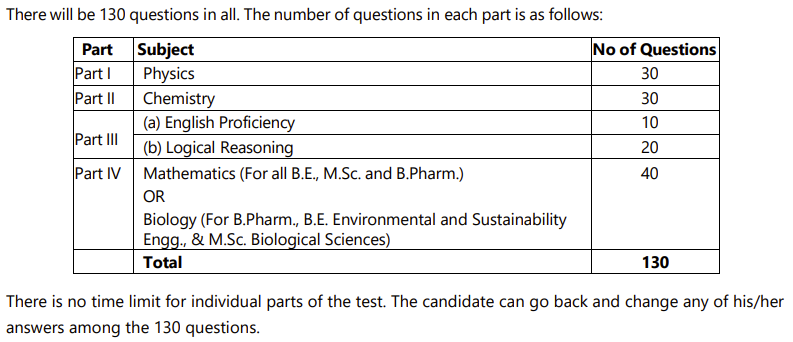
The BITSAT exam consists of a total of 130 questions: 30 from Physics, 30 from Chemistry, 40 from Mathematics/Biology, and 30 from English & Logical Reasoning
BITSAT Mathematics is rated hard by students, so prepare strategically from high-weightage topics, practice mixed numericals and have a proper understanding of formulas.
BITSAT 2027 Syllabus Highlights
The BITSAT Syllabus key highlights are tabulated below:
Particular | Details |
|---|---|
Conducting Body | BITS Pilani |
Mode of Exam | CBT |
BITSAT 2027 Syllabus | NCERT Class 11 and 12 |
BITSAT Syllabus Weightage |
|
Total Subjects |
|
Total Marks | 390 |
Also Check: BITSAT Paper Analysis: Check Subject-wise Exam Analysis, Difficulty Level, Question Paper
How to Download the BITSAT 2027 Syllabus
Step 1: Visit the official BITS Pilani admissions portal at bitsadmission.com.
Step 2: Click the BITSAT link on the homepage.
Step 3: Search for BITSAT Syllabus or “BITSAT Brochure”.
Step 4: Press Ctrl + S (Windows) or click the download option to save the BITSAT Syllabus PDF to your device.
BITSAT Syllabus 2027 Subject-wise Weightage
The BITSAT syllabus subject-wise weightage is tabulated below. Each correct answer fetches 3 marks, while each incorrect answer has a penalty of 1 mark. The time duration is 3 hours, comprising the following subjects.
Subjects | Questions | Marks |
|---|---|---|
Physics | 30 | 90 |
Chemistry | 30 | 90 |
Maths/ Biology | 40 | 120 |
English Proficiency +Logical Reasoning | 30 | 90 |
Source: admissions.bits-pilani.ac.in
BITSAT Physics Syllabus 2027
A detailed BITSAT 2027 Syllabus subject wise is discussed below, along with the topics covered in each unit. Check out below as per your stream.
BITSAT Syllabus for Physics includes both Class 11 and 12 NCERT.
It covers both theoretical and numerical-based questions.
Students should be clear on formulas, definitions, and problem-solving techniques.
Thermodynamics, Electrostatics & Current Electricity, Optics and Modern Physics are important for BITSAT 2027 Physics Syllabus.
BITSAT Exam Syllabus for Physics Topics | Sub Topics | Approx Weightage (%) |
|---|---|---|
Units & Measurement | Different systems of units, SI units and derived units, dimensional analysis, significant figures, Vernier callipers, screw gauge, physical balance | 2- 3 |
Kinematics | Properties of vectors, position, velocity, acceleration vectors, motion with constant acceleration, projectile motion, circular and relative motion | 3- 4 |
Newton’s Laws of Motion | Newton’s laws, free body diagrams, resolution of forces, motion on inclined planes, pulley systems, centripetal force, inertial and non-inertial frames | 3- 5 |
Impulse and Momentum | Impulse and momentum definitions, conservation of momentum, collisions, momentum of a system, centre of mass | 3- 4 |
Work and Energy | Work done by force, kinetic energy, work-energy theorem, power, conservative forces, potential energy, conservation of mechanical energy | 4 |
Rotational Motion | Angular displacement, velocity, acceleration, rotation with constant angular acceleration, moment of inertia, parallel and perpendicular axes theorems, torque, angular momentum, conservation laws, rolling motion | 4- 5 |
Gravitation | Newton’s law, gravitational potential energy, escape velocity, Kepler’s laws, satellite motion | 3 |
Mechanics of Solids and Fluids | Elasticity, pressure, density, Archimedes’ principle, viscosity, surface tension, Bernoulli’s theorem | 3- 5 |
Oscillations | SHM, spring-mass system, pendulums, forced and damped oscillations, resonance | 4- 5 |
Waves | Progressive waves, standing waves in strings and pipes, beats, superposition of waves, Doppler Effect | 4- 5 |
Heat and Thermodynamics | Kinetic theory of gases, thermal equilibrium, temperature, specific heat, conduction, convection and radiation, thermal conductivity, Newton’s law of cooling, first and second laws of thermodynamics, Carnot engine, efficiency and COP | 8- 10 |
Electrostatics | Coulomb’s law, electric fields (discrete and continuous), electrostatic potential and energy, Gauss’s law, electric dipole, capacitance and dielectrics, parallel plate capacitor, series and parallel capacitors | 4- 5 |
Current Electricity | Ohm’s law, Joule heating, DC circuits, resistors and cells, Kirchhoff’s laws, potentiometer, Wheatstone bridge, resistivity and its temperature dependence | 5- 6 |
Magnetic Effect of Current | Biot-Savart’s law, Ampere’s law, Lorentz force, force on conductors, magnetic moment, torque on current loops, galvanometer to voltmeter and ammeter conversion | 8- 10 |
Electromagnetic Induction | Faraday’s law, Lenz’s law, eddy currents, self and mutual inductance, transformers, generators, AC (peak and RMS values), LCR circuits | 2- 3 |
Optics | Laws of reflection and refraction, lenses and mirrors, optical instruments (telescope, microscope), interference (Huygen’s principle, Young’s double slit), thin film interference, diffraction (single slit), electromagnetic waves and spectrum (qualitative), polarisation | 4- 5 |
Modern Physics | Dual nature of light and matter, photoelectric effect, de Broglie wavelength, Rutherford’s model, Bohr’s model, hydrogen atom spectrum, radioactivity, nuclear fission and fusion, binding energy | 6- 8 |
Electronic Devices | Energy bands, conductors, insulators, semiconductors, diode, rectifier, LED, photodiode, solar cell, Zener diode, junction transistor, transistor as amplifier and oscillator, logic gates, transistor as a switch | 2- 4 |
Important Physics Topics for BITSAT 2027
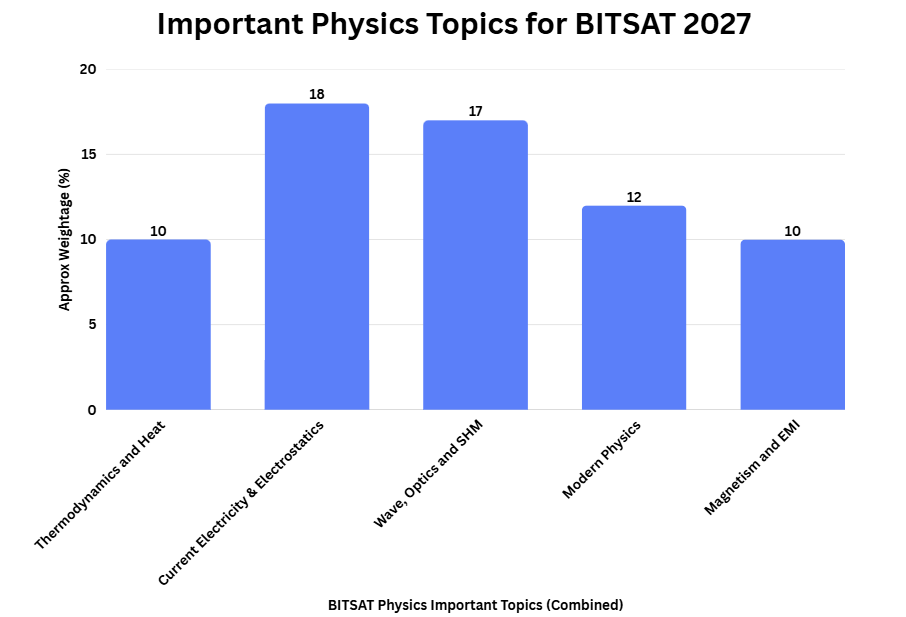
BITSAT 2027 important chapters from Physics along with weightage are tabulated below. As per expert analysis, these topics in Physics help you cover more than half of BITSAT Physics Syllabus 2027.
BITSAT Physics Important Topics (Combined) | Approx Weightage (%) |
|---|---|
Thermodynamics and Heat | 8- 10 |
Current Electricity & Electrostatics | 18 |
Wave, Optics and SHM | 13- 17 |
Modern Physics | 10- 12 |
Magnetism and EMI | 8- 10 |
BITSAT Chemistry Syllabus 2027
BITSAT exam Syllabus for Chemistry includes NCERT Class 11 and 12 Physical, Organic and Inorganic Chemistry.
Understand each topic well, as it tests how well you can apply the concepts in solving problems.
BITSAT Chemistry Syllabus covers theoretical concepts, equations, reactions, practical-based knowledge, and applications.
As per trends, your BITSAT 2027 Syllabus for Chemistry includes:
35- 40% Physical Chemistry
35% Organic Chemistry
32- 35% Inorganic Chemistry
BITSAT Exam Syllabus for Chemistry Topics | Sub Topics | Approx Number of Questions from each topic |
|---|---|---|
States of Matter | Laws of chemical combination, mole concept, states of matter, gas laws, ideal gas equation, liquefaction of gases, van der Waals equation, vapour pressure, surface tension, viscosity, solid-state classification, unit cell, density, crystal structures, defects, band theory | 1- 2 |
Atomic Structure | Subatomic particles, atomic models, hydrogen spectrum, Bohr's model, quantum numbers, orbitals, electronic configuration, periodic table trends | 1- 2 |
Periodicity and Bonding | Valence electrons, Ionic Bond, Types of elements: s, p, d, and f blocks, Molecular Structure, Covalent Bond: Valence Bond Theory, Dipole moments; Hydrogen Bond | 2- 4 |
Thermodynamics | Basic Concepts, First Law of Thermodynamics, Second Law of Thermodynamics, Third Law- Introduction | 2 |
Physical and Chemical Equilibria | Solutions and concentration units, Raoult’s law, colligative properties, equilibrium constant, Le Chatelier’s principle, acids and bases, solubility product, buffer, pH, ionic equilibria | 1 |
Electrochemistry | Redox reactions, electrochemical cells, electrode potentials, Nernst equation, batteries, electrolysis, Faraday’s laws, conductance, corrosion | 2- 3 |
Chemical Kinetics | Rate of reaction, order and molecularity, half-life, effect of temperature and concentration, collision theory, activation energy | 1- 2 |
Hydrogen and s-block elements | Properties and uses of hydrogen, heavy water, hydrogen peroxide, alkali and alkaline earth metals, important compounds like NaOH, CaCO₃, and their uses | 3- 6 |
p-, d-, and f-block elements | Properties of elements in groups 13-18, uses of compounds, preparation of industrial chemicals, transition metals, lanthanides and actinides, coordination compounds | |
Principles of Organic Chemistry and Hydrocarbons | Functional groups, types of reactions, alkanes, alkenes, alkynes, aromatic compounds, haloalkanes and haloarenes, reaction mechanisms | 3- 5 |
Stereochemistry | Isomerism, conformations of ethane, geometrical isomerism in alkenes | |
Organic Compounds with Functional Groups Containing Oxygen and Nitrogen | Alcohols, phenols, ethers, aldehydes, ketones, carboxylic acids, amines, diazonium salts, cyanides, reaction mechanisms, preparation and uses | 3 |
Biological, Industrial and Environmental Chemistry | Carbohydrates, proteins, vitamins, nucleic acids, hormones, polymers, pollution, green chemistry, chemistry in medicines and food | 1- 3 |
Theoretical Principles of Experimental Chemistry | Volumetric analysis, qualitative and quantitative analysis, purification methods, organic preparations, chromatography, basic lab techniques, physical chemistry experiments |
Important Chemistry Topics for BITSAT 2027
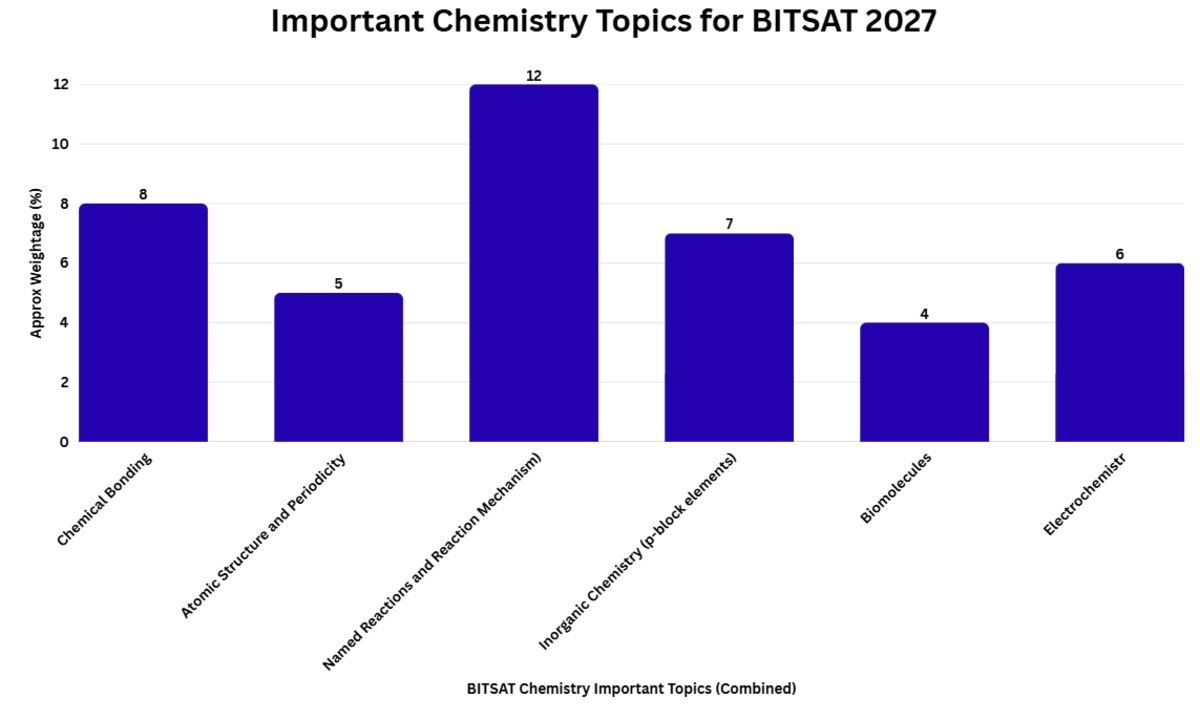
BITSAT 2027 important chapters for Chemistry along with weightage are tabulated below. Covering these topics in Chemistry is crucial to score maximum marks in BITSAT Chemistry section.
BITSAT Chemistry Important Topics (Combined) | Approx Weightage (%) |
|---|---|
Chemical Bonding | 8 |
Atomic Structure and Periodicity | 4- 5 |
Organic Chemistry (Named Reactions and Reaction Mechanism) | 12 |
Inorganic Chemistry (p-block elements) | 6- 7 |
Biomolecules | 3- 4 |
Electrochemistry | 5- 6 |
Related Links:
BITSAT Chemistry Syllabus: Check Important Topics, Chapter-Wise Weightage, PYQs, and Best Books
BITSAT Chemistry Sample Paper PDF: Direct Link, Solutions, and Its Importance
BITSAT PYQs for Chemistry in Everyday Life with Solutions: Practice BITSAT Previous Year Questions
BITSAT Chemistry Syllabus Easy Chapters: Check Easy Chapters Weightage and Chemistry Syllabus
Ques. Which chapters are most important in Physics for BITSAT?
BITSAT Maths Syllabus 2027
BITSAT syllabus for Maths includes major units such as Algebra, Trigonometry, Calculus, Geometry, and Probability.
You should prepare each topic well and understand all formulas and concepts clearly.
BITSAT Maths syllabus focuses on logical thinking, problem-solving, and application-based understanding.
BITSAT Exam Syllabus for Maths Topics | Key Topics | Approx Number of Questions per Topics |
|---|---|---|
Algebra | Complex numbers, quadratic equations, progressions, exponential series, logarithms, binomial theorem, permutations and combinations, sets, relations and functions, types of matrices, determinants, linear equations, mathematical induction, linear inequalities, mathematical reasoning | 10- 12 |
Trigonometry | Measurement of angles, trigonometric identities, equations, inverse trigonometric functions, graphs of trigonometric functions | 6- 8 |
Two-dimensional Coordinate Geometry | Cartesian coordinates, distance, section formula, straight lines, pair of lines, angle between lines, bisectors, circles, parametric form, parabola, ellipse, hyperbola | 4- 7 |
Three-dimensional Coordinate Geometry | Coordinate planes and axes, distance between points, direction ratios and cosines, equation of a line and plane, angle between lines and planes, shortest distance, coplanarity | 2- 3 |
Differential calculus | Domain and range, limits, continuity, differentiability, derivatives of different functions, chain rule, tangents and normals, increasing/decreasing functions, maxima and minima, Rolle’s and Mean Value Theorems | 6- 8 |
Integral calculus | Indefinite integrals, standard formulas, integration by parts, substitution, partial fractions, trigonometric identities, definite integrals and properties, area under curves | 6- 7 |
Ordinary Differential Equations | Order and degree, forming differential equations, solving first-order and first-degree equations | 1- 2 |
Probability | Basics of probability, addition and multiplication rules, conditional probability, Bayes' theorem, independent events, discrete random variables, mean and variance | 2- 3 |
Vectors | Direction ratios/cosines, vector addition, scalar multiplication, position vectors, dot and cross product, scalar triple product | 2- 3 |
Statistics | Measures of dispersion, frequency distribution, comparing variances | 1- 2 |
Linear Programming | Formulation of LPP, graphical method, feasible region and solution, optimal solutions | 1- 2 |
Mathematical modeling | Real-life problem solving using matrices, calculus, and linear programming | 1 |
Important Maths Topics for BITSAT 2027
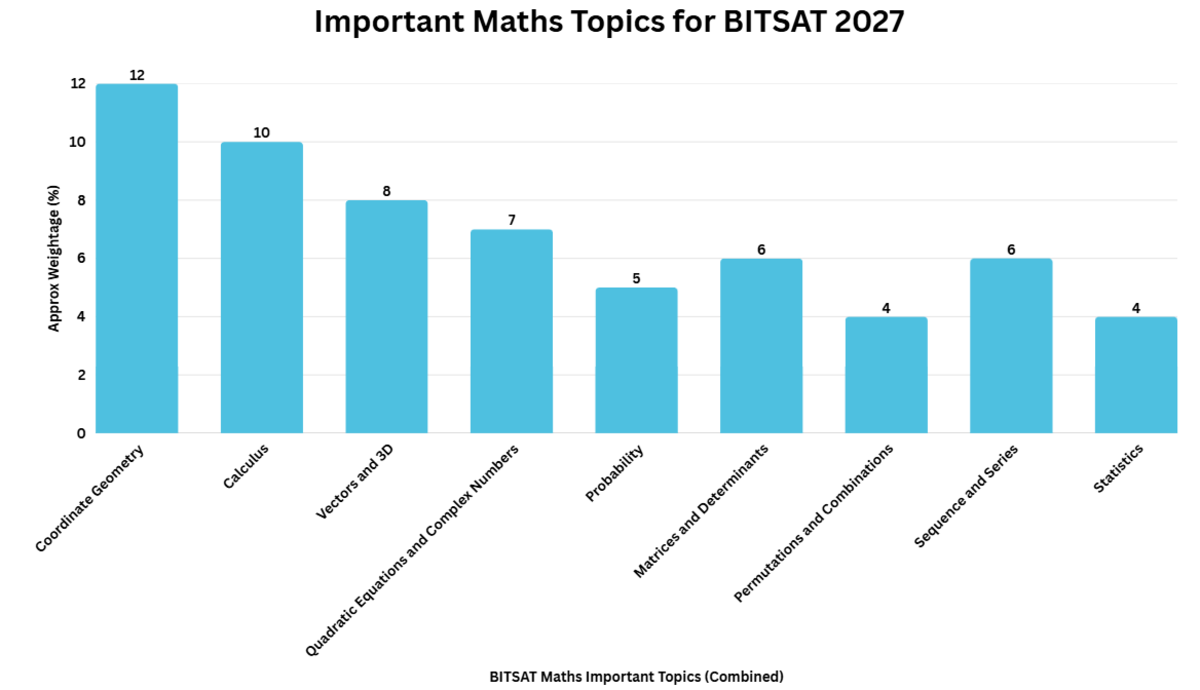
BITSAT 2027 important chapters for Maths along with weightages are tabulated below.
BITSAT Maths Important Topics (Combined) | Approx Weightage (%) |
|---|---|
Coordinate Geometry | 10- 12 |
Calculus | 8- 10 |
Vectors and 3D | 7- 8 |
Quadratic Equations and Complex Numbers | 6- 7 |
Probability | 4-5 |
Matrices and Determinants | 6 |
Permutations and Combinations | 3- 4 |
Sequence and Series | 5- 6 |
Statistics | 3- 4 |
Related Links:
BITSAT Maths 2027 Syllabus: Subject-Wise Topics, Chapter-Wise Weightage
BITSAT Mathematics Sample Paper 2026 PDF: Direct Link, Solutions, and Its Importance
BITSAT PYQs for Arithmetic Progression with Solutions: Practice BITSAT Previous Year Questions
Ques. Can I prepare for BITSAT using JEE Main preparation?
BITSAT Biology Syllabus 2027
Candidates opting for BPharm or MSc Biological Sciences must prepare Biology in place of Mathematics. The BITSAT Biology syllabus is based on NCERT.
According to trends, the paper difficulty is moderate.
BITSAT Biology focuses on core life science concepts, applied biological knowledge, and real-world biological applications.
Cell Structure, Genetics, Biotechnology and Physiology are core Biology concepts in the BITSAT 2027 syllabus.
BITSAT Exam Syllabus for Biology Topics | Key Topics |
|---|---|
Diversity in Living World | Meaning and relevance to mankind, Introductory classification of living organisms, Plant and Animal kingdom |
Cell: The Unit of Life; Structure and Function | Cell wall, Cell membrane, Endomembrane system, Centrosome and Centriole, Nucleus, Microbodies, Structural differences between prokaryotic and eukaryotic, Biomolecules and Enzymes |
Genetics and Evolution | Mendelian inheritance, Chromosome theory of inheritance, Inheritance patterns of haemophilia and blood groups in humans, DNA, Gene expression and regulation and Theories and evidence of evolution |
Structure and Function- Plants | Morphology of a flowering plant, Absorption and movement of water, Mineral nutrition, Photosynthesis, Respiration |
Structure and Function - Animals | Human Physiology, Body fluids and circulation, Excretion system, Locomotion and movement, Control and co-ordination |
Reproduction, Growth and Movement in Plants | Asexual and Sexual methods of reproduction, types of growth regulators and their role in seed dormancy, germination and movement, Apical dominance |
Reproduction and Development in Humans | Male and female reproductive systems, Gamete production, Fertilisation; |
Ecology and Environment | Meaning of ecology, environment, habitat and niche, Ecological levels of organization, Energy flow, Biodiversity and Environmental Issues |
Biology and Human Welfare | Animal husbandry, Cancer, AIDS, Basic concepts of immunology, Plant Breeding and Tissue Culture in crop improvement. |
Biotechnology and its Applications | Microbial technology in food processing, industrial production, Steps in recombinant DNA technology, Applications of R-DNA technology in human health, Applications in Industry and Agriculture |
BITSAT 2027 Important Chapters from Biology
Cell Biology, Plant and Animal Kingdom, Human Physiology, Genetics & Molecular Basis, Biotechnology, Plant Physiology and Ecology are important Biology topics for BITSAT 2027. Users on Reddit claim that BITSAT Biology is directly NCERT-based and less time-consuming. Around 60- 70% is straight-up NCERT lines, definitions, and examples.
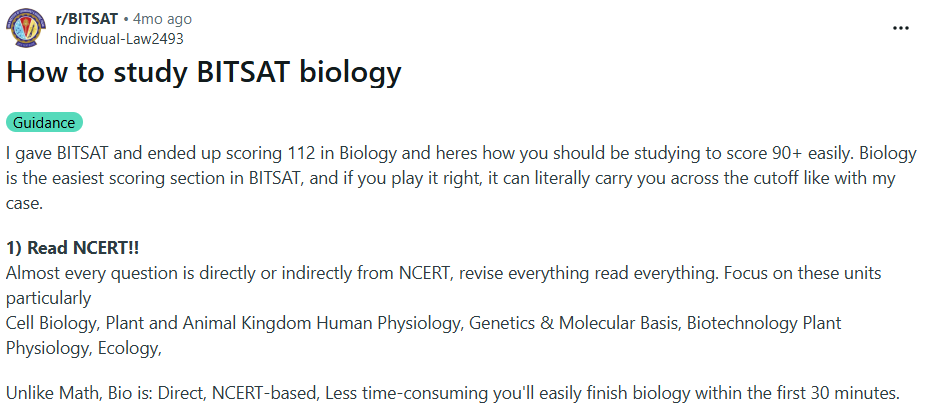
Source: Reddit
Related Links:
Ques. Is the Class 12 syllabus enough for BITSAT?
BITSAT English Syllabus
BITSAT English Syllabus is divided into two parts, which include English Proficiency and Logical Reasoning. Unlike Physics and Chemistry, the BITSAT English syllabus does not require deep knowledge. It is the easiest and fastest section to complete.
Check out the BITSAT English Syllabus below.
BITSAT English Proficiency Syllabus 2027
A total of 10 questions are asked from English Proficiency in BITSAT English.
BITSAT English Proficiency Syllabus Topics | Key Topics |
|---|---|
Determiners, Prepositions, Modals, Adjectives, Relative Pronouns, Agreement, Time and Tense, Parallel Construction, Voice, Transformation, Question Tags, Relative Clauses | |
Odd Word, One Word, Spelling & Word Formation, Definitions, Academic Vocabulary, Connotation, Synonyms, Antonyms, Collocations, Phrasal Verbs & Idioms | |
Reading Comprehension | Content/Ideas, Vocabulary, Summary, Referents and Reorganisation of Information |
Composition | Rearrangement, Paragraph & Unity and Linkers/Connectives |
BITSAT Logical Reasoning Syllabus 2027
A total of 20 questions are asked from Logical Reasoning in BITSAT English 2027.
BITSAT Logical Reasoning Syllabus Topics | Key Topics |
|---|---|
Analogy, Classification, Series Completion, Logical Deduction and Chart Logic | |
Non- Verbal Reasoning | Pattern Perception, Figure Formation and Analysis, Paper Cutting, Figure Matrix, Rule Detection |
Watch the YouTube video by “ Harshal BITS Pilani” regarding the BITSAT Syllabus 2027 subject wise topics to score 300+ marks in your Exam. The video describes a complete list of chapters for each section.
Related Links:
Best Books for BITSAT 2027
The best study resources for BITSAT 2027 are tabulated below:
Subject | Book | Author/ Publication |
|---|---|---|
Physics | NCERT Physics Book Class 11 and 12 | - |
Concepts of Physics- Vol. 1 and Vol. 2 | H.C. Verma | |
Understanding Physics Series | D.C. Pandey (Arihant) | |
Chemistry | NCERT Chemistry Book Class 11 and 12 | - |
Advanced Problems in Organic Chemistry | Himanshu Pandey | |
Advanced Problems in Physical Chemistry | Dr P Bahadur | |
Maths | NCERT Maths Book Class 11 and 12 | - |
BITSAT Prep Guide | Arihant | |
Objective Mathematics | RD Sharma | |
Biology | NCERT Biology Book Class 11 and 12 | - |
Objective Biology | R K Gupta | |
English | High School English Grammar and Composition | Wren and Martin |
Verbal and Non-Verbal Reasoning | RS Aggarwal |
Related Article: BITSAT Important Books: Check Subject-wise Books, Preparation Resources, Best Books, Mock Papers & PYQs
BITSAT 2027 Syllabus Preparation Tips
The BITSAT Syllabus preparation tips 2027 are listed below:
BITSAT Syllabus: Physics Preparation Tips
Complete NCERT Class 11 and 12 Physics fully before picking up any reference book
Prioritise high-weightage chapters such as Current Electricity, Electrostatics, Heat & Thermodynamics, and Modern Physics.
Prepare a one-page formula sheet per chapter and revise it daily.
After completing the syllabus, practice PYQs and mock tests to increase your time management skills ana analyze them for accuracy.
BITSAT Syllabus: Chemistry Preparation Tips
Complete NCERT Class 11 and 12 Chemistry fully.
Focus on important units: Chemical Bonding, Chemical Kinetics, Coordination Compounds, Block Elements, and Organic Reactions first.
Memorise named reactions and practise Electrochemistry and Equilibrium numericals every week.
Many users on Reddit claim that reading the NCERT book 2- 3 times a week helps you score well, as questions are direct.
BITSAT Syllabus: Maths Preparation Tips
Focus on high-weightage topics like Calculus, Coordinate Geometry, Algebra, Probability, and 3D Vectors.
Prepare a separate notebook for formulas for quick revision
Focus on practising numericals daily under timed conditions to increase your speed, which matters in BITSAT.
Solve full-length, chapter-wise mocks per week and analyze it to increase your accuracy.
BITSAT Syllabus: Biology Preparation Tips
Start your preparation with your NCERT book only, as questions are direct NCERT-based.
Memorise the definitions line by line; practice diagrams and labelling.
Solve chapter-wise mocks weekly to increase your speed.