
Eduspray
HomeExamsNTSE 2026Paper Analysis
NTSE 2026
Entrance Exam

NTSE 2026

National Council of Educational Research and Training (NCERT)

NTSE (National Talent Search Examination) was NCERT’s national scholarship exam for Class 10 students, held in two stages with MAT and SAT papers. The scheme was approved till 31 March 2021 and has been stalled since; the last Stage 2 exam was held on 24 October 2021. No NTSE 2026 notification has been issued by NCERT.

NTSENTSE 2026NTSE StatusNational Talent Search ExamNCERT ScholarshipNTSE Exam PatternNTSE SyllabusNTSE Scholarship

Last updated: 16 Oct 2026

Exam Pattern

Full page
Exam Pattern

NTSE status (checked 15 October 2026): NCERT has not conducted the National Talent Search Examination since the 2021 cycle. Its notice states that the National Talent Search Scheme was approved till 31 March 2021, and that further implementation of the scheme in its present form has not been approved and has been stalled till further orders. No NTSE 2026 notification has been issued. The details on this page come from NCERT's last official NTSE information brochure and are given for reference only.

Key Takeaways

  • NTSE had two papers: MAT and SAT.

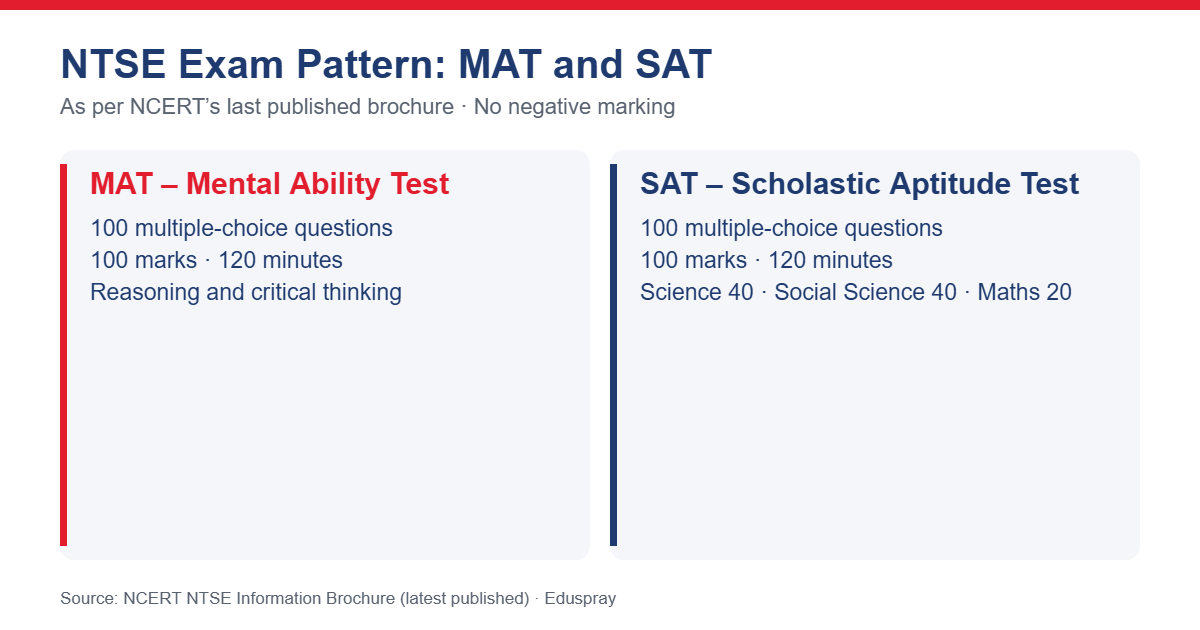
  • Each paper had 100 multiple-choice questions, 100 marks and 120 minutes.

  • There was no negative marking (removed in 2018).

  • Answers were marked on an OMR sheet.

NTSE Exam Pattern

NTSE tested two broad abilities: reasoning (through the Mental Ability Test) and subject knowledge at Class IX–X level (through the Scholastic Aptitude Test). The same two-paper format was followed in both stages, although States/UTs set their own Stage 1 papers.

NTSE exam pattern: MAT 100 questions and SAT 100 questions, 120 minutes each

NTSE Exam Pattern: Overview

Paper

Questions

Marks

Duration

Stage 2 timing

Mental Ability Test (MAT)

100

100

120 minutes

9:30 am – 11:30 am

Scholastic Aptitude Test (SAT)

100 (Science 40, Social Science 40, Maths 20)

100

120 minutes

1:30 pm – 3:30 pm

Key Features

  • Question type: Multiple-choice questions with four options.

  • Marking: 1 mark for each correct answer.

  • Negative marking: None (abolished in 2018, as per NCERT).

  • Answer sheet: OMR sheet.

  • Visually challenged candidates: Separate timetable with extra time for SAT.

Medium of the Exam (Stage 2)

Stage 2 papers were available in Asamiya, Bangla, English, Gujarati, Hindi, Kannada, Marathi, Malayalam, Odia, Punjabi, Tamil, Telugu and Urdu. The medium chosen on the application form could not be changed later. Stage 1 languages were decided by each State/UT.

Explore the Paper in Detail

Pro Tip: With 100 questions in 120 minutes, you get about 72 seconds per question. Practise full papers against the clock.

Source: NCERT NTSE Information Brochure (latest published edition).

Official Website

For authentic NTSE information, refer only to official NCERT resources:

Students should not pay any fee or share personal details on unofficial websites claiming to conduct NTSE.

Eduspray guidance for school students and scholarship exams

Need Help Choosing the Right Scholarship or Olympiad?

Eduspray India helps students and parents find active scholarship exams, plan preparation and choose the right stream after Class 10. Explore scholarships, browse entrance exams or take the psychometric test.
NTSE Exam PatternNTSE MATNTSE SAT

Syllabus

Full page

NTSE status (checked 15 October 2026): NCERT has not conducted the National Talent Search Examination since the 2021 cycle. Its notice states that the National Talent Search Scheme was approved till 31 March 2021, and that further implementation of the scheme in its present form has not been approved and has been stalled till further orders. No NTSE 2026 notification has been issued. The details on this page come from NCERT's last official NTSE information brochure and are given for reference only.

Key Takeaways

  • There was no fixed NTSE syllabus; questions matched the Class IX–X level.

  • MAT tested reasoning and critical thinking.

  • SAT covered Science, Social Science and Mathematics.

NTSE Syllabus

Unlike most entrance exams, NTSE had no officially prescribed syllabus. NCERT's brochure states that the standard of questions would conform to the level of Classes IX and X. This makes NCERT Class IX–X textbooks the best foundation for preparation.

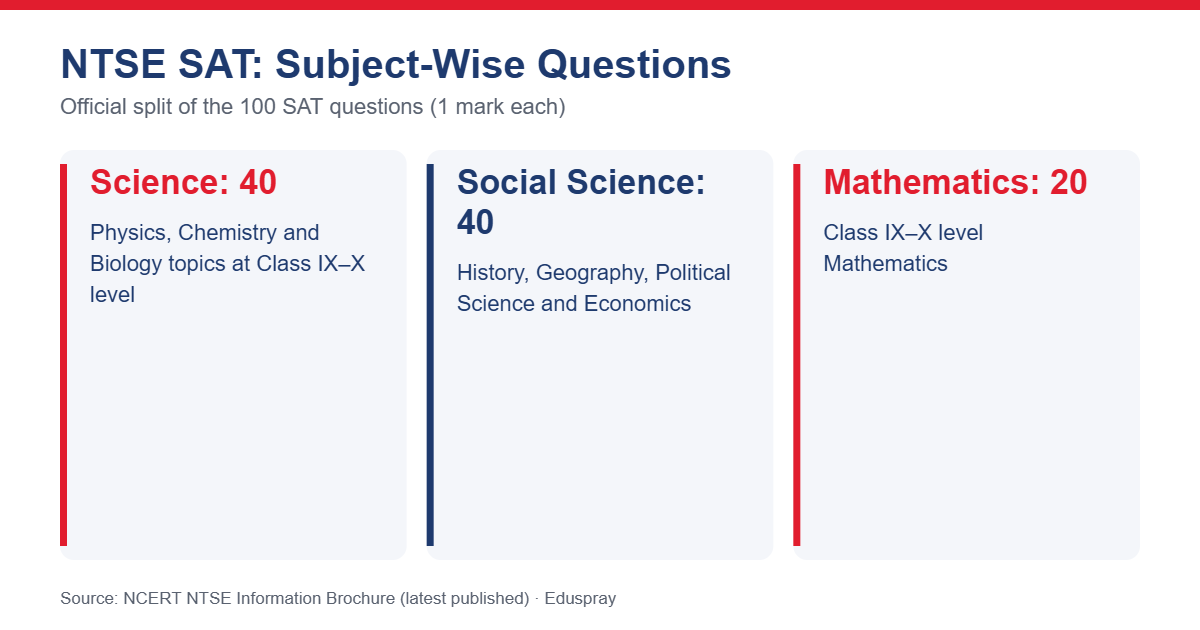
NTSE SAT subject-wise questions: Science 40, Social Science 40, Mathematics 20

NTSE Syllabus: Section-Wise Overview

Paper

Areas

Questions

MAT

Verbal and non-verbal reasoning, analysis, synthesis and critical thinking

100

SAT – Science

Physics, Chemistry and Biology

40

SAT – Social Science

History, Geography, Political Science and Economics

40

SAT – Mathematics

Class IX–X Mathematics

20

Subject-wise Syllabus Pages

Note: NCERT did not prescribe a fixed NTSE syllabus. Its brochure states that questions conform to the level of Classes IX and X. The topics below follow NCERT Class IX–X textbooks, which have been rationalised in recent years, so use the latest textbooks for study.

Pro Tip: Read NCERT textbooks line by line first. Most SAT questions test clear concepts, not obscure facts.

Source: NCERT NTSE Information Brochure (latest published edition).

Official Website

For authentic NTSE information, refer only to official NCERT resources:

Students should not pay any fee or share personal details on unofficial websites claiming to conduct NTSE.

Eduspray guidance for school students and scholarship exams

Need Help Choosing the Right Scholarship or Olympiad?

Eduspray India helps students and parents find active scholarship exams, plan preparation and choose the right stream after Class 10. Explore scholarships, browse entrance exams or take the psychometric test.
NTSE SyllabusNTSE MAT SyllabusNTSE SAT Syllabus

Chemistry Syllabus

Full page

NTSE status (checked 15 October 2026): NCERT has not conducted the National Talent Search Examination since the 2021 cycle. Its notice states that the National Talent Search Scheme was approved till 31 March 2021, and that further implementation of the scheme in its present form has not been approved and has been stalled till further orders. No NTSE 2026 notification has been issued. The details on this page come from NCERT's last official NTSE information brochure and are given for reference only.

Key Takeaways

  • Chemistry questions come under the 40 SAT Science questions.

  • Questions match the Class IX–X level.

  • Reactions, acids and bases, and carbon compounds are core areas.

NTSE Chemistry Syllabus

Chemistry is part of the Science section of the SAT paper. NCERT did not publish a separate Chemistry weightage, so study all Class IX–X chemistry chapters thoroughly.

Note: NCERT did not prescribe a fixed NTSE syllabus. Its brochure states that questions conform to the level of Classes IX and X. The topics below follow NCERT Class IX–X textbooks, which have been rationalised in recent years, so use the latest textbooks for study.

Class IX Chemistry Topics (NCERT Science)

Topic

Key ideas

Matter in Our Surroundings

States of matter, change of state, evaporation

Is Matter Around Us Pure?

Mixtures, solutions, separation techniques

Atoms and Molecules

Laws of chemical combination, mole concept, formulae

Structure of the Atom

Atomic models, electron distribution, valency, isotopes

Class X Chemistry Topics (NCERT Science)

Topic

Key ideas

Chemical Reactions and Equations

Balancing equations, types of reactions, oxidation and reduction

Acids, Bases and Salts

pH scale, indicators, common salts and their uses

Metals and Non-metals

Properties, reactivity series, extraction, corrosion

Carbon and its Compounds

Covalent bonding, homologous series, functional groups

Related: Physics Syllabus · Biology Syllabus

Pro Tip: Make a one-page chart of common reactions and their products. Quick revision of this chart helps a lot in MCQs.

Source: NCERT NTSE Information Brochure (latest published edition).

Official Website

For authentic NTSE information, refer only to official NCERT resources:

Students should not pay any fee or share personal details on unofficial websites claiming to conduct NTSE.

Eduspray guidance for school students and scholarship exams

Need Help Choosing the Right Scholarship or Olympiad?

Eduspray India helps students and parents find active scholarship exams, plan preparation and choose the right stream after Class 10. Explore scholarships, browse entrance exams or take the psychometric test.

NTSE Chemistry SyllabusNTSE Science

Maths Syllabus

Full page

NTSE status (checked 15 October 2026): NCERT has not conducted the National Talent Search Examination since the 2021 cycle. Its notice states that the National Talent Search Scheme was approved till 31 March 2021, and that further implementation of the scheme in its present form has not been approved and has been stalled till further orders. No NTSE 2026 notification has been issued. The details on this page come from NCERT's last official NTSE information brochure and are given for reference only.

Key Takeaways

  • Mathematics had 20 of the 100 SAT questions.

  • Questions match the Class IX–X level.

  • Algebra, geometry and mensuration are core areas.

NTSE Maths Syllabus

Mathematics carried 20 questions in the SAT paper. Although it is the smallest section, maths questions often take more time, so accuracy and speed both matter.

Note: NCERT did not prescribe a fixed NTSE syllabus. Its brochure states that questions conform to the level of Classes IX and X. The topics below follow NCERT Class IX–X textbooks, which have been rationalised in recent years, so use the latest textbooks for study.

Class IX Maths Topics (NCERT)

Area

Topics

Algebra

Number systems, polynomials, linear equations in two variables

Geometry

Lines and angles, triangles, quadrilaterals, circles

Coordinate Geometry

Cartesian plane, plotting points

Mensuration

Heron's formula, surface areas and volumes

Statistics

Data representation

Class X Maths Topics (NCERT)

Area

Topics

Number systems and algebra

Real numbers, polynomials, pair of linear equations, quadratic equations, arithmetic progressions

Geometry

Triangles (similarity), circles

Coordinate Geometry

Distance and section formulae

Trigonometry

Trigonometric ratios, identities, heights and distances

Mensuration

Areas related to circles, surface areas and volumes

Statistics and Probability

Mean, median, mode; basic probability

Related: SAT Pattern · Subject-Wise Weightage

Pro Tip: Learn key formulae for areas, volumes and trigonometric ratios by heart. It saves valuable time in a 120-minute paper.

Source: NCERT NTSE Information Brochure (latest published edition).

Official Website

For authentic NTSE information, refer only to official NCERT resources:

Students should not pay any fee or share personal details on unofficial websites claiming to conduct NTSE.

Eduspray guidance for school students and scholarship exams

Need Help Choosing the Right Scholarship or Olympiad?

Eduspray India helps students and parents find active scholarship exams, plan preparation and choose the right stream after Class 10. Explore scholarships, browse entrance exams or take the psychometric test.

NTSE Maths SyllabusNTSE Mathematics

MAT Pattern

Full page

NTSE status (checked 15 October 2026): NCERT has not conducted the National Talent Search Examination since the 2021 cycle. Its notice states that the National Talent Search Scheme was approved till 31 March 2021, and that further implementation of the scheme in its present form has not been approved and has been stalled till further orders. No NTSE 2026 notification has been issued. The details on this page come from NCERT's last official NTSE information brochure and are given for reference only.

Key Takeaways

  • MAT: 100 questions, 100 marks, 120 minutes.

  • Four-option multiple-choice questions, 1 mark each, no negative marking.

  • Tests reasoning and critical thinking, not school chapters.

NTSE MAT Pattern

The Mental Ability Test (MAT) measured a student's ability to reason, analyse, see patterns and think critically. It did not depend on any school subject, so regular practice made a big difference.

Feature

MAT (last published brochure)

Number of questions

100

Total marks

100

Duration

120 minutes (Stage 2: 9:30 am – 11:30 am)

Question type

Multiple choice, four options

Negative marking

None

Qualifying marks

40% (General/OBC), 32% (SC/ST/PwD)

NTSE exam pattern: MAT 100 questions and SAT 100 questions, 120 minutes each

Question Types Commonly Seen in MAT

NCERT's sample MAT paper and previous papers included questions such as:

  • Number and letter series

  • Analogies and classification (odd one out)

  • Coding–decoding

  • Blood relations and direction sense

  • Figure series, mirror and water images, embedded figures

  • Venn diagrams and pattern completion

See the MAT Syllabus for a topic list and Previous Year Papers for official samples.

How to Approach MAT

  • Start with question types you are fastest at.

  • Skip and return to time-consuming puzzles.

  • Because there is no negative marking, attempt every question before time runs out.

Pro Tip: Practise 20–25 reasoning questions daily with a timer. Speed in MAT comes from recognising patterns quickly.

Source: NCERT NTSE Information Brochure (latest published edition).

Official Website

For authentic NTSE information, refer only to official NCERT resources:

Students should not pay any fee or share personal details on unofficial websites claiming to conduct NTSE.

Eduspray guidance for school students and scholarship exams

Need Help Choosing the Right Scholarship or Olympiad?

Eduspray India helps students and parents find active scholarship exams, plan preparation and choose the right stream after Class 10. Explore scholarships, browse entrance exams or take the psychometric test.

NTSE MAT PatternMental Ability Test

SAT Pattern

Full page

NTSE status (checked 15 October 2026): NCERT has not conducted the National Talent Search Examination since the 2021 cycle. Its notice states that the National Talent Search Scheme was approved till 31 March 2021, and that further implementation of the scheme in its present form has not been approved and has been stalled till further orders. No NTSE 2026 notification has been issued. The details on this page come from NCERT's last official NTSE information brochure and are given for reference only.

Key Takeaways

  • SAT: 100 questions — Science 40, Social Science 40, Mathematics 20.

  • 100 marks and 120 minutes.

  • Questions conform to the Class IX–X level.

NTSE SAT Pattern

The Scholastic Aptitude Test (SAT) checked a student's understanding of school subjects at the Class IX–X level. It carried equal weight to MAT in the final merit.

NTSE SAT subject-wise questions: Science 40, Social Science 40, Mathematics 20

Subject

Questions

Marks

Science (Physics, Chemistry, Biology)

40

40

Social Science (History, Geography, Political Science, Economics)

40

40

Mathematics

20

20

Total

100

100

Key Features

  • Duration: 120 minutes (Stage 2: 1:30 pm – 3:30 pm).

  • Four-option multiple-choice questions, 1 mark each.

  • No negative marking.

  • Qualifying marks: 40% (General/OBC), 32% (SC/ST/PwD).

Subject Syllabus Pages

Pro Tip: Social Science carries as many questions as Science. Many students under-prepare it, so steady revision here can lift your SAT score.

Source: NCERT NTSE Information Brochure (latest published edition).

Official Website

For authentic NTSE information, refer only to official NCERT resources:

Students should not pay any fee or share personal details on unofficial websites claiming to conduct NTSE.

Eduspray guidance for school students and scholarship exams

Need Help Choosing the Right Scholarship or Olympiad?

Eduspray India helps students and parents find active scholarship exams, plan preparation and choose the right stream after Class 10. Explore scholarships, browse entrance exams or take the psychometric test.

NTSE SAT PatternScholastic Aptitude Test

Stage 1 and Stage 2 Pattern

Full page
Stage 1 and Stage 2 Pattern

NTSE status (checked 15 October 2026): NCERT has not conducted the National Talent Search Examination since the 2021 cycle. Its notice states that the National Talent Search Scheme was approved till 31 March 2021, and that further implementation of the scheme in its present form has not been approved and has been stalled till further orders. No NTSE 2026 notification has been issued. The details on this page come from NCERT's last official NTSE information brochure and are given for reference only.

Key Takeaways

  • Both stages used the MAT and SAT format.

  • States/UTs set the Stage 1 papers; NCERT set Stage 2.

  • Final merit used Stage 2 marks only.

NTSE Stage 1 and Stage 2 Pattern

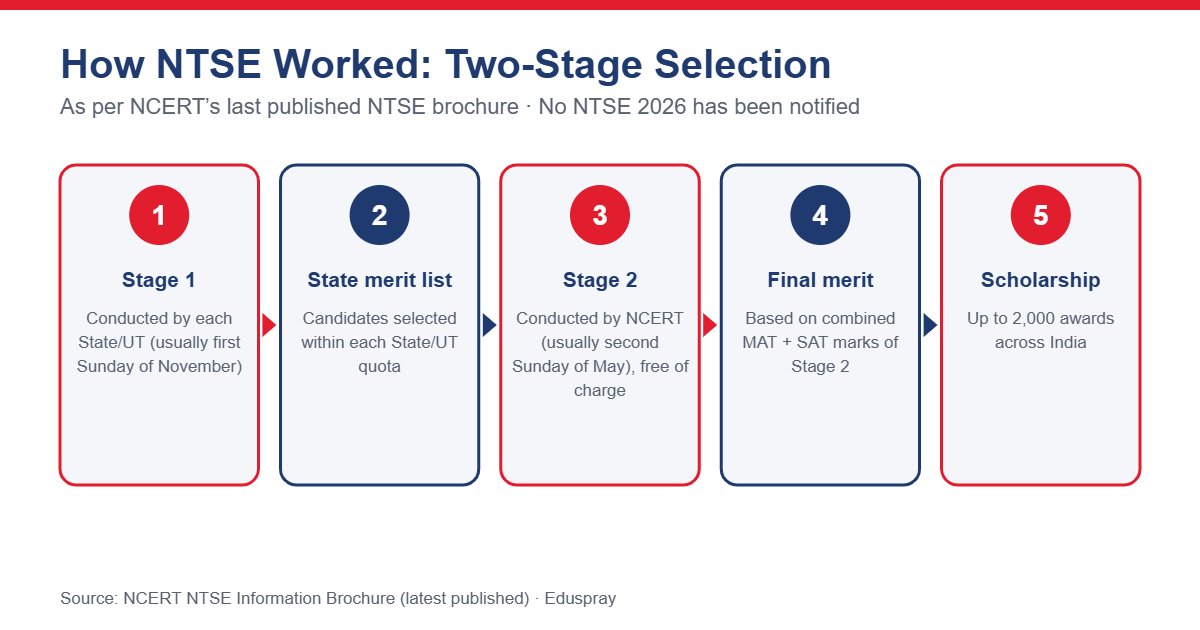
NTSE was a two-level exam. Stage 1 screened students within each State/UT, and Stage 2 selected national scholarship winners.

How NTSE worked: Stage 1 by states, state merit list, Stage 2 by NCERT, final merit and scholarship

Stage 1 vs Stage 2

Feature

Stage 1

Stage 2

Conducted by

State/UT

NCERT

Usual date

First Sunday of November

Second Sunday of May

Papers

MAT and SAT (as set by the State/UT)

MAT (100) and SAT (100)

Fee

As set by the State/UT

No fee

Medium

As decided by the State/UT

13 languages, including English and Hindi

Result

State merit list within quota

National merit list for scholarships

Who Could Skip Stage 1?

Class X students studying abroad, with at least 60% in the previous annual exam, were exempt from Stage 1 and appeared directly in Stage 2.

Read more: State Quota and Stage 1 Selection.

Pro Tip: Stage 1 papers can vary between states. Practise your own State/UT's previous papers for Stage 1, and NCERT papers for Stage 2.

Source: NCERT NTSE Information Brochure (latest published edition).

Official Website

For authentic NTSE information, refer only to official NCERT resources:

Students should not pay any fee or share personal details on unofficial websites claiming to conduct NTSE.

Eduspray guidance for school students and scholarship exams

Need Help Choosing the Right Scholarship or Olympiad?

Eduspray India helps students and parents find active scholarship exams, plan preparation and choose the right stream after Class 10. Explore scholarships, browse entrance exams or take the psychometric test.

NTSE Stage 1 PatternNTSE Stage 2 Pattern

Social Science Syllabus

Full page

NTSE status (checked 15 October 2026): NCERT has not conducted the National Talent Search Examination since the 2021 cycle. Its notice states that the National Talent Search Scheme was approved till 31 March 2021, and that further implementation of the scheme in its present form has not been approved and has been stalled till further orders. No NTSE 2026 notification has been issued. The details on this page come from NCERT's last official NTSE information brochure and are given for reference only.

Key Takeaways

  • Social Science had 40 of the 100 SAT questions — as many as Science.

  • It covers History, Geography, Political Science and Economics.

  • Questions match the Class IX–X level.

NTSE Social Science Syllabus

Social Science carried 40 questions in the SAT paper. It rewards steady reading of NCERT textbooks and careful revision of facts, maps and concepts.

Note: NCERT did not prescribe a fixed NTSE syllabus. Its brochure states that questions conform to the level of Classes IX and X. The topics below follow NCERT Class IX–X textbooks, which have been rationalised in recent years, so use the latest textbooks for study.

History

  • Class IX: The French Revolution, Socialism in Europe and the Russian Revolution, Nazism and the rise of Hitler, forest society and colonialism, pastoralists

  • Class X: Rise of nationalism in Europe, nationalism in India, the making of a global world, the age of industrialisation, print culture

Geography

  • Class IX: India – size and location, physical features, drainage, climate, natural vegetation and wildlife, population

  • Class X: Resources and development, forest and wildlife, water resources, agriculture, minerals and energy, manufacturing industries, lifelines of the economy

Political Science

  • Class IX: What is democracy, constitutional design, electoral politics, working of institutions, democratic rights

  • Class X: Power sharing, federalism, gender, religion and caste, political parties, outcomes of democracy

Economics

  • Class IX: The story of village Palampur, people as resource, poverty, food security

  • Class X: Development, sectors of the Indian economy, money and credit, globalisation, consumer rights

Some chapters listed above were removed or shortened in NCERT's rationalised textbooks. Follow the latest edition.

Pro Tip: Use a blank map of India to revise rivers, mountains, crops and minerals. Map-based facts are easy to forget without practice.

Source: NCERT NTSE Information Brochure (latest published edition).

Official Website

For authentic NTSE information, refer only to official NCERT resources:

Students should not pay any fee or share personal details on unofficial websites claiming to conduct NTSE.

Eduspray guidance for school students and scholarship exams

Need Help Choosing the Right Scholarship or Olympiad?

Eduspray India helps students and parents find active scholarship exams, plan preparation and choose the right stream after Class 10. Explore scholarships, browse entrance exams or take the psychometric test.

NTSE Social Science SyllabusNTSE SST

Biology Syllabus

Full page

NTSE status (checked 15 October 2026): NCERT has not conducted the National Talent Search Examination since the 2021 cycle. Its notice states that the National Talent Search Scheme was approved till 31 March 2021, and that further implementation of the scheme in its present form has not been approved and has been stalled till further orders. No NTSE 2026 notification has been issued. The details on this page come from NCERT's last official NTSE information brochure and are given for reference only.

Key Takeaways

  • Biology questions come under the 40 SAT Science questions.

  • Questions match the Class IX–X level.

  • Diagrams and life processes are important areas.

NTSE Biology Syllabus

Biology is the third part of the SAT Science section, along with Physics and Chemistry. NCERT did not publish a separate Biology weightage.

Note: NCERT did not prescribe a fixed NTSE syllabus. Its brochure states that questions conform to the level of Classes IX and X. The topics below follow NCERT Class IX–X textbooks, which have been rationalised in recent years, so use the latest textbooks for study.

Class IX Biology Topics (NCERT Science)

Topic

Key ideas

The Fundamental Unit of Life

Cell structure, organelles, plant and animal cells

Tissues

Plant and animal tissues and their functions

Improvement in Food Resources

Crop production, animal husbandry

Class X Biology Topics (NCERT Science)

Topic

Key ideas

Life Processes

Nutrition, respiration, transportation, excretion

Control and Coordination

Nervous system, hormones in animals and plants

How do Organisms Reproduce?

Asexual and sexual reproduction, reproductive health

Heredity

Mendel's experiments, inheritance of traits, sex determination

Our Environment

Ecosystems, food chains, ozone layer, waste management

Related: Physics Syllabus · Chemistry Syllabus

Pro Tip: Practise labelling diagrams such as the human heart, digestive system and plant cell. Diagram-based questions are quick marks if you know them well.

Source: NCERT NTSE Information Brochure (latest published edition).

Official Website

For authentic NTSE information, refer only to official NCERT resources:

Students should not pay any fee or share personal details on unofficial websites claiming to conduct NTSE.

Eduspray guidance for school students and scholarship exams

Need Help Choosing the Right Scholarship or Olympiad?

Eduspray India helps students and parents find active scholarship exams, plan preparation and choose the right stream after Class 10. Explore scholarships, browse entrance exams or take the psychometric test.

NTSE Biology SyllabusNTSE Science

MAT Syllabus

Full page

NTSE status (checked 15 October 2026): NCERT has not conducted the National Talent Search Examination since the 2021 cycle. Its notice states that the National Talent Search Scheme was approved till 31 March 2021, and that further implementation of the scheme in its present form has not been approved and has been stalled till further orders. No NTSE 2026 notification has been issued. The details on this page come from NCERT's last official NTSE information brochure and are given for reference only.

Key Takeaways

  • MAT had no prescribed syllabus.

  • It tested reasoning, analysis, visualisation and critical thinking.

  • Regular timed practice matters more than theory.

NTSE MAT Syllabus

NCERT did not publish a chapter-wise MAT syllabus. MAT questions assessed general reasoning ability. The topics below are commonly seen in NCERT's sample paper and previous papers, and are useful for practice.

Verbal Reasoning Topics

  • Number, letter and alphanumeric series

  • Analogies

  • Classification (odd one out)

  • Coding–decoding

  • Blood relations

  • Direction sense

  • Ranking and arrangement

  • Logical Venn diagrams

Non-verbal Reasoning Topics

  • Figure series and analogies

  • Mirror and water images

  • Embedded and hidden figures

  • Paper folding and cutting

  • Pattern completion

  • Counting figures

MAT Topic Summary

Skill

What it checks

Pattern recognition

Series, analogies and figure patterns

Logical thinking

Coding, relations, directions and arrangements

Visualisation

Mirror images, paper folding and embedded figures

Pro Tip: Maintain an error notebook. Note the trick behind every reasoning question you get wrong, and revise it weekly.

Source: NCERT NTSE Information Brochure (latest published edition).

Official Website

For authentic NTSE information, refer only to official NCERT resources:

Students should not pay any fee or share personal details on unofficial websites claiming to conduct NTSE.

Eduspray guidance for school students and scholarship exams

Need Help Choosing the Right Scholarship or Olympiad?

Eduspray India helps students and parents find active scholarship exams, plan preparation and choose the right stream after Class 10. Explore scholarships, browse entrance exams or take the psychometric test.

NTSE MAT SyllabusNTSE Reasoning

Marking Scheme and Qualifying Marks

Full page
Marking Scheme and Qualifying Marks

NTSE status (checked 15 October 2026): NCERT has not conducted the National Talent Search Examination since the 2021 cycle. Its notice states that the National Talent Search Scheme was approved till 31 March 2021, and that further implementation of the scheme in its present form has not been approved and has been stalled till further orders. No NTSE 2026 notification has been issued. The details on this page come from NCERT's last official NTSE information brochure and are given for reference only.

Key Takeaways

  • 1 mark per correct answer; no negative marking.

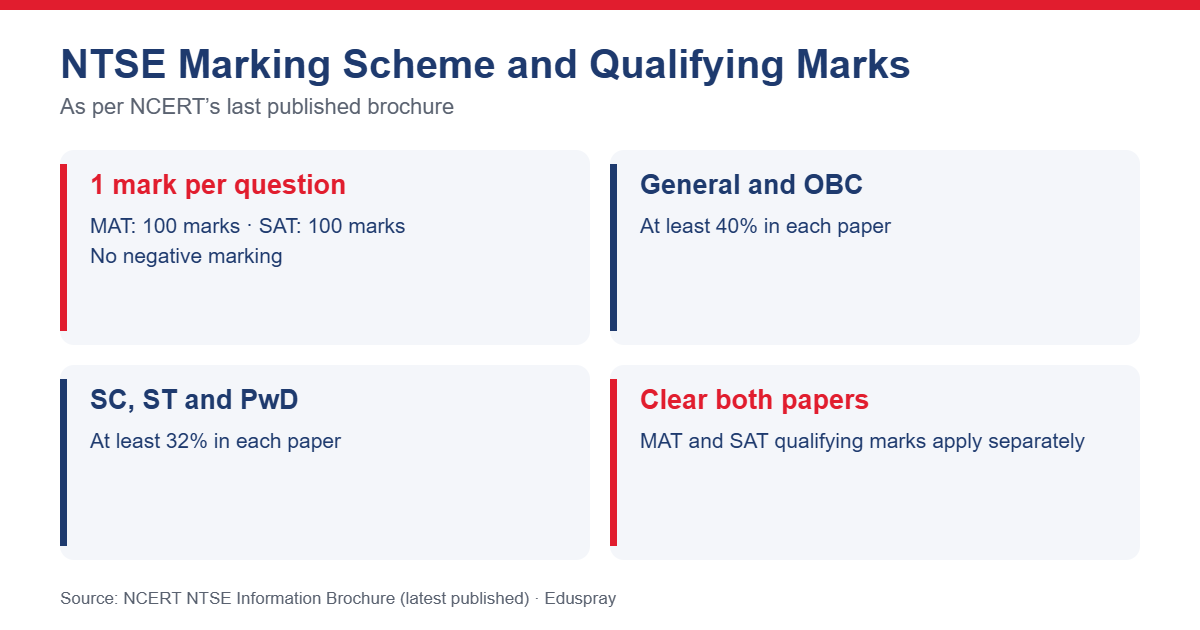
  • Qualifying marks: 40% (General/OBC) and 32% (SC/ST/PwD) in each paper.

  • Both papers had to be cleared separately.

NTSE Marking Scheme

NTSE used a simple marking scheme. Each correct answer earned one mark, and there was no penalty for wrong answers after NCERT removed negative marking in 2018.

NTSE marking scheme and qualifying marks: 40 percent General and OBC, 32 percent SC ST PwD in each paper

Paper

Questions

Marks per question

Total

Negative marking

MAT

100

1

100

No

SAT

100

1

100

No

NTSE Qualifying Marks

Category

Minimum in MAT

Minimum in SAT

General and OBC

40%

40%

SC, ST and PwD

32%

32%

Note: the eligibility and selection sections of NCERT’s brochure state 32% for SC, ST and PwD candidates, while its introduction mentions that this minimum was raised to 35% in 2015. Any revived scheme will confirm the current figure.

Candidates had to clear the qualifying marks in each paper. Clearing only one paper was not enough to enter the merit list.

Qualifying Marks vs Cutoff

Qualifying marks were only the minimum. Actual selection depended on state quotas in Stage 1 and the national merit list in Stage 2. See NTSE Cutoff.

Pro Tip: Because there is no negative marking, never leave a question blank. Use elimination to make your best guess.

Source: NCERT NTSE Information Brochure (latest published edition).

Official Website

For authentic NTSE information, refer only to official NCERT resources:

Students should not pay any fee or share personal details on unofficial websites claiming to conduct NTSE.

Eduspray guidance for school students and scholarship exams

Need Help Choosing the Right Scholarship or Olympiad?

Eduspray India helps students and parents find active scholarship exams, plan preparation and choose the right stream after Class 10. Explore scholarships, browse entrance exams or take the psychometric test.

NTSE Marking SchemeNTSE Qualifying Marks

Subject-Wise Weightage

Full page
Subject-Wise Weightage

NTSE status (checked 15 October 2026): NCERT has not conducted the National Talent Search Examination since the 2021 cycle. Its notice states that the National Talent Search Scheme was approved till 31 March 2021, and that further implementation of the scheme in its present form has not been approved and has been stalled till further orders. No NTSE 2026 notification has been issued. The details on this page come from NCERT's last official NTSE information brochure and are given for reference only.

Key Takeaways

  • Official SAT split: Science 40, Social Science 40, Mathematics 20.

  • MAT and SAT carried equal weight (100 marks each).

  • NCERT did not publish chapter-wise weightage.

NTSE Subject-Wise Weightage

The only official weightage for NTSE is at the paper and subject level. NCERT never released chapter-wise weightage, so any chapter-wise figures you see online are estimates from coaching institutes, not official data.

NTSE SAT subject-wise questions: Science 40, Social Science 40, Mathematics 20

Official Weightage

Paper / subject

Questions

Share of total 200 marks

MAT

100

50%

SAT – Science

40

20%

SAT – Social Science

40

20%

SAT – Mathematics

20

10%

Total

200

100%

What This Means for Preparation

  • MAT is half the total. Reasoning practice deserves as much time as all SAT subjects together.

  • Science and Social Science are equal. Do not neglect Social Science.

  • Mathematics is the smallest share but can be time-consuming, so build speed.

Related: NTSE Exam Pattern · NTSE Syllabus

Pro Tip: Plan your weekly study time roughly in line with this weightage: about half on reasoning, and the rest shared across Science, Social Science and Maths.

Source: NCERT NTSE Information Brochure (latest published edition).

Official Website

For authentic NTSE information, refer only to official NCERT resources:

Students should not pay any fee or share personal details on unofficial websites claiming to conduct NTSE.

Eduspray guidance for school students and scholarship exams

Need Help Choosing the Right Scholarship or Olympiad?

Eduspray India helps students and parents find active scholarship exams, plan preparation and choose the right stream after Class 10. Explore scholarships, browse entrance exams or take the psychometric test.

NTSE WeightageNTSE Subject Wise Marks

Previous Year Papers and Scoring Keys

Full page

NTSE status (checked 15 October 2026): NCERT has not conducted the National Talent Search Examination since the 2021 cycle. Its notice states that the National Talent Search Scheme was approved till 31 March 2021, and that further implementation of the scheme in its present form has not been approved and has been stalled till further orders. No NTSE 2026 notification has been issued. The details on this page come from NCERT's last official NTSE information brochure and are given for reference only.

Key Takeaways

  • NCERT published sample MAT and SAT papers and a sample OMR sheet.

  • Official 2021 scoring keys are still available on NCERT's NTSE page.

  • Old papers are useful practice for other aptitude and scholarship exams too.

NTSE Previous Year Papers and Scoring Keys

Practising official papers is the best way to understand NTSE. NCERT's NTSE page still lists sample papers and scoring keys from the last exam cycle.

Official NCERT Resources

Resource

Link

Sample Mental Ability Test (MAT)

MAT sample (PDF)

Sample Scholastic Aptitude Test (SAT)

SAT sample (PDF)

Sample OMR sheet

OMR sheet (PDF)

MAT scoring key (2021)

Download

SAT scoring key (2021)

Download

Final scoring key, Stage 2

Download

How to Practise With Previous Papers

  1. Print the paper and an OMR sheet.

  2. Set a 120-minute timer for each paper.

  3. Mark answers on the OMR sheet, just as in the real exam.

  4. Score yourself with the official key: 1 mark per correct answer.

  5. Note weak topics and revise them before the next paper.

Stage 1 Papers

Stage 1 papers were set by States/UTs. Check your State Council of Educational Research and Training (SCERT) website for any officially released papers.

Pro Tip: Solve each paper twice: once timed, and once untimed to understand every solution. The second round is where most learning happens.

Official Website

For authentic NTSE information, refer only to official NCERT resources:

Students should not pay any fee or share personal details on unofficial websites claiming to conduct NTSE.

Eduspray guidance for school students and scholarship exams

Need Help Choosing the Right Scholarship or Olympiad?

Eduspray India helps students and parents find active scholarship exams, plan preparation and choose the right stream after Class 10. Explore scholarships, browse entrance exams or take the psychometric test.

NTSE Previous Year PapersNTSE Sample Paper

Physics Syllabus

Full page

NTSE status (checked 15 October 2026): NCERT has not conducted the National Talent Search Examination since the 2021 cycle. Its notice states that the National Talent Search Scheme was approved till 31 March 2021, and that further implementation of the scheme in its present form has not been approved and has been stalled till further orders. No NTSE 2026 notification has been issued. The details on this page come from NCERT's last official NTSE information brochure and are given for reference only.

Key Takeaways

  • Physics questions come under the 40 SAT Science questions.

  • Questions match the Class IX–X level.

  • Focus on concepts, numericals and diagrams from NCERT books.

NTSE Physics Syllabus

Physics is part of the Science section of the SAT paper, which had 40 questions in total across Physics, Chemistry and Biology. NCERT did not publish a separate Physics weightage.

Note: NCERT did not prescribe a fixed NTSE syllabus. Its brochure states that questions conform to the level of Classes IX and X. The topics below follow NCERT Class IX–X textbooks, which have been rationalised in recent years, so use the latest textbooks for study.

Class IX Physics Topics (NCERT Science)

Topic

Key ideas

Motion

Distance, displacement, speed, velocity, acceleration, graphs

Force and Laws of Motion

Newton's laws, inertia, momentum

Gravitation

Universal law of gravitation, free fall, mass and weight, buoyancy

Work and Energy

Work, kinetic and potential energy, power

Sound

Propagation, characteristics of sound, reflection, echo

Class X Physics Topics (NCERT Science)

Topic

Key ideas

Light – Reflection and Refraction

Mirrors, lenses, mirror and lens formulae, refractive index

The Human Eye and the Colourful World

Defects of vision, dispersion, scattering of light

Electricity

Ohm's law, resistance, series and parallel circuits, heating effect

Magnetic Effects of Electric Current

Magnetic field, force on a conductor, domestic circuits

Related: Chemistry Syllabus · Biology Syllabus · SAT Pattern

Pro Tip: Draw ray diagrams and circuit diagrams by hand while revising. Many questions test whether you can visualise them quickly.

Source: NCERT NTSE Information Brochure (latest published edition).

Official Website

For authentic NTSE information, refer only to official NCERT resources:

Students should not pay any fee or share personal details on unofficial websites claiming to conduct NTSE.

Eduspray guidance for school students and scholarship exams

Need Help Choosing the Right Scholarship or Olympiad?

Eduspray India helps students and parents find active scholarship exams, plan preparation and choose the right stream after Class 10. Explore scholarships, browse entrance exams or take the psychometric test.

NTSE Physics SyllabusNTSE Science