
Eduspray
HomeExamsCSIR NETAccepting Colleges and Courses
CSIR NET
Entrance Exam

CSIR NET

National Testing Agency (NTA) for CSIR

Joint CSIR-UGC NET December 2026 by NTA decides JRF fellowships, Assistant Professor eligibility and PhD admission in five science subjects. Check dates, eligibility, age limit, pattern, syllabus, fees, cutoffs and results.

CSIR NETCSIR NET December 2026Joint CSIR UGC NETCSIR NET JRFCSIR NET Life SciencesNTA CSIR NET

Last updated: 16 Oct 2026

HomeExamsCSIR NETAccepting Colleges and Courses

Accepting Colleges and Courses

Updated 16 Oct 20263 topics

CSIR NET Subjects and Career Options

Full page

CSIR NET is offered in five science subjects. Your choice should match your postgraduate specialisation and the research area you want to pursue. Here is what each subject covers and where it can lead.

The Five CSIR NET Subjects

Code

Subject

Typical background

Research areas

701

Chemical Sciences

M.Sc. Chemistry and allied areas

Inorganic, organic, physical, analytical, materials, medicinal and green chemistry

702

Earth, Atmospheric, Ocean and Planetary Sciences

M.Sc. Geology, Geophysics, Meteorology, Oceanography, Geography and allied areas

Geology, geophysics, climate and atmospheric science, ocean science, planetary science

703

Life Sciences and Bio-Technology

M.Sc. Life Sciences, Biotechnology, Botany, Zoology, Microbiology, Biochemistry and allied areas

Molecular and cell biology, genetics, immunology, plant and animal sciences, ecology, biotechnology, bioinformatics

704

Mathematical Sciences

M.Sc. Mathematics, Statistics and allied areas

Pure and applied mathematics, statistics, operations research

705

Physical Sciences

M.Sc. Physics and allied areas

Condensed matter, nuclear and particle, atomic and molecular, theoretical and applied physics

Career Paths After CSIR NET

Path

How CSIR NET helps

PhD with fellowship (JRF)

JRF holders receive ₹37,000 per month for two years and may move to SRF at ₹42,000 per month, plus a ₹20,000 annual contingency grant

Assistant Professor

Category 1 and 2 qualifiers are eligible for appointment as Assistant Professor in Indian universities and colleges, subject to the recruiting body’s rules

PhD admission without fellowship

Category 2 and 3 scores can replace university entrance tests for PhD admission

Research at national laboratories

Fellowships can be held at CSIR laboratories and other recognised research establishments

Industry R&D

Fellowships can also be held at R&D establishments of recognised public or private sector industrial firms

Which Subject Should You Choose?

  • Pick the subject of your Master’s degree unless your research goal is clearly in another area.

  • Four-year bachelor’s degree holders may choose the subject in which they want to do a PhD, irrespective of their undergraduate discipline.

  • Look at subject-wise cutoffs and competition: Life Sciences has the largest pool, Earth Sciences the smallest.

Key Takeaways

  • Five subjects: Chemical, Earth, Life Sciences & Biotech, Mathematical and Physical Sciences.

  • Outcomes: funded PhD, Assistant Professor eligibility, PhD admission.

  • Fellowships can be held in universities, IITs, CSIR labs and recognised industrial R&D units.

Pro Tip: Before choosing your subject, shortlist 5–10 research groups you would like to join and check which NET subject their past students qualified in.

Source: Joint CSIR-UGC NET December 2026 Information Bulletin (Sections 1.5–1.8, Annexure II), NTA / CSIR

Frequently Asked Questions

How many subjects are there in CSIR NET?

Five: Chemical Sciences; Earth, Atmospheric, Ocean and Planetary Sciences; Life Sciences and Bio-Technology; Mathematical Sciences; and Physical Sciences.

What can I do after qualifying CSIR NET?

Pursue a funded PhD as JRF, become eligible for Assistant Professor posts, or use the score for PhD admission.

Can a 4-year degree holder choose any CSIR NET subject?

Yes. They may choose the subject in which they want to pursue a PhD, irrespective of their undergraduate discipline.
CSIR NET subjectscareer after CSIR NET

Where You Can Use CSIR NET

Full page

A CSIR NET qualification is not tied to one college — it is a national eligibility that you carry to the institution of your choice. Here is where and how it can be used, as described in the official bulletin.

Where JRF Fellowships Can Be Held

As per the December 2026 Information Bulletin, Joint CSIR-UGC NET fellowships are accepted in:

  • Universities

  • Indian Institutes of Technology (IITs)

  • Postgraduate colleges

  • Government research establishments, including those of the CSIR

  • Research and development establishments of recognised public or private sector industrial firms

  • Other recognised institutions

Fellowships are tenable only in India, and the award is for a fixed tenure — it does not guarantee later employment with CSIR or UGC.

How Institutions Use CSIR NET

Use

What the rules say

PhD admission for JRF holders

Admitted to PhD through an interview, as per the UGC (Minimum Standards and Procedures for Award of Ph.D. Degree) Regulations, 2022

PhD admission for Category 2 and 3

NET can be used as the entrance test in place of tests run by universities / HEIs; 70% weight to NET marks and 30% to the interview

Assistant Professor recruitment

NET (Category 1 or 2) is the eligibility; selection is done by the recruiting university or college

Research projects

JRF holders can also join suitable research schemes, governed by CSIR, UGC or project terms

Before You Apply to an Institute

  • Check the institute’s PhD admission notice — many publish separate calls for “NET-JRF qualified” candidates.

  • Confirm whether the institute accepts your NET subject for the PhD programme you want.

  • Keep your e-certificate / award letter ready — most institutes ask for it at the application stage.

  • Note that NET marks for PhD admission (Categories 2 and 3) are valid for one year.

Key Takeaways

  • JRF can be held at universities, IITs, PG colleges, CSIR and other government labs, and recognised industrial R&D units.

  • JRF holders are admitted to PhD through an interview.

  • Category 2 and 3 scores can replace university PhD entrance tests.

Pro Tip: Apply to several institutes in parallel. PhD admission calls for NET-qualified candidates open at different times through the year.

Source: Joint CSIR-UGC NET December 2026 Information Bulletin (Sections 1.5 and 1.7), NTA / CSIR

Frequently Asked Questions

Where can a CSIR NET JRF be held?

In universities, IITs, postgraduate colleges, government research establishments including CSIR labs, R&D units of recognised industrial firms and other recognised institutions.

Can I use the CSIR JRF abroad?

No. The fellowships are tenable only in India.

Does CSIR NET guarantee a job?

No. The fellowship is for a fixed tenure and does not guarantee employment with CSIR or UGC.

CSIR NET institutesCSIR NET PhD admission

CSIR NET JRF Fellowship and Stipend

Full page

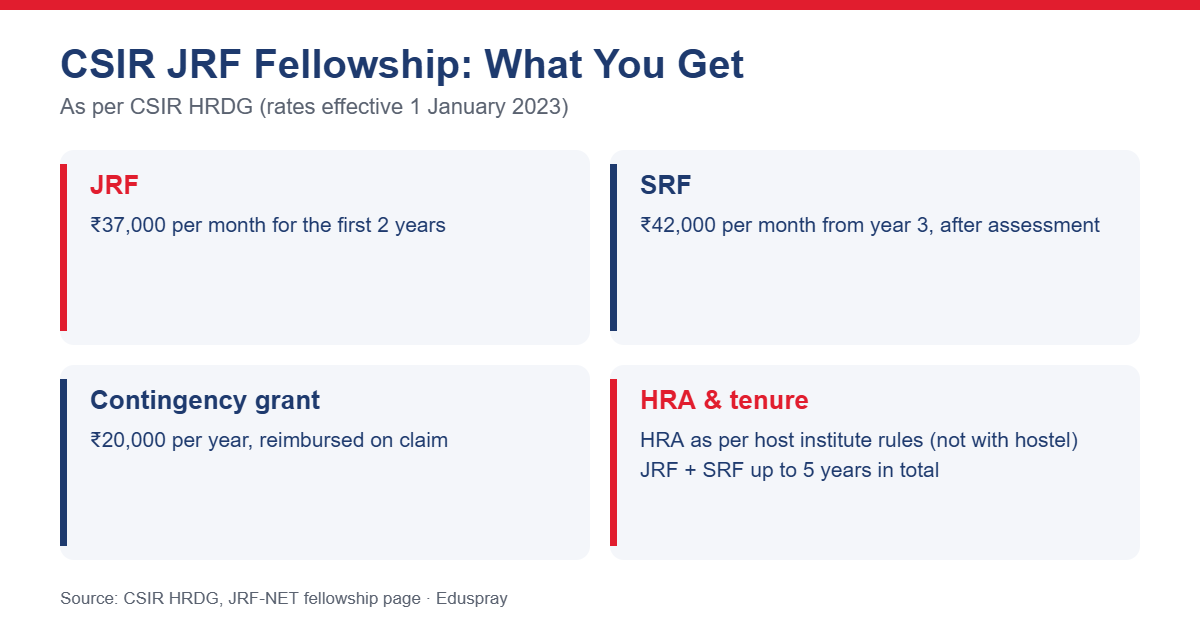
The Junior Research Fellowship (JRF) is the biggest reward of CSIR NET. It funds your PhD research for up to five years. The amounts below are from the December 2026 Information Bulletin and the CSIR HRDG fellowship page.

CSIR JRF and SRF fellowship amounts and contingency grant

CSIR NET JRF and SRF Fellowship Amounts

Component

Amount

Details

JRF stipend

₹37,000 per month

For the first two years

SRF (NET) stipend

₹42,000 per month

From the 3rd year onwards, after a successful assessment and PhD registration

Contingency grant

₹20,000 per year

Reimbursed directly to the fellow

House Rent Allowance (HRA)

As per host institute rules

Capped at Central Government rates; not paid to fellows staying in a hostel

Total tenure

Up to 5 years

JRF + SRF combined

How JRF Is Upgraded to SRF

After two years as JRF, if the fellow is registered for a PhD, the fellowship can be upgraded to SRF (NET). The upgrade is based on an assessment of the fellow’s research progress through an interview by an Expert Committee — usually the guide, the Head of the Department and an external expert not below the rank of Associate Professor. If the committee does not recommend the upgrade, or the fellow is not registered for a PhD, the fellow may continue as JRF at ₹37,000 per month for the third year, or the fellowship may be terminated as per the committee’s recommendation and CSIR’s decision.

Other National Fellowships Through CSIR NET

Candidates aiming for the National Fellowship for OBC (NFOBC), National Fellowship for SC (NFSC) and National Fellowship for Persons with Disabilities (NFPwD/NFPwBD) must also apply for Joint CSIR-UGC NET. Their results are declared by the respective nodal agencies, as per the bulletin.

Important Points

  • The number of fellowships in each subject is limited and may vary from cycle to cycle.

  • The fellowship is governed by the terms and conditions of CSIR, UGC or the research scheme, as applicable.

  • The award does not guarantee future employment with CSIR or UGC.

Key Takeaways

  • JRF: ₹37,000 per month for 2 years; SRF: ₹42,000 per month after assessment.

  • Contingency grant: ₹20,000 per year.

  • HRA as per host institute rules (not for hostel residents).

  • JRF + SRF tenure: up to 5 years in total.

Pro Tip: Join a host institute quickly after receiving your award letter — a CSIR JRF award is valid for two years and is not extendable.

Source: Joint CSIR-UGC NET December 2026 Information Bulletin (Sections 1.8–1.9), NTA / CSIR; CSIR HRDG JRF-NET fellowship page

Frequently Asked Questions

What is the JRF stipend after CSIR NET?

₹37,000 per month for the first two years.

What is the SRF amount?

₹42,000 per month from the third year, after a successful assessment and PhD registration.

Is HRA given with the CSIR JRF?

Yes, as per the host institute’s rules (capped at Central Government rates), but not to fellows living in a hostel.

CSIR JRF stipendCSIR SRF fellowship