Syllabus
Full pageThe CAT Syllabus 2026 is divided into VARC, DILR, and QA with 68 questions in total. Based on previous year CAT question papers and the CAT 2025 syllabus, the CAT RC section is 67% of VARC, while Arithmetic and Algebra together consist of 72% of QA.
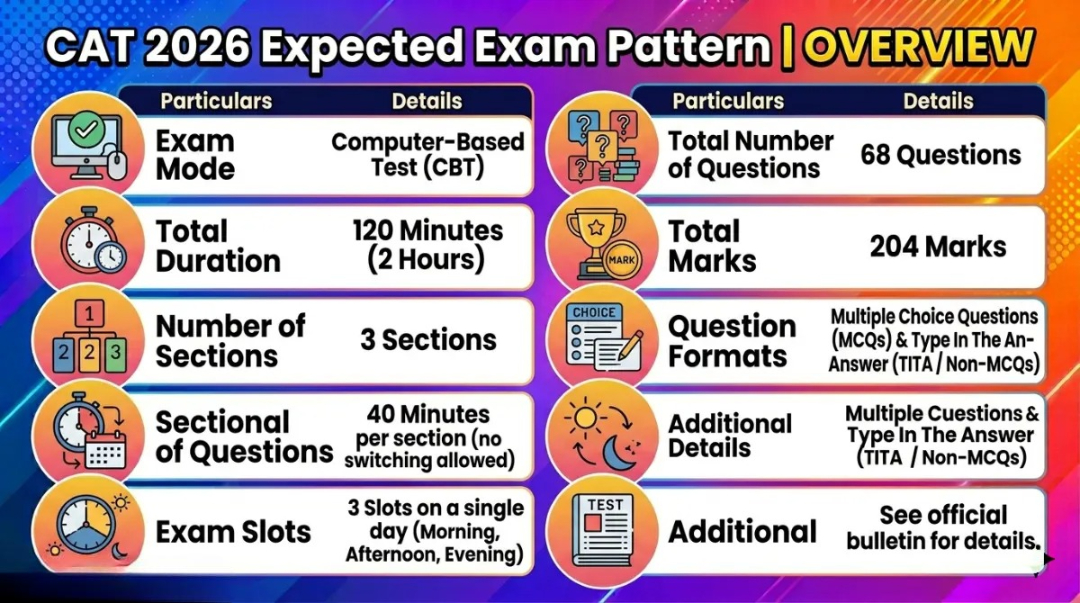
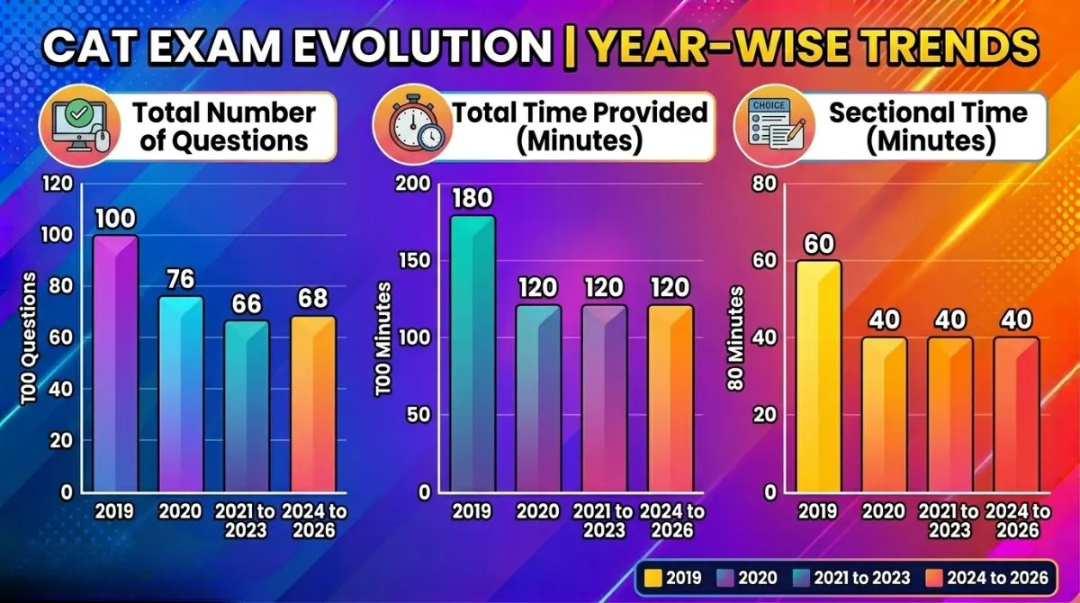
As mentioned in the CAT 2026 notification, the CAT 2026 exam will follow the same format as CAT 2025. It will have 68 questions and a 120-minute duration. Each section will have a 40-minute time limit.
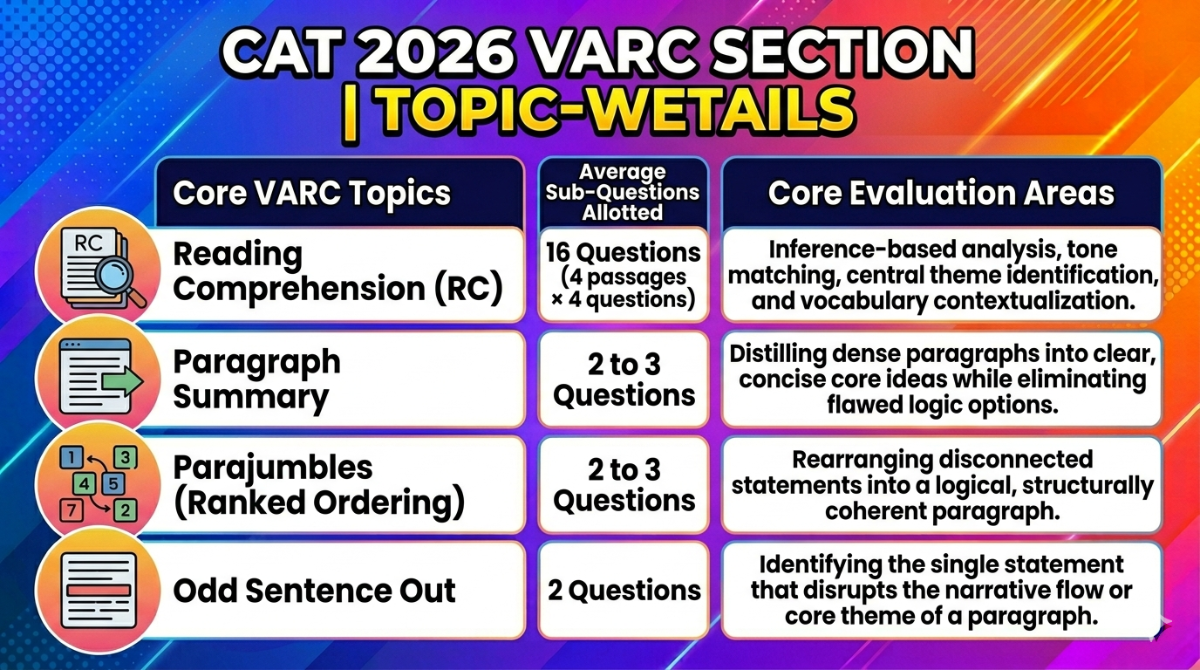
Candidates will get 24 questions in VARC, including 16 Reading Comprehension and 8 Verbal Ability questions.
The CAT VARC section comprises topics like Reading Comprehension, Para Jumbles, Para Summary, Odd One Out and Para Completion.
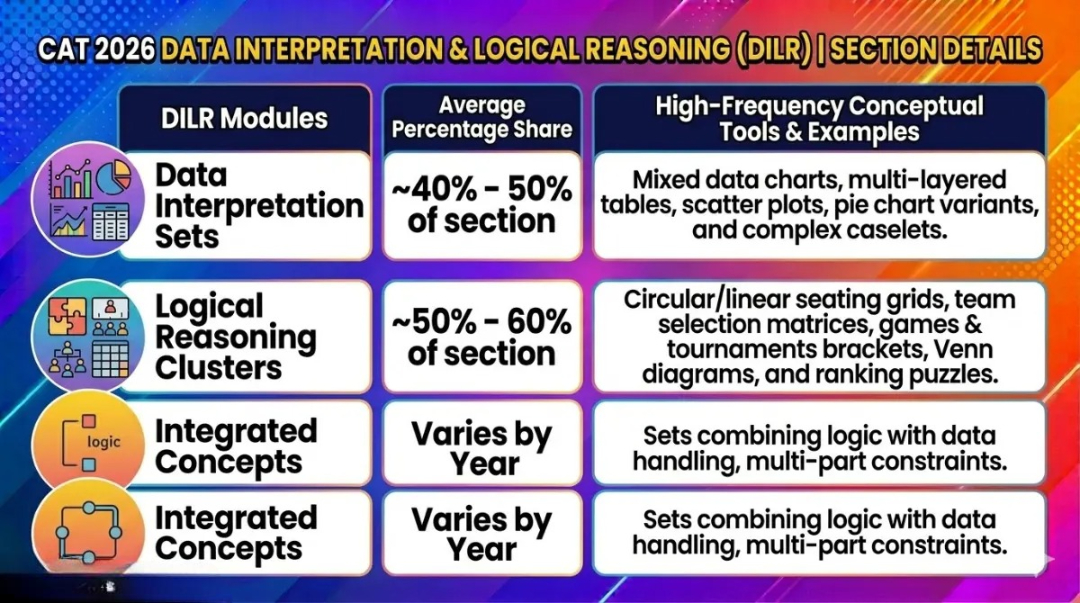
For the DILR section, candidates will get 22 questions. Based on 2021–2025 CAT exam trends, DILR is divided into around 55% Logical Reasoning and 45% Data Interpretation.
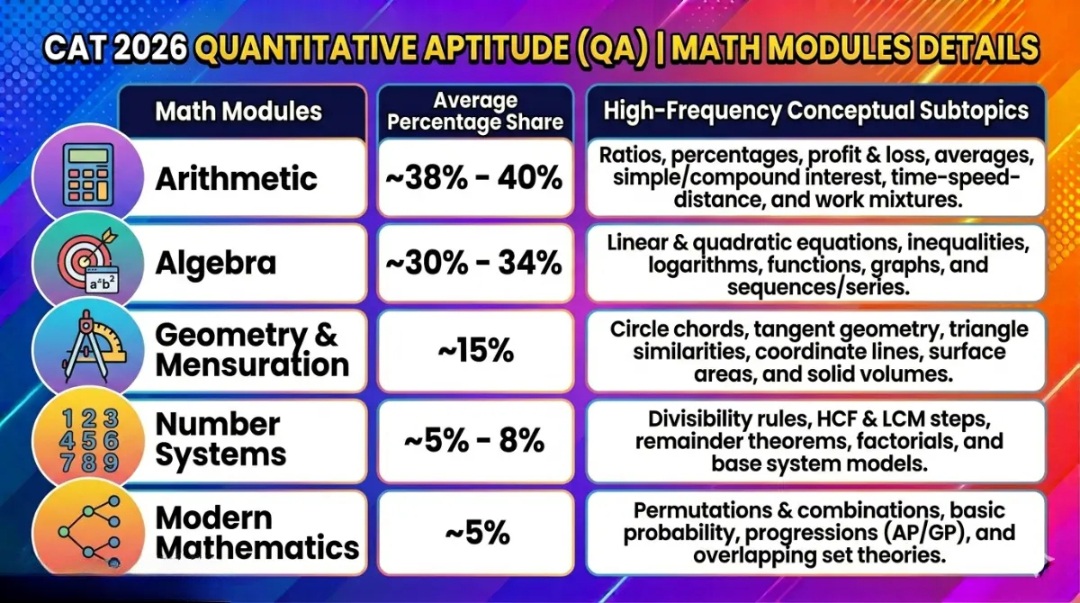
In QA, Arithmetic accounts for about 38% of questions, followed by Algebra at 34%, Geometry & Mensuration at 15%, Number Systems at 8%, and Modern Mathematics at 5%.
Note: IIMs do not release a detailed chapter-wise syllabus, so the CAT Syllabus 2026 topics and weightages are based on previous years' question papers.
What is CAT Syllabus 2026 for MBA?
There is no fixed official CAT Syllabus 2026. The following CAT Syllabus 2026 is prepared from the topics and question types repeatedly asked in previous CAT papers.
VARC has the highest number of questions, with 24 questions accounting for 35.3% of the CAT 2026 paper.
Candidates also need to manage an average of about 1 minute 40 seconds per question for VARC section.
DILR and QA each contribute 22 questions, or approximately 32.4% of the paper.
With 40 minutes for each section, candidates have about 1 minute 49 seconds per question on average for DILR and QA section.
Latest Changes in CAT Syllabus 2026
There is no major change expected in the CAT syllabus for 2026 compared with CAT 2025. The CAT syllabus continues to cover three major sections: Verbal Ability and Reading Comprehension (VARC), Data Interpretation and Logical Reasoning (DILR), and Quantitative Aptitude (QA).
Based on the latest exam pattern,
Parameter | CAT 2025 | CAT 2026 (Expected) | What Has Changed? |
|---|---|---|---|
Total Questions | 68 | 68 | No major change expected |
Total Duration | 120 minutes | 120 minutes | No change expected |
VARC Questions | 24 | 24 | No major change expected |
DILR Questions | 22 | 22 | No major change expected |
QA Questions | 22 | 22 | No major change expected |
VARC Focus | Reading Comprehension, Para Summary, Para Jumbles, Odd One Out | Same core areas | No major syllabus change |
DILR Focus | Data Interpretation, Arrangements, Puzzles, Logical Reasoning | Same core areas | No major syllabus change |
QA Focus | Arithmetic, Algebra, Geometry, Number System, Modern Maths | Same core areas | No major syllabus change |
Marking Scheme | +3 for correct, -1 for wrong MCQ, no negative marking for TITA | Expected to remain similar | No major change expected |
Sectional Time Limit | 40 minutes per section | 40 minutes per section | No change expected |
Note:
No new subject or major topic has been officially added to the CAT syllabus for 2026.
Candidates should continue preparing the core topics covered in CAT 2025 and previous CAT papers.
The question difficulty, topic weightage and question types may vary from one year or slot to another.
CAT Syllabus 2026 PDF Download: Section-wise Topics & Weightage
Candidates can download the complete CAT Syllabus 2026 PDF covering VARC, DILR and QA with topic-wise weightage based on previous year trends
The CAT 2026 syllabus PDF covers:
CAT QA syllabus 2026
CAT VARC syllabus 2026
CAT DILR syllabus 2026
CAT syllabus 2026 topics
Important CAT topics
Topic-wise preparation priorities
CAT 2026 VARC Syllabus: Reading Comprehension Weightage & Important Topics
The CAT 2026 VARC syllabus tests the verbal and reading ability of the students. As per the previous years' exams, the candidates have faced long and complex questions from this section, especially in Reading Comprehension.
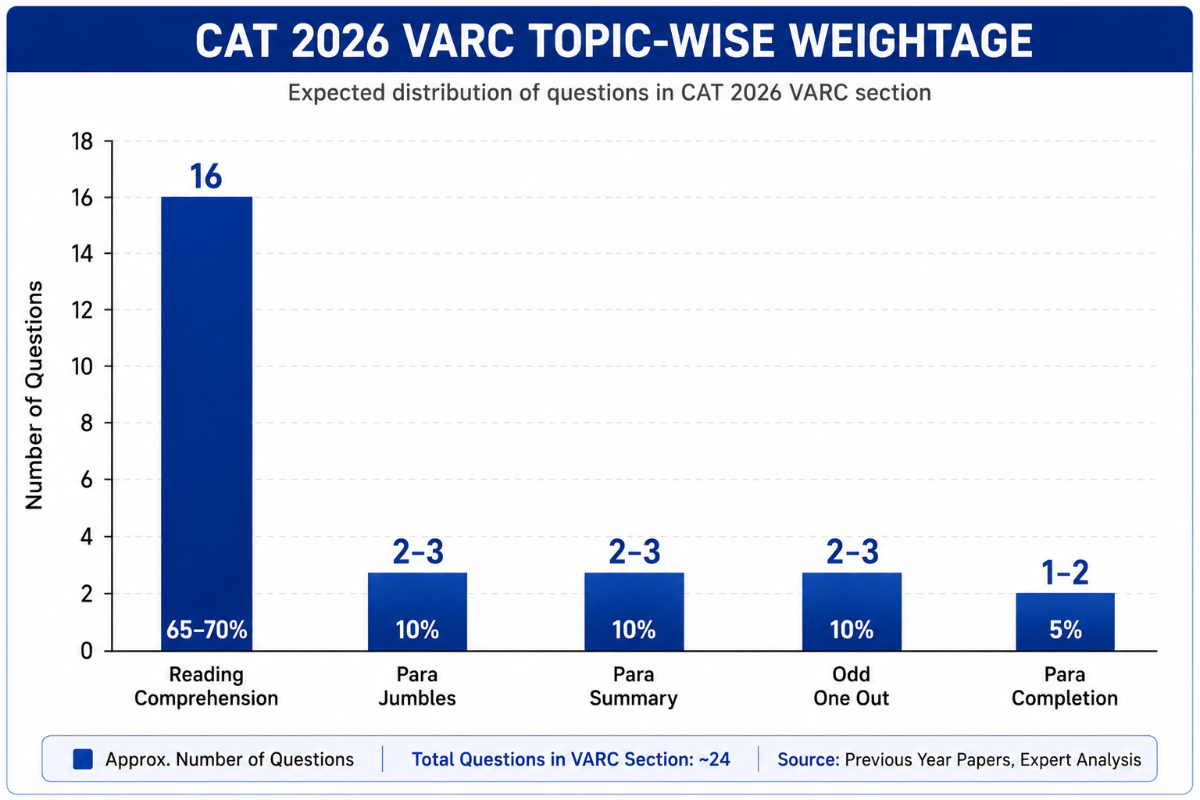
Reading Comprehension (RC) dominates VARC, contributing 65 -70% weightage with around 16 questions.
The remaining 30 -35% comes from Verbal Ability topics, which have low individual weightage but together impact the overall score.
Topic | Major Areas Covered | Approx. Questions | Approx. Weightage |
|---|---|---|---|
Reading Comprehension | Philosophy, Economics, Sociology, Science, Technology, History, Culture, Abstract passages | 16 | 65 -70% |
Para Jumbles | Sentence arrangement, logical sequence and paragraph structure | 2 -3 | 10% |
Para Summary | Main idea, supporting arguments and best summary | 2 -3 | 10% |
Odd One Out | Identifying the sentence that does not fit the paragraph | 2 -3 | 10% |
Para Completion | Completing a paragraph using context and logical flow | 1 -2 | 5% |
CAT 2026 Reading Comprehension (RC) Important Topics: Expected
CAT 2026 RC important topics are broad, with Science & Technology, Environment, Social Science, Arts and Economics among the recurring areas seen in previous CAT papers.
Candidates should focus less on memorising subject matter and more on main idea, inference, tone, logical structure and author's viewpoint, as these skills apply across different CAT RC topics.
CAT 2026 RC Important Topic | Topics/Areas to Prepare | Question Type |
|---|---|---|
Science & Technology | AI, evolution, scientific developments, technology and innovation | MCQ |
Environment & Life Sciences | Climate, biodiversity, forests, ecology and evolution | MCQ |
Social Science & History | Society, inequality, social change, history and communities | MCQ |
Arts & Culture | Art, literature, museums, culture and traditions | MCQ |
Economics & Management | Economic growth, markets, inequality, business and management | MCQ |
Philosophy & Abstract Topics | Ethics, knowledge, reality and philosophical arguments | MCQ |
Psychology | Human behaviour, cognition and decision-making | MCQ |
Politics & Public Policy | Governance, laws, public policy and political ideas | MCQ |
CAT 2026 Verbal Ability (VA) Important Topics: Expected
Para Summary and Para Jumbles are among the key CAT 2026 VA topics, while Odd One Out and Paragraph Completion should also be included in regular practice.
Since VA questions test logical flow and comprehension, candidates should practise sentence sequencing, paragraph structure, central idea and contextual interpretation instead of relying only on vocabulary or grammar preparation.
CAT 2026 VA Important Topic | What to Prepare | Question Type |
|---|---|---|
Para Summary | Central idea, author's argument, supporting points and elimination of incorrect options | MCQ |
Para Jumbles | Sentence sequencing, logical links, opening/closing sentences and paragraph flow | TITA |
Odd One Out | Identifying the sentence that does not logically fit the paragraph | TITA |
Paragraph Completion | Understanding context, tone and selecting the most logical concluding sentence | MCQ |
Sentence/Paragraph Inference | Drawing conclusions from the given information | MCQ/TITA where applicable |
Logical Coherence | Connecting ideas, transitions and maintaining continuity between sentences | MCQ/TITA |
CAT 2025 VARC Slot-Wise Question Distribution
Reading Comprehension should be your top priority for CAT 2026 preparation. It made up two-thirds of the VARC questions in all three 2025 slots.
The CAT 2026 VARC syllabus should be prepared because the 2025 RC passages ranged from AI and science to economics, environment, literature and culture.
For VA, candidates should focus on Para Summary, Paragraph Completion, Para Jumbles, and Odd Sentence questions. Pay close attention to both MCQ and TITA formats.
The consistency across all three slots makes this CAT 2025 VARC analysis useful for identifying the question distribution candidates should expect while preparing for CAT 2026.
Section / Question Type | CAT 2025 Slot 1 | CAT 2025 Slot 2 | CAT 2025 Slot 3 |
|---|---|---|---|
Reading Comprehension | 16 MCQs | 16 MCQs | 16 MCQs |
RC Passage 1 | 4 - Alienists & mental disorders | 4 - Tetrafish adaptation & evolution | 4 - Ill-effects of dams |
RC Passage 2 | 4 - Income inequality & economic growth | 4 - Biases of AI | 4 - AI & ethical decision-making |
RC Passage 3 | 4 - Electronic music | 4 - Role of “Place” in literature | 4 - Forest Act 1982 |
RC Passage 4 | 4 - Complex systems & tail events | 4 - Science & culture | 4 - Tribal art |
Verbal Ability | 8 | 8 | 8 |
Paragraph Completion | 2 MCQs | 2 MCQs | 2 MCQs |
Para Summary | 2 MCQs | 2 MCQs | 2 MCQs |
Odd Sentence | 2 TITA | 2 TITA | 2 TITA |
Jumbled Paragraphs | 2 TITA | 2 TITA | 2 TITA |
Total VARC Questions | 24 | 24 | 24 |
CAT QA Syllabus 2026: Arithmetic, Algebra & Geometry Chapter-wise Weightage
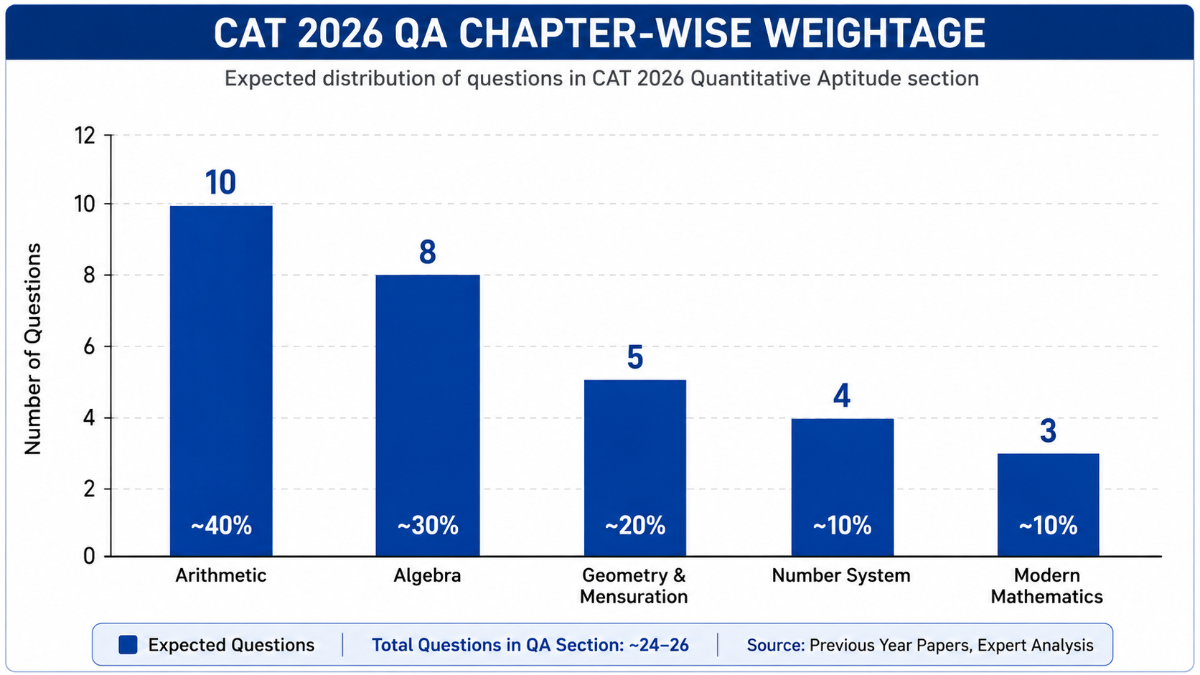
Arithmetic and Algebra together form around 72% of the CAT QA syllabus 2026, making them the highest-priority areas for preparation
Algebra contributes 30-32% of Quant questions.
Quadratic equations and inequalities are among the most frequently asked problems.
Topic | Major Areas Covered | Approx. Questions | Approx. Weightage |
|---|---|---|---|
Arithmetic | Percentages, Profit & Loss, Averages, Ratio & Proportion, Mixtures & Alligation, Time-Speed-Distance, Time & Work, Interest | 8 -10 | 40% |
Algebra | Linear & Quadratic Equations, Inequalities, Functions, AP/GP, Logarithms, Sequences & Series | 6 -8 | 30% |
Geometry & Mensuration | Lines, Angles, Triangles, Circles, Polygons, Coordinate Geometry, 2D & 3D Mensuration | 3 -5 | 20% |
Number Systems | Divisibility, HCF & LCM, Remainders, Factors, Base Systems, Unit Digits | 2 -4 | 10% |
Modern Mathematics | Permutation & Combination, Probability, Set Theory, Basic Statistics | 2 -3 | 10% |
CAT 2026 Quantitative Aptitude (QA) Important Topics: Expected
Arithmetic and Algebra are the most important areas in the CAT 2026 QA syllabus, together.
Candidates should prioritise these topics before moving to Geometry, Number Systems and Modern Mathematics.
Candidates should focus on percentages, ratios, averages, profit and loss, time and work, equations, inequalities, functions and progressions, while also practising Geometry and Number Systems regularly.
CAT 2026 QA Important Topic | Topics/Areas to Prepare | Question Type |
|---|---|---|
Arithmetic | Percentages, Profit & Loss, Ratio & Proportion, Averages, Time-Speed-Distance, Time & Work, Simple & Compound Interest | MCQ/TITA |
Algebra | Linear & Quadratic Equations, Inequalities, Functions, Progressions, Sequences & Series, Algebraic Expressions | MCQ/TITA |
Geometry & Mensuration | Lines & Angles, Triangles, Quadrilaterals, Circles, Coordinate Geometry, Areas, Volumes and Surface Areas | MCQ/TITA |
Number Systems | Divisibility, LCM & HCF, Remainders, Factors, Number Properties and Base Systems | MCQ/TITA |
Modern Mathematics | Set Theory, Permutation & Combination, Probability and Binomial Theorem | MCQ/TITA |
CAT 2025 Quant Slot-Wise Question Distribution
Arithmetic and Algebra were the dominant areas in CAT 2025 QA, together accounting for 14 questions in Slot 1, 16 in Slot 2 and 15 in Slot 3.
The CAT Quant syllabus 2026 should therefore give strong priority to Arithmetic topics such as Time-Speed-Distance, Time & Work, Profit & Loss, Ratio and Mixtures, along with Algebra topics such as Functions, Equations, Logarithms and Maxima & Minima.
Number System contributed 3 questions in each CAT 2025 slot, showing a consistent presence across the three papers.
Geometry and Mensuration appeared in every slot, while Modern Mathematics had fewer questions and varied from 0 to 1 question across the slots.
Area / Topic | CAT 2025 Slot 1 | CAT 2025 Slot 2 | CAT 2025 Slot 3 |
|---|---|---|---|
Number System | 3 Q - Factors (1), Digits (1), Set-based (1) | 3 Q - Digits (1), Remainders (1), Divisors (1) | 3 Q - Digit-based (2), Calculation-based (1) |
Algebra | 6 Q - Logarithms (1), Linear Equations (2), Functions (2), Inequality (1) | 8 Q - Logarithms (1), Linear Equations (2), Functions (1), Sequence & Series (1), Algebraic Expression (1), Maxima & Minima (1), Quadratic Equations (2) | 6 Q - Logarithms (1), Functions (2), Maxima & Minima (2), Exponents (1) |
Arithmetic | 8 Q - TSD (1), Time & Work (1), SI/CI (1), Percentage (1), Ratio (1), Profit & Loss (1), Mixture (1), Maxima & Minima (1) | 8 Q - TSD (1), Time & Work (1), SI/CI (1), Percentage (0), Profit & Loss (2), Mixture (1), Averages (1), Ratio (1) | 9 Q - TSD (2), Time & Work (1), Ratio (2), Profit & Loss (1), Mixture (1), Averages (1), Pipes & Cisterns (1) |
Modern Mathematics | 1 Q - Permutation & Combination (1) | 0 Q | 1 Q - Set Theory (1) |
Geometry & Mensuration | 4 Q - Circle (1), Polygon (1), Coordinate Geometry (2) | 3 Q - Circle/Tangent (1), Polygon/Hexagon (1), Triangle (1) | 3 Q - Triangle (2), Trapezium (1) |
Total QA Questions | 22 | 22 | 22 |
CAT DILR Syllabus 2026: Logical Reasoning vs Data Interpretation Split
The DILR section tests the analytical and logical thinking ability of the students. In CAT 2025, this section was considered one of the most unpredictable, with a mix of data-based and logic-driven sets that require careful selection and time management.
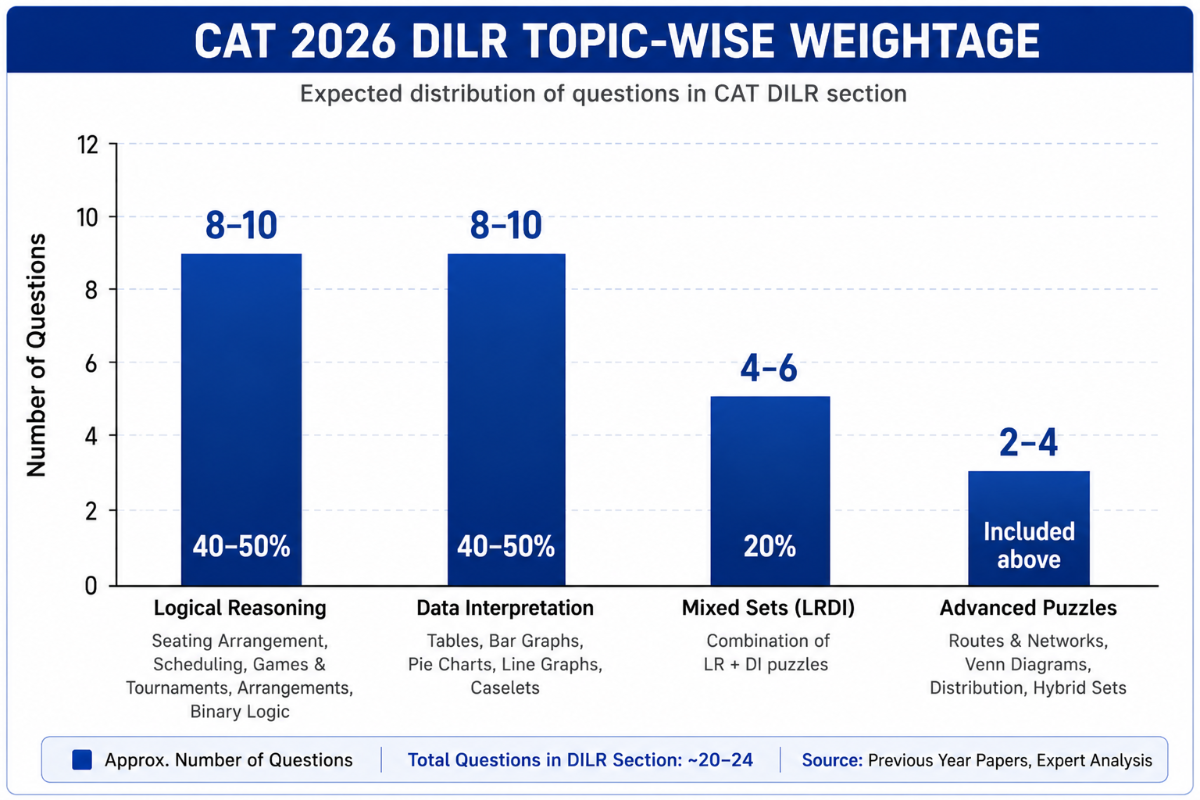
The CAT DILR syllabus 2026 typically splits into approximately 55% Logical Reasoning and 45% Data Interpretation sets, though the exact distribution varies across slots
Mixed LRDI sets form about 20% of the section (4 -6 questions), combining both logic and data interpretation.
Topic | Major Areas Covered | Approx. Questions | Approx. Weightage |
|---|---|---|---|
Logical Reasoning | Seating arrangements, scheduling, games & tournaments, arrangements, binary logic, puzzles | 8 -10 | 40 -50% |
Data Interpretation | Tables, bar graphs, pie charts, line graphs and caselets | 8 -10 | 40 -50% |
Mixed LRDI Sets | Sets combining logical conditions with numerical/data interpretation | 4 -6 | 20% |
Advanced Sets | Routes & networks, Venn diagrams, distribution and hybrid sets | 2 -4 | Included above |
CAT 2026 Data Interpretation (DI) Important Topics: Expected
CAT 2026 DI important topics include tables, bar graphs, line graphs, mixed graphs, caselets and data sets involving percentages, ratios, averages and comparisons.
Candidates should also practise logical DI and calculation-intensive sets, as recent CAT papers included data sets that required both numerical interpretation and logical deduction.
CAT 2026 DI Important Topic | What to Prepare | Question Type |
|---|---|---|
Tables | Percentages, ratios, averages, comparisons, totals and missing values | MCQ/TITA |
Bar Graphs | Comparative analysis, percentage change, ratios and trends | MCQ/TITA |
Line Graphs | Trends, growth rates, comparisons and changes over time | MCQ/TITA |
Pie Charts | Percentages, proportions, ratios and sector-wise comparisons | MCQ/TITA |
Caselets | Numerical information presented in paragraph form, requiring calculations and interpretation | MCQ/TITA |
Mixed Graphs | Combining information from tables, graphs or charts to solve a set | MCQ/TITA |
Data Comparison | Comparing quantities, ratios, averages and percentage differences | MCQ/TITA |
Logical DI | Data sets requiring mathematical calculations along with logical deduction | MCQ/TITA |
Data Sufficiency | Determining whether the given information is sufficient to answer the question | MCQ/TITA |
CAT 2026 Logical Reasoning (LR) Important Topics: Expected
CAT 2026 LR important topics include seating arrangements, puzzles, rankings, grouping, sequencing and other constraint-based sets that require candidates to establish relationships before answering questions.
The CAT LR syllabus 2026 should be prepared through set-based practice, with emphasis on arrangement, selection, ordering and deduction rather than isolated formula-based questions.
CAT 2026 LR Important Topic | What to Prepare | Question Type |
|---|---|---|
Seating Arrangements | Linear, circular and other arrangement-based sets involving people, objects or positions | MCQ/TITA |
Ranking & Ordering | Relative positions, rankings, ordering and comparison-based conditions | MCQ/TITA |
Grouping & Distribution | Assigning people or objects to groups based on given constraints | MCQ/TITA |
Puzzles | Multi-condition sets involving people, objects, positions, schedules or activities | MCQ/TITA |
Selection & Scheduling | Choosing items or arranging events while satisfying multiple conditions | MCQ/TITA |
Networks & Connections | Relationships, routes, connections and movement between different entities | MCQ/TITA |
Logical Sequences | Identifying patterns, sequences and relationships from given information | MCQ/TITA |
Venn Diagrams & Set-Based Reasoning | Overlapping groups, common elements and logical relationships | MCQ/TITA |
Direction & Movement | Movement, positions, routes and directional relationships | MCQ/TITA |
Data Sufficiency | Evaluating whether statements provide enough information to solve a logical problem | MCQ/TITA |
CAT 2025 DILR Slot-Wise Question Distribution
The CAT 2025 DILR analysis shows that each slot had 22 questions across five sets, with a mix of Data Interpretation and Logical Reasoning sets.
DI sets included tables, graphs, weighted averages, currency exchange and trade data, while LR sets included arrangements, rankings, calling patterns and logical conditions.
The question format varied across sets, with both MCQ and TITA questions appearing in all three slots.
The distribution across slots shows why candidates preparing the CAT DILR syllabus 2026 should practise different set formats rather than focusing on only one type of DI or LR question.
Area / Set | CAT 2025 Slot 1 | CAT 2025 Slot 2 | CAT 2025 Slot 3 |
|---|---|---|---|
Set 1 | DI - Performance rating of 6 employees - 5 Q (4 TITA) | DI - Pollution Index, weighted average - 5 Q (1 MCQ, 3 TITA) | LR - 6 friends calling each other - 4 Q (1 MCQ, 3 TITA) |
Set 2 | DI - Import-export data of 5 countries - 4 Q (4 MCQ) | DI - Authors and number of books, bar graphs - 4 Q (2 MCQ, 2 TITA) | DI - Four friends solving puzzles, chart - 4 Q (2 MCQ, 2 TITA) |
Set 3 | LR - Circular arrangement of 4 persons and 7 chairs - 5 Q (4 MCQ, 1 TITA) | DI - Scatter plot and index calculations - 4 Q (4 MCQ) | LR - Circular arrangement of 7 students - 4 Q (4 MCQ) |
Set 4 | LR - Five persons tapping Yes/No - 4 Q (2 MCQ, 2 TITA) | LR - Ranking of 6 balls and 4 holes - 4 Q (2 MCQ, 3 TITA) | DI - Currency exchange across 4 countries - 5 Q (2 MCQ, 3 TITA) |
Set 5 | LR - Train movement from stations A to E - 4 Q (4 TITA) | LR - Musicians - 5 Q (2 MCQ, 3 TITA) | DI - Trade balance, import and export - 5 Q (2 MCQ, 3 TITA) |
Total DILR Questions | 22 | 22 | 22 |
CAT Syllabus: Year-wise Important Topics and Questions
The following tables summarise the major topics and the distribution of questions across CAT 2020–2024. This gives candidates a quick view of how the syllabus has been tested across different slots.
CAT VARC: Year-wise Slot-wise Topics
The RC topics above are condensed from the individual passage topics reported for each year. CAT 2021–2024 had 16 RC questions per slot, while CAT 2020 had 18 RC questions.
Year | Slot 1: Important Topics | Slot 2: Important Topics | Slot 3: Important Topics | Total Questions |
|---|---|---|---|---|
CAT 2024 | RC: Digital Content, Craftsmanship, Bandicoot Revival, Behavioural Economics | RC: Spice Trade, Peer Review, Technology, Human-Carnivore Conflict | RC: Chinese Liquor, Space Exploration, Language Extinction, AI Regulation | 24 |
CAT 2023 | RC: Geography, Postcolonial Literature, Affluent Society, Wolves | RC: Sustainable Fashion, Liberalism, Netflix & Culture, Human Consciousness ; | RC: Colonialism, Rationality, Cultural Property, Language Extinction; | 24 |
CAT 2022 | RC: Supernatural Figures, Imitation, Stoicism, Political Philosophy | RC: Music, Technology, Cephalopods, Social Sciences | RC: Automation, Orientalism, Crime, Social Learning | 24 |
CAT 2021 | RC: Mayan Civilisation, Utopia & Dystopia, Marshmallow Experiment, History of Tea; | RC: Language, Fiction, Colonialism, Philosophy; | RC: Nanotechnology, Language Instinct, Entropy & Time, Psychoanalysis | 24 |
CAT 2020 | RC: Tang Dynasty Currency, Elephant Seals, Grammar, Anarchism ; | RC: Visual Culture, Piracy, Renewable Energy, Aggression | RC: Travel Writing, Human Nature, Screen Time, Financial Crisis | 26 |
CAT DILR: Year-wise Slot-wise Topics
The 2024 set distribution is confirmed as three 4-question and two 5-question sets, while the 2021–2023 papers had four 5/4/6-question set combinations depending on the year.
Year | Slot 1: Set/Topic – Questions | Slot 2: Set/Topic – Questions | Slot 3: Set/Topic – Questions | Total Questions |
|---|---|---|---|---|
CAT 2024 | Stock Price/Candlestick DI – 4 Q; | Gymnast Ratings – 5 Q; | App Subscriptions DI – 4 Q; | 22 |
CAT 2023 | Gig Workers & Restaurants DI – 5 Q; | Firms & Funds DI – 5 Q; | Course Enrolment DI – 5 Q; | 20 |
CAT 2022 | Venn Diagram DI – 5 Q; | Revenue & Cost Scatter Plot – 5 Q; | Mortality Rate Bar Graph – 5 Q; | 20 |
CAT 2021 | Sales Bar Graph – 4 Q; | Delivery Time Bar Graph – 4 Q; | Employee Schedule Bar Graph – 4 Q; | 20 |
CAT 2020 | Students & Subjects DI – 6 Q; | Elections DI – 6 Q; | School Facilities/Elections DI – 4 Q; | 24 |
CAT QA: Year-wise Slot-wise Topics
Arithmetic and Algebra remained the strongest QA areas across these years. For example, CAT 2024 had 9–8 Arithmetic questions and 6–7 Algebra questions across the three slots.
Year | Slot 1: Topic – Questions | Slot 2: Topic – Questions | Slot 3: Topic – Questions | Total Questions |
|---|---|---|---|---|
CAT 2024 | Arithmetic – 9 Q; | Arithmetic – 8 Q; | Arithmetic – 8 Q; | 22 |
CAT 2023 | Arithmetic – 9 Q; | Arithmetic – 9 Q; | Arithmetic – 8 Q; | 22 |
CAT 2022 | Arithmetic – 8 Q; | Arithmetic – 9 Q; | Arithmetic – 9 Q; | 22 |
CAT 2021 | Arithmetic – 11 Q; | Arithmetic – 11 Q; | Arithmetic – 11 Q; | 22 |
CAT 2020 | Arithmetic – 10 Q; | Arithmetic – 9 Q; | Arithmetic – 10 Q; | 26 |
CAT Syllabus Overlap with XAT, SNAP & NMAT 2026
Preparing for CAT cover 70% to 80% of the syllabus for XAT, SNAP and NMAT.
All four exams test core Quantitative Aptitude, Data Interpretation, Logical Reasoning, and Verbal Ability.
CAT's core preparation in Arithmetic, Algebra, Number System and Geometry can help for XAT and SNAP, while NMAT also overlaps in Arithmetic, Algebra and Number Properties.
CAT's 24-question VARC section, including 16 RC questions and 8 VA questions, provides a strong base for the English sections of XAT, SNAP and NMAT.
CAT preparation in Data Interpretation and Logical Reasoning is directly useful for all three exams, although the exact section structure and question mix differ.
Note: XAT requires the most syllabus-specific addition because of Decision Making and General Knowledge, which are not tested in CAT.
CAT 2026 Topic | XAT 2026 | SNAP 2026 | NMAT 2026 |
|---|---|---|---|
Reading Comprehension | High | High | High |
Para Summary | High | High | High |
Para Jumbles / Paragraph Formation | High | High | High |
Vocabulary & Grammar | High | High | High |
Logical Reasoning | High | High | High |
Puzzles & Arrangements | High | High | High |
Data Interpretation | High | High | High |
Tables & Charts | High | High | High |
Arithmetic | High | High | High |
Algebra | High | High | High |
Geometry & Mensuration | High | High | Limited |
Number System | High | High | High |
Probability | High | High | High |
Permutation & Combination | High | High | — |
Data Sufficiency | High | High | High |
Decision Making | High | — | — |
General Knowledge & Current Affairs | High | — | — |
Best Books for CAT 2026 Preparation (QA, VARC & DILR)
Section | Best Book | Author | Best For |
|---|---|---|---|
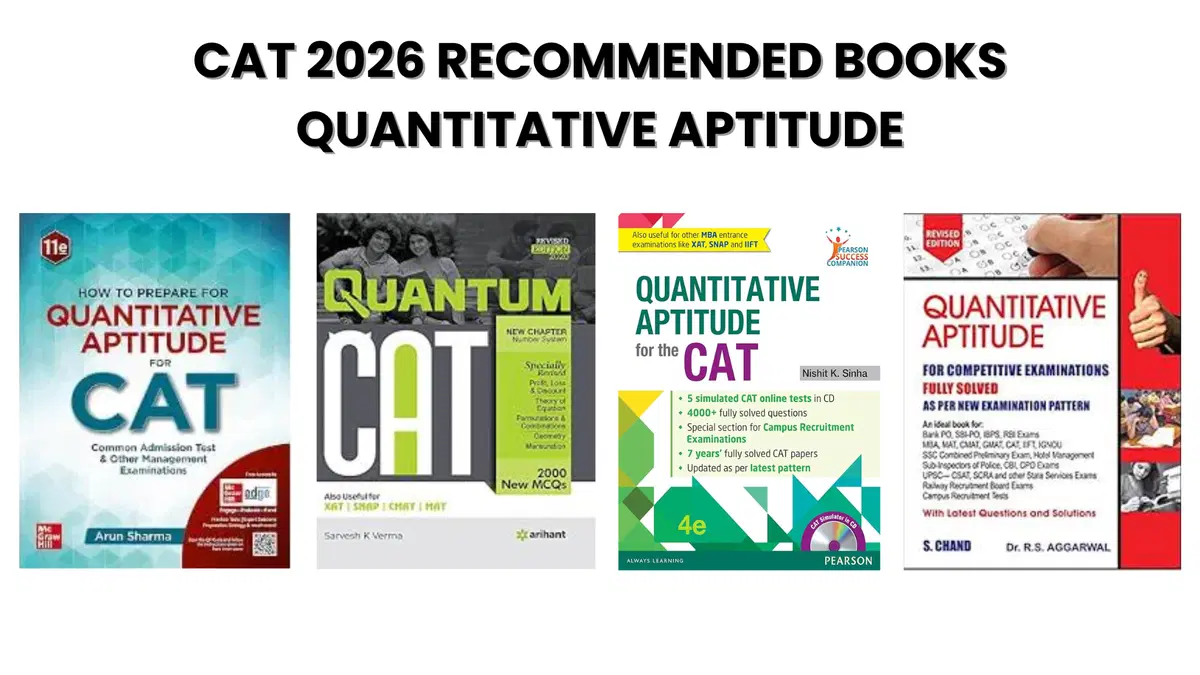
QA | How to Prepare for Quantitative Aptitude for CAT | Arun Sharma | Concepts & Practice |
QA | Quantum CAT | Sarvesh Verma | Advanced Practice |
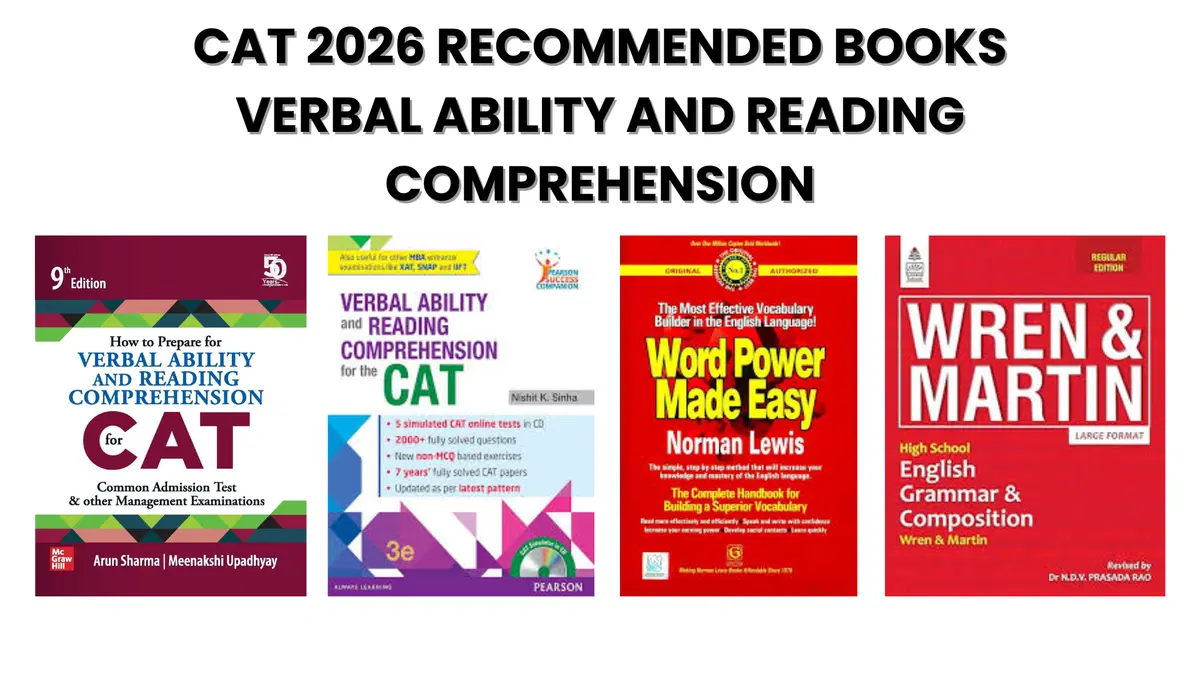
VARC | Word Power Made Easy | Norman Lewis | Vocabulary |
VARC | How to Prepare for VARC | Arun Sharma & Meenakshi | RC & VA |
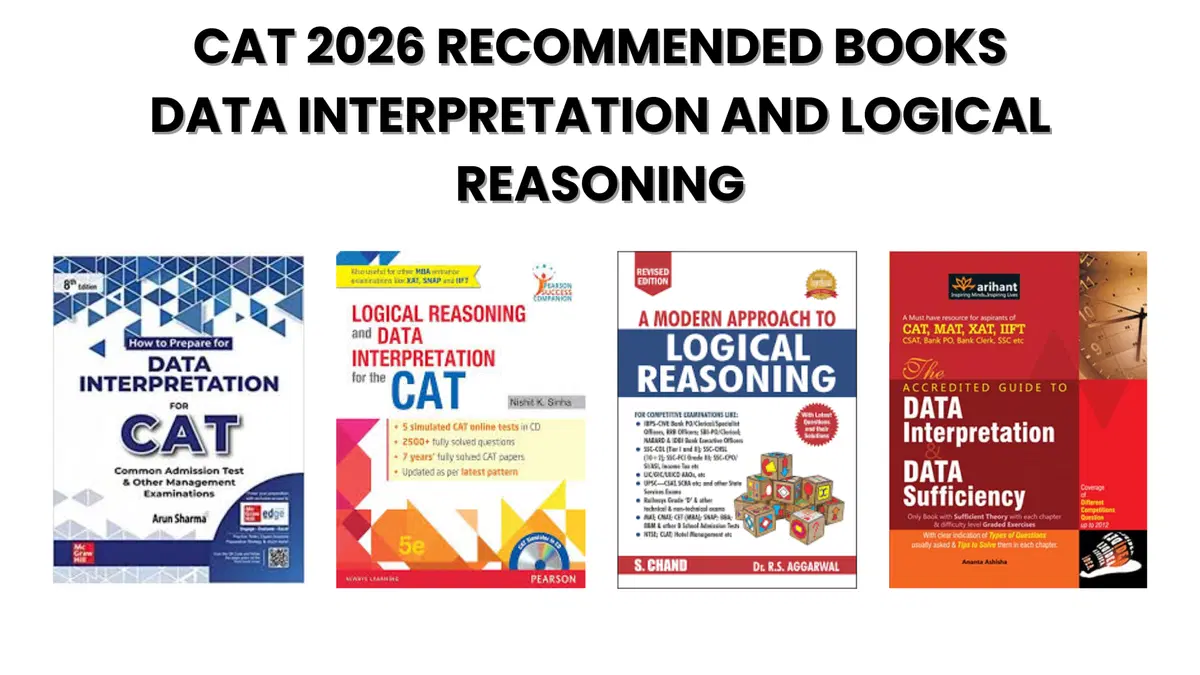
DILR | How to Prepare for DILR | Arun Sharma | Concepts & Practice |
DILR | Logical Reasoning & DI for CAT | Nishit Sinha | CAT-level Sets |
Best Books for CAT QA
Best Books for CAT VARC
Best Books for CAT DILR
CAT Mock Tests 2026: Free PDFs & Analysis Strategy
Mock tests help you to assess your preparation, improve time management, and identify weak areas.
Once you've completed the major syllabus topics, start attempting sectional and full-length mock tests regularly.
Preparation Phase | Recommended Mocks |
|---|---|
Foundation | 0-2 |
Practice | 8-10 |
Final Revision | 20-25 |
Overall | 30-35 |