Syllabus
Exam Pattern
The CAT Exam Pattern 2026 is expected to be released along with the official notification in July 2026 on iimcat.ac.in.by the conducting authority, IIM Indore.
The exam pattern will outline the section-wise question distribution, marking scheme, and time limits for the CAT 2026 exam scheduled on November 29, 2026.
According to the expected pattern, CAT 2026 will be a 120-minute computer-based test comprising 68 questions across VARC, DILR, and Quantitative Aptitude sections. Candidates will have 40 minutes to complete each section, and you won't be able to move between sections while answering.
CAT 2026 is expected to be a 2-hour online exam with 68 questions carrying a total of 204 marks.
Candidates will get 40 minutes for each section, and they cannot revisit a section once the allotted time is over.
The exam will consist of VARC (24 questions), DILR (22 questions), and Quantitative Aptitude (22 questions).
Each correct answer will fetch +3 marks, while MCQs carry a -1 negative marking for incorrect responses. There is no negative marking for TITA (Type in the Answer) questions.
The paper will include both MCQ and non-MCQ (TITA) questions across all three sections.

CAT 2026 Exam Pattern
It is expected to remain largely similar to recent years (CAT 2025/2024). CAT is a computer-based test (CBT) known for its rigorous evaluation of candidates' quantitative, verbal, and logical abilities.
No major structural changes are expected unless mentioned in the official notification.
CAT 2026 Expected Exam Pattern Overview
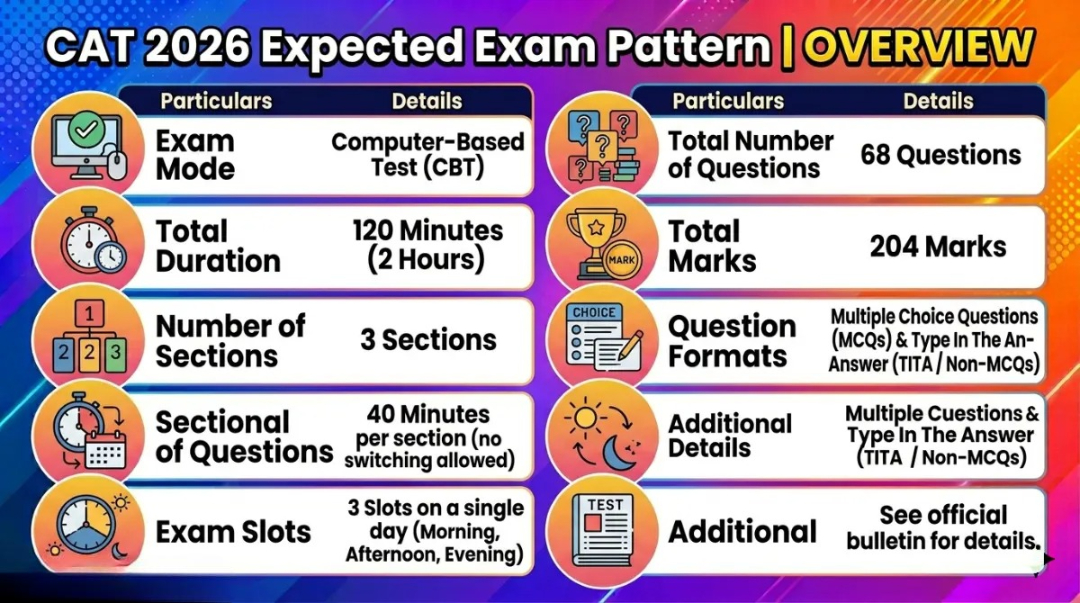
Particulars | Details |
|---|---|
Exam Mode | Computer-Based Test (CBT) |
Total Duration | 120 Minutes (2 Hours) |
Number of Sections | 3 Sections |
Sectional Time Limit | 40 Minutes per section ( no switching allowed) |
Total Number of Questions | 68 Questions |
Total Marks | 204 Marks |
Question Formats | Multiple Choice Questions (MCQs) & Type In The Answer (TITA / Non-MCQs) |
Exam Slots | 3 Slots on a single day (Morning, Afternoon, Evening) |
CAT 2026 Marking Scheme
The CAT 2026 total score is 204 marks. Negative marking scheme is used to discourage random guessing under time constraints.
Incorrect MCQs deduct 1 mark. A balanced approach to selecting solvable problems is essential.
No marks are deducted for wrong TTITA questions. They generally account for roughly 25% to 34% of the entire paper.
Feature Details | Scoring Evaluation Impact |
|---|---|
Correct Response | +3 Marks ( For both MCQs and TITA questions) |
Incorrect MCQ Selection | -1 Mark (One mark is deducted for every wrong choice) |
Incorrect TITA Input | 0 Marks (No negative marking or fractional deductions applied) |
Unattempted Question | 0 Marks (Skipping a question carries no penalty) |

CAT 2026 Exam Pattern Changes and Last 10 Years Question Paper Trends
The CAT 2026 exam will consist of 68 questions in total, which is consistent with the pattern established in 2024 and 2025. No major changes are expected this year.
Sections: The exam will be divided into three sections:
Verbal Ability & Reading Comprehension (VARC): 24 questions
Data Interpretation & Logical Reasoning (DILR): 22 questions
Quantitative Ability (QA): 22 questions
The exam will include both Multiple Choice Questions (MCQs) and Type In The Answer (TITA) questions. The marking scheme awards +3 marks for each correct answer, -1 mark for incorrect MCQs, and no negative marking for TITA questions.
Key Changes in Pattern Across the Last 10 Years
Period | Major Trend |
|---|---|
2015–2019 | Stable pattern with 100 questions, 180 minutes, and three sections. Difficulty mainly fluctuated due to QA and DILR. |
2020 | Biggest structural overhaul: 2-hour exam, 76 questions, 3 slots because of the pandemic. |
2021–2023 | Exam stabilized at 66 questions. Speed and question selection became more important than endurance. |
2024 | Minor revision to 68 questions, with QA becoming relatively more approachable while maintaining similar section timings. |
CAT Question Paper Trends for Last 10 Years
Most students preparing for CAT focus heavily on solving more questions, but fewer students actually stop to analyze section-wise behavior properly. As per the last 10 years trends, we can see that:
Arithmetic consistently carries the highest weightage inside Quant across recent CAT papers.
Algebra questions usually appear in application-heavy formats instead of direct formula-based questions.
Reading comprehension dominates VARC, making RC practice extremely important for CAT 2026 preparation online.
DILR increasingly rewards smart set selection instead of attempting every set aggressively.
Vocabulary-based VARC questions have reduced significantly over recent years.
CAT Year | Overall Difficulty | Key Areas Tested | Major Changes in Pattern / Questions |
|---|---|---|---|
2024 | Easy–Moderate | VARC: Inference-heavy RCs, Para Summary | Total questions increased from 66 → 68 (24 VARC, 22 DILR, 22 QA). QA was comparatively easier than 2023. |
2023 | Difficult | VARC: Dense RCs, Abstract passages | Pattern unchanged (66 questions), but QA and DILR became significantly tougher. Considered one of the hardest CATs in recent years. |
2022 | Moderate | VARC: Balanced RCs & VA | Pattern remained stable (66 questions). Better balance across all three sections than 2021. |
2021 | Moderate–Difficult | VARC: Narrative RCs | Total questions reduced from 76 → 66. Distribution became 24 VARC, 20 DILR, 22 QA. |
2020 | Moderate | VARC: RC-heavy | COVID-year changes: Exam duration reduced from 180 → 120 minutes, questions reduced 100 → 76, exam conducted in 3 slots. |
2019 | Moderate–Difficult | VARC: RC dominant | Last CAT with 100 questions and 3-hour duration. DILR emerged as the deciding section. |
2018 | Moderate–Difficult | VARC: Inference-based RCs | No structural change. DILR was widely regarded as the toughest section. |
2017 | Moderate | VARC: Easier RCs | Pattern unchanged (100 questions). VARC was relatively easier, improving overall attempts. |
2016 | Difficult | VARC: RC emphasis | No structural changes. One of the toughest CAT papers, especially QA and DILR. |
2015 | Difficult | VARC: RCs & Verbal Ability | First full year after introduction of the three-section format (VARC, DILR, QA). Non-MCQs (TITA) became an important feature. |
CAT 2026 Section-wise Pattern
Common Admission Test (CAT) is divided into three different sections, mainly Verbal Ability & Reading Comprehension (VARC), Data Interpretation & Logical Reasoning (DILR), and Quantitative Aptitude (QA).
Each section has a strict 40-minute electronic countdown.
Once the timer reaches zero, your answers for that segment are automatically saved.
Then the section locks permanently, and the system transitions to the next portion of the exam.
In 2011, the exam pattern was changed to just two sections: Section 1: Quantitative Ability & Data Interpretation. Section 2: Verbal Ability & Logical Reasoning
CAT 2026 Exam Pattern Section-wise Overview
Section Name | Total Expected Questions | Time Allocated | Max Obtainable Score |
|---|---|---|---|
Section I: Verbal Ability & Reading Comprehension (VARC) | 24 | 40 Minutes | 72 Marks |
Section II: Data Interpretation & Logical Reasoning (DILR) | 22 | 40 Minutes | 66 Marks |
Section III: Quantitative Aptitude (QA) | 22 | 40 Minutes | 66 Marks |
Total Specifications | 68 Questions | 120 Minutes | 204 Marks |
CAT VARC Exam Pattern 2026
Verbal Ability & Reading Comprehension evaluates reading speed, dense contextual processing, and structural paragraph comprehension. It holds 24 questions, for a total of 72 marks.
Based on the analysis of the CAT 2025 question paper
The VARC has a 35% weightage of the overall test.
.Reading Comprehension (RC): 16 questions. It has 4 passages containing 4 questions each.
Verbal Ability (VA): 8 questions. Paragraph Summaries (2 questions), Paragraph Jumbles (3 questions), Odd Sentence Out (1-2 questions), and Paragraph Completion (1-2 questions).
Component Parameters | Expected 2026 Details & Formats |
|---|---|
Total Questions | 24 Questions |
Sectional Marks | 72 Marks |
MCQ Volume | ~22 Questions |
TITA Volume | ~2 Questions |
CAT DILR Section Exam Pattern 2026
The Data Interpretation & Logical Reasoning section accounts for 32% of the examination. It comprises 22 questions for a total of 66 marks.
Based on the previous year and the 2025 question paper pattern,
The section contains complex, multi-layered data arrays and structural reasoning.
It has 5 problem sets. That includes 3 sets consisting of 4 questions each, and 2 sets consisting of 5 questions each.
Component Parameters | Expected 2026 Details & Formats |
|---|---|
Total Questions | 22 Questions |
Sectional Marks | 66 Marks |
MCQ Volume | ~14 Questions |
TITA Volume | ~8 Questions |
CAT QA Section Exam Pattern 2026
The Quantitative Ability section carries 22 questions worth 66 marks, accounting for 32% of the test.
Arithmetic and Algebra together form the entire quantitative evaluation. This is expected to be maintained for CAT 2026.
Arithmetic: 8–9 questions covering Percentages, Profit & Loss, Simple/Compound
Algebra: 5–6 questions covering Quadratic/Linear Equations, Logarithms, Progressions
Geometry & Mensuration: 2–3 questions covering Triangles, Circles, Polygons,
Modern Math & Number Systems: 2–3 questions covering Permutations & Combinations, Probability, etc.
Component Parameters | Expected 2026 Details & Formats |
|---|---|
Total Questions | 22 Questions |
Sectional Marks | 66 Marks |
MCQ Volume | ~16 Questions |
TITA Volume | ~6 Questions |
CAT Exam Pattern over the Years
IIM Indore has made some important changes in past years. They have managed the exam during two highly critical periods: 2013-2014 and more recently in 2020.
In 2014, IIM Indore extended the exam duration to 170 minutes and pushed the total number of questions to 100.
In 2020 during the pandemic IIM Indore permanently changed the traditional 3-hour exam into a 2-hour format.
They reduced the sectional timelines from 60 minutes down to 40 minutes and dropped total questions to 76.
In 2025 number of questions has increased to 68 from 66 in 2024, with 2 additional questions in DILR.
Experts predict that it is unlikely that the pattern for CAT 2026 will change significantly. Students are asked to keep checking the official website of IIM Indore for important updates.
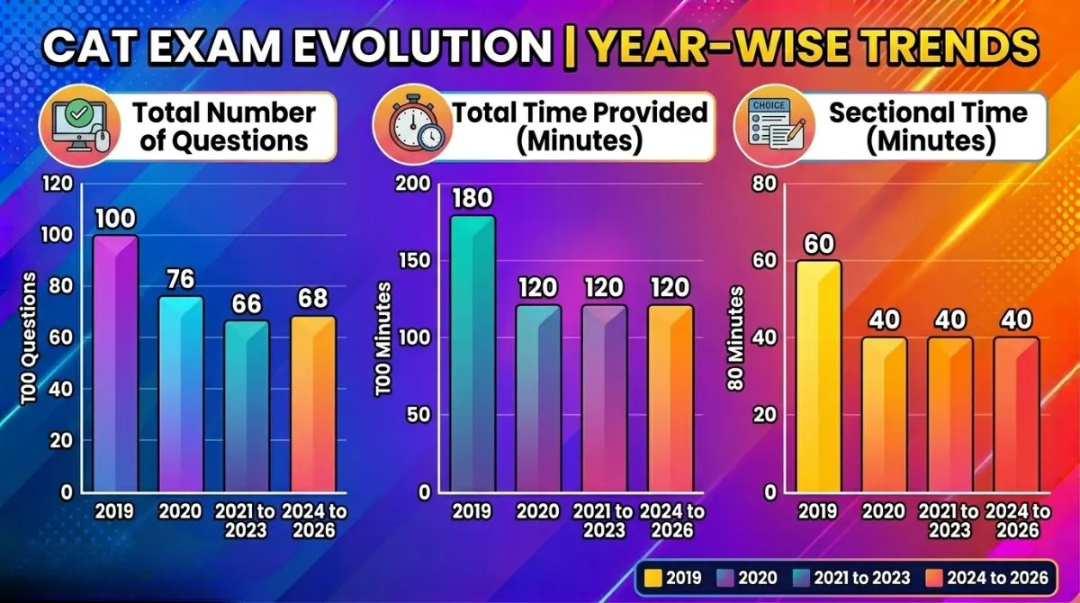
The table below outlines changes over the years to the exam structure:
Year of Exam | Total Number of Questions | Total Time Provided | Sectional Time |
|---|---|---|---|
2019 | 100 | 180 Minutes | 60 Minutes |
2020 | 76 | 120 Minutes | 40 Minutes |
2021 to 2023 | 66 | 120 Minutes | 40 Minutes |
2024 to 2026 | 68 | 120 Minutes | 40 Minutes |
CAT 2026 Section-wise Syllabus & Expected Weightage
Verbal Ability & Reading Comprehension (VARC)
This section assesses critical reading speed, semantic processing, inference skills, and cohesive text logic. Reading comprehension passages make up nearly 65% to 70% of this section's total marks.
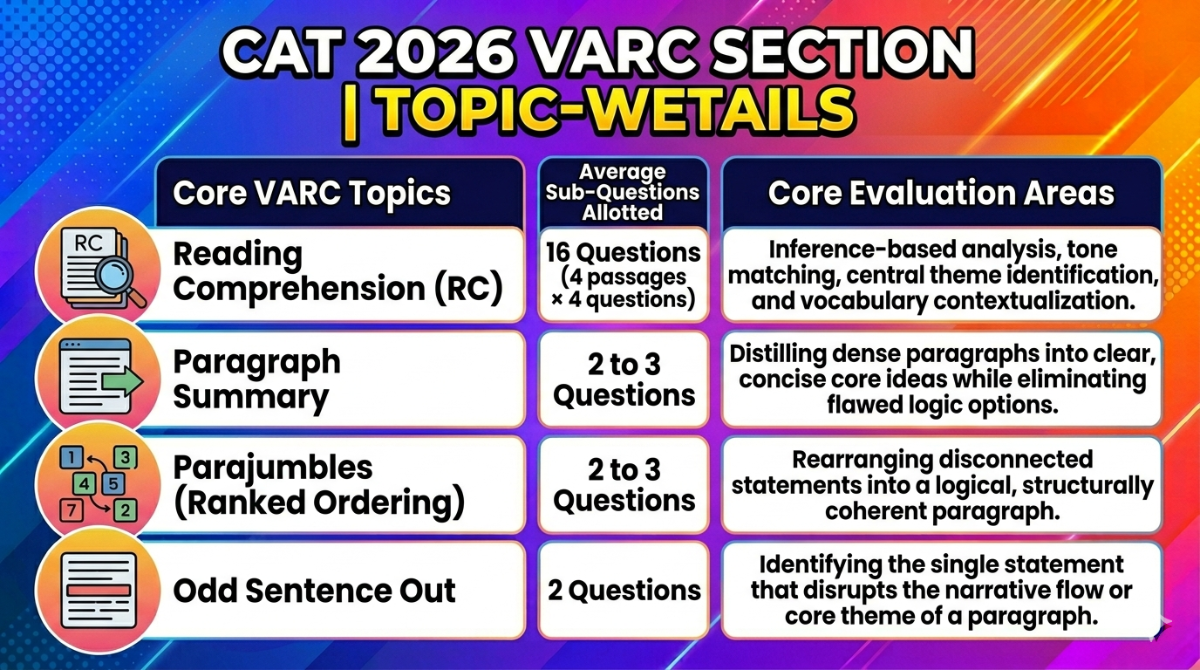
VARC Core Topics | Average Sub-Questions Allotted | Core Evaluation Areas |
|---|---|---|
Reading Comprehension (RC) | 16 Questions (4 passages × 4 questions) | Inference-based analysis, tone matching, central theme identification, and vocabulary contextualization. |
Paragraph Summary | 2 to 3 Questions | Distilling dense paragraphs into clear, concise core ideas while eliminating flawed logic options. |
Parajumbles (Ranked Ordering) | 2 to 3 Questions | Rearranging disconnected statements into a logical, structurally coherent paragraph. |
Odd Sentence Out | 2 Questions | Identifying the single statement that disrupts the narrative flow or core theme of a paragraph. |
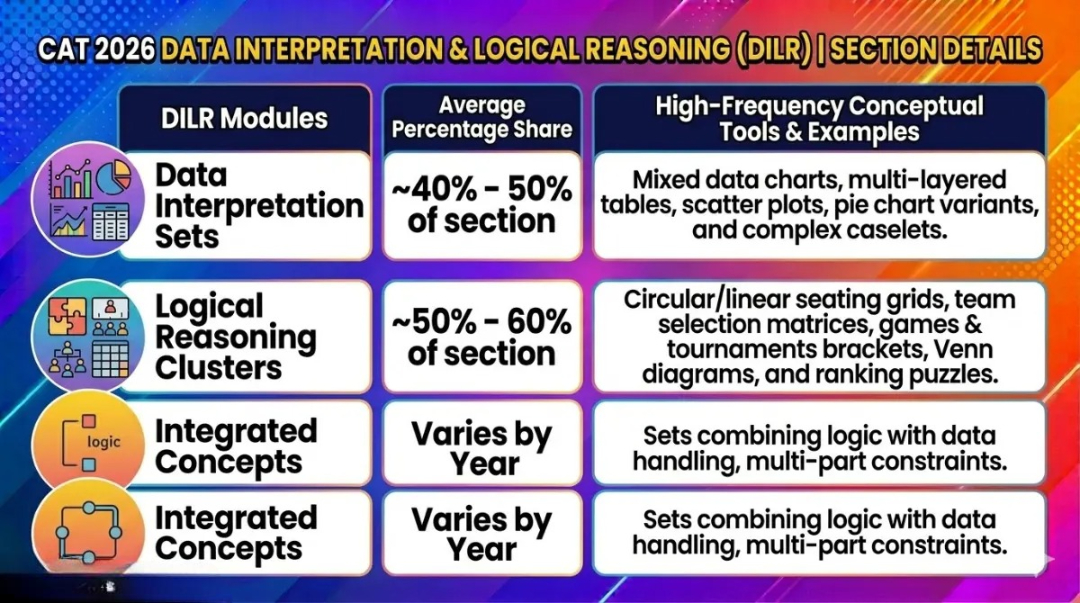
Data Interpretation & Logical Reasoning (DILR)
The DILR section features comprehensive, multi-layered problem sets. The section typically features 4 distinct sets containing 5 questions each, or a mix of 5-question and 4-question sets.
DILR | Typical Weightage | Core Conceptual Tools Covered |
|---|---|---|
Data Interpretation Sets | ~40% - 50% of the section | Mixed data charts, multi-layered tables, scatter plots, pie chart variants, and complex caselets. |
Logical Reasoning Clusters | ~50% - 60% of the section | Circular/linear seating grids, team selection matrices, games & tournaments brackets, Venn diagrams, and ranking puzzles. |
Quantitative Aptitude (QA)
This section evaluates math proficiency spanning arithmetic operations up to higher-order equations. It is systematically dominated by two major modules: Arithmetic and Algebra.
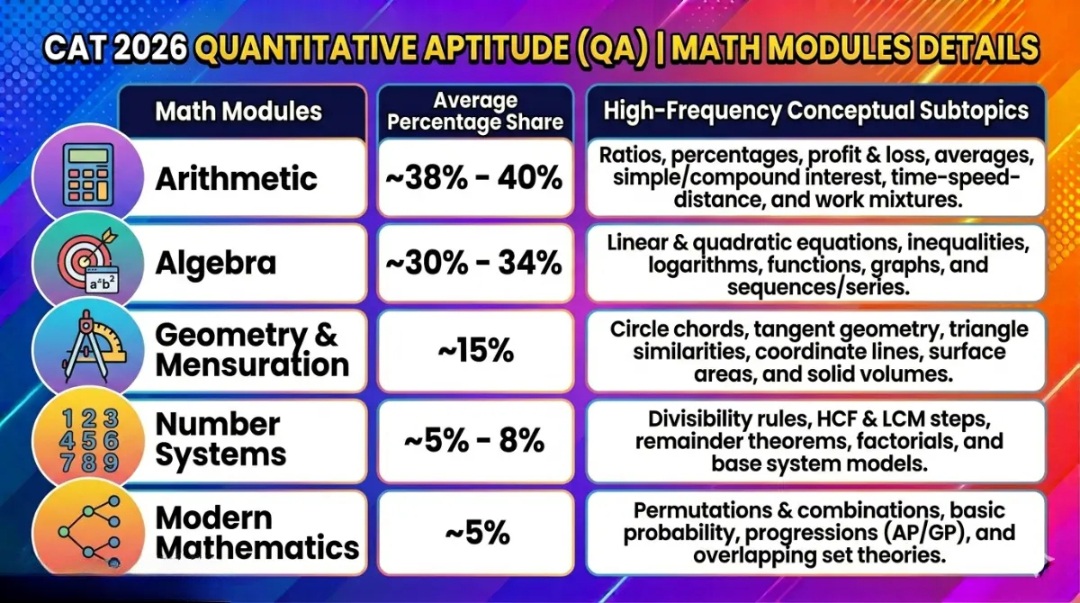
QA Math Modules | Percentage Share | High-Frequency Conceptual Subtopics |
|---|---|---|
Arithmetic | ~38% - 40% | Ratios, percentages, profit & loss, averages, simple/compound interest, time-speed-distance, and work mixtures. |
Algebra | ~30% - 34% | Linear & quadratic equations, inequalities, logarithms, functions, graphs, and sequences/series. |
Geometry & Mensuration | ~15% | Circle chords, tangent geometry, triangle similarities, coordinate lines, surface areas, and solid volumes. |
Number Systems | ~5% - 8% | Divisibility rules, HCF & LCM steps, remainder theorems, factorials, and base system models. |
Modern Mathematics | ~5% | Permutations & combinations, basic probability, progressions (AP/GP), and overlapping set theories. |