


Counselling and Admission Process
Seat Reservation and Quotas
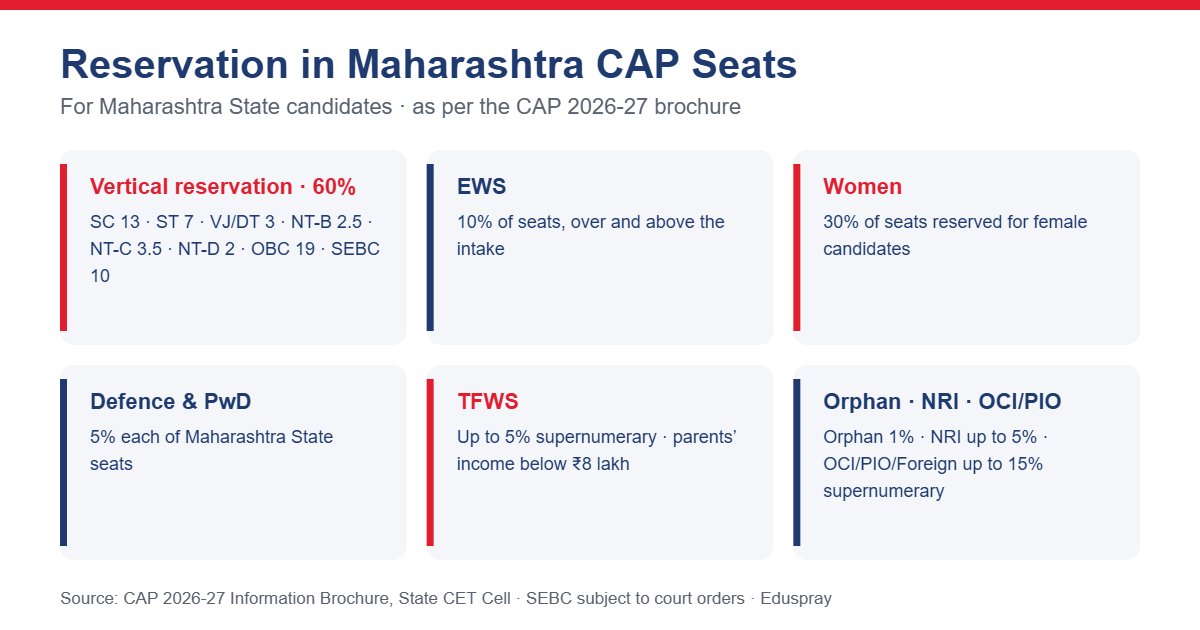
Seats in Maharashtra’s CAP are divided by quota (Home University, Other Than Home University, State Level, All India, minority, institutional) and then reserved by category, gender and special groups. Knowing which seats you are eligible for helps you read cutoffs correctly and plan choices.
Category-wise Reservation for Maharashtra State Candidates
Category | Reservation |
|---|---|
Scheduled Castes (SC) | 13% |
Scheduled Tribes (ST) | 7% |
Vimukta Jati / Denotified Tribes (VJ/DT – NT-A) | 3% |
Nomadic Tribes B (NT-B) | 2.5% |
Nomadic Tribes C (NT-C) | 3.5% |
Nomadic Tribes D (NT-D) | 2% |
Other Backward Classes (OBC) | 19% |
Socially and Educationally Backward Class (SEBC) | 10% (subject to court orders) |
Total | 60% |
Reservation for backward classes applies only to Maharashtra State candidates. Candidates of VJ/DT, NT, OBC, SBC and SEBC categories must submit a valid non-creamy layer certificate, and reserved-category candidates need a caste validity certificate.
Other Reservations and Special Seats
Quota | Share (CAP 2026-27) | Who is eligible |
|---|---|---|
Economically Weaker Sections (EWS) | 10% | Maharashtra candidates not covered by other reservations, with a valid EWS certificate |
Women | 30% | Female candidates |
Defence | 5% of Maharashtra State seats | Wards of defence personnel and ex-servicemen, as defined |
Persons with Disability (PwD) | 5% of Maharashtra State seats | At least 40% permanent disability certified by a competent authority |
Orphan | 1% of CAP seats | Orphan candidates with the prescribed certificate |
Tuition Fee Waiver Scheme (TFWS) | Up to 5% (supernumerary) | Maharashtra candidates with parents’ annual income below ₹8 lakh — tuition fee is waived |
NRI | Up to 5% (within institutional quota) | Non-Resident Indian candidates |
OCI / PIO / Foreign nationals / Children of Indian workers in Gulf | Up to 15% (supernumerary) | As defined in the brochure; exempt from MHT CET |
Quota-wise Seat Distribution (Schedule I, CAP 2026-27)
Institute type | How seats are split |
|---|---|
Government / aided – autonomous | 100% State Level |
Government / aided – non-autonomous | 70% Home University, 30% Other Than Home University |
COEP Technological University | 80% State Level, 20% All India |
ICT Mumbai and LIT Nagpur | 70% State Level, 30% All India |
Dr. Babasaheb Ambedkar Technological University, Lonere | 85% State Level, 15% for candidates from Konkan districts |
Unaided private (non-minority) | 65% State Level (autonomous) or 45.5% HU + 19.5% OHU; 15% All India; 20% institutional (including up to 5% NRI) |
Unaided minority | At least 51% of CAP seats for minority candidates; 15% All India; 20% institutional; rest for Maharashtra candidates |
Government / aided minority | 50% minority quota; remaining 50% State Level (autonomous) or 35% HU + 15% OHU |
TFWS: A Scheme Worth Knowing
Under the Tuition Fee Waiver Scheme, eligible Maharashtra candidates from families earning below ₹8 lakh a year get the tuition fee waived on supernumerary seats of up to 5%. TFWS seats are allotted on merit and appear as separate entries in the official cutoff lists. Keep a valid income certificate from a Maharashtra authority ready.
Key Takeaways
60% of Maharashtra CAP seats are reserved for SC, ST, VJ/DT, NT, OBC and SEBC categories.
EWS gets 10%, women 30%, defence and PwD 5% each, orphans 1%.
TFWS gives a tuition fee waiver to eligible students with family income below ₹8 lakh.
Seat split by Home University, State Level and All India depends on the type of institute.
Pro Tip: Apply for your caste validity and non-creamy layer certificates well before CAP. Missing or expired certificates are one of the most common reasons a category claim fails at verification.
Source: CAP 2026-27 Information Brochure (Rules 7 and 8, Schedule I), State CET Cell, Maharashtra