Syllabus
Full pageThe IPMAT Syllabus 2027 primarily covers Quantitative Ability and Verbal Ability while in IPMAT Rohtak there is an additional Logical Reasoning section. The IPMAT 2027 syllabus differs between IPMAT Indore and IPMAT Rohtak with separate exam structures for both.
Arithmetic carries around 38%–50% of Quant weightage in IPMAT Rohtak which covers percentages, profit and loss, ratio, interest, time and work and TSD.
Algebra contributes nearly 15%–18% of Quant weightage with questions from equations, logarithms, progressions, functions and inequalities.
Modern Maths and Number System account for around 16%–22% while Geometry and Mensuration may contribute approximately 8%–13% of Quant.
Reading Comprehension carries nearly 27%–33% of Verbal weightage, making passage-based direct and inference questions a major preparation area.
Grammar and Vocabulary contribute around 30%, covering error spotting, sentence correction, fill in the blanks, synonyms, antonyms and idioms.
Logical Reasoning for IPMAT Rohtak includes puzzles, coding decoding, blood relations, seating arrangements, series, syllogisms and related topics.
Candidates should use the section wise syllabus and PYQs to focus on high weightage topics instead of giving equal time to every chapter.
Related Link:IPMAT Exam: Eligibility, Syllabus, Exam Pattern, Cutoff and Marks vs Rank
Key Summary
NCERT Class 9–12 Maths builds the Quant foundation while Arun Sharma and R.S. Aggarwal add higher-level practice.
Word Power Made Easy helps with vocabulary while Wren & Martin covers grammar for IPMAT Verbal Ability.
IPMAT Indore Quant includes 15 QA-SA and 30 QA-MCQ questions with Geometry and Algebra carrying notable weightage.
IPMAT Rohtak Quant has 40 questions with Arithmetic expected to account for around 40–50% of the section.
IPMAT Indore Verbal Ability includes 12–15 Reading Comprehension questions along with Vocabulary, Grammar and para-based questions.
Candidates should analyse mocks in detail and spend 2–3 hours reviewing mistakes to avoid repeating them.
IPMAT Exam Syllabus 2027 for Quantitative Ability
IPMAT Indore 2027 syllabus includes Coordinate Geometry, Matrices & Determinants, and Binomial Theorem under Quantitative Ability.
IPMAT Rohtak 2027 gives higher focus to Arithmetic, while Algebra and Geometry have comparatively lower weightage.
IPMAT Indore Exam Quantitative Ability Syllabus
Quantitative Ability in IPMAT Indore Exam is divided into QA Short Answer which has 15 questions and QA MCQ has 30 questions.
Algebra, Geometry, Logarithms, Functions and Coordinate Geometry are expected to carry higher weightage in IPMAT Indore Exam 2027.
Category | Topics Covered |
|---|---|
Number System | Divisibility Rules, HCF & LCM, Factors & Multiples, Remainders, Unit Digit, Surds & Indices, Factorials |
Arithmetic | Percentages, Profit & Loss, Discount, Simple & Compound Interest, Ratio & Proportion, Partnership, Averages, Mixtures & Alligations, Time & Work, Pipes & Cisterns, Time-Speed-Distance, Boats & Streams, Ages |
Algebra | Linear Equations, Quadratic Equations, Inequalities, Modulus, Functions & Graphs, Domain & Range, Progressions (AP, GP, HP), Logarithms, Polynomials, Algebraic Identities |
Geometry & Mensuration | Lines & Angles, Triangles, Circles, Quadrilaterals, Polygons, Coordinate Geometry, Mensuration (2D & 3D), Heights & Distance, Trigonometry |
Modern Mathematics | Permutation & Combination, Probability, Set Theory & Venn Diagrams, Matrices & Determinants, Binomial Theorem |
Data Interpretation | Tables, Bar Graphs, Pie Charts, Line Graphs, Caselets, Calculation-based DI |
IPMAT Rohtak Quantitative Ability Syllabus
IPMAT Rohtak Exam includes a single Quantitative Ability section with 40 MCQ questions.
Arithmetic carries the highest weightage and is expected to account for 40–50% of the Quantitative Ability section.
Algebra and Geometry generally have lower weightage in IPMAT Rohtak than in IPMAT Indore.
Category | Topics Covered |
|---|---|
Number System | Divisibility, HCF & LCM, Factors, Remainders, Unit Digit, Surds & Indices |
Arithmetic | Percentages, Profit & Loss, Simple & Compound Interest, Ratio & Proportion, Averages, Mixtures & Alligations, Time & Work, Pipes & Cisterns, Time-Speed-Distance, Boats & Streams, Ages, Partnership |
Algebra | Linear & Quadratic Equations, Inequalities, Progressions (AP/GP), Logarithms, Basic Functions |
Geometry & Mensuration | Lines & Angles, Triangles, Circles, Mensuration (2D & 3D), Basic Coordinate Geometry |
Modern Mathematics | Permutation & Combination, Probability, Set Theory |
Data Interpretation | Tables, Graphs, Charts, Basic DI sets |
IPMAT Exam Syllabus 2027 for Verbal Ability
IPMAT Indore 2027 includes Error Spotting, Sentence Correction, Modifiers and Parallelism under the Grammar section.
IPMAT Rohtak 2027 covers One-word Substitution, Phrasal Verbs, Odd Sentence Out and Logical Consistency questions.
IPMAT Indore Verbal Ability Syllabus
Reading Comprehension carries the highest weightage in IPMAT Indore Verbal Ability with around 12–15 questions.
Vocabulary and Grammar are important parts of the IPMAT Indore Verbal Ability syllabus.
Para Jumbles and Para Completion are regularly asked in the IPMAT Indore examination.
Category | Topics Covered |
|---|---|
Reading Comprehension | Passages (factual, inference-based, tone, main idea, vocabulary in context, conversation-based RC) |
Vocabulary | Synonyms, Antonyms, Idioms & Phrases, Phrasal Verbs, One-word Substitution, Confusing Words, Foreign Words, Word Usage |
Grammar | Subject-Verb Agreement, Tenses, Articles, Prepositions, Conjunctions, Modifiers, Parallelism, Error Spotting, Sentence Correction, Active-Passive Voice, Direct-Indirect Speech |
Para-based Questions | Para Jumbles, Para Completion, Sentence Completion / Fill in the Blanks, Odd Sentence Out |
Other Verbal Ability | Analogies, Logical Consistency, Assumption/Inference-based questions |
IPMAT Rohtak Verbal Ability Syllabus
Reading Comprehension carries the highest weightage in IPMAT Indore Verbal Ability with around 12–15 questions.
Vocabulary and Grammar are important parts of the IPMAT Indore Verbal Ability syllabus.
Para Jumbles and Para Completion are regularly asked in the IPMAT Indore examination.
Category | Topics Covered |
|---|---|
Reading Comprehension | Passages (factual, inference-based, tone, main idea, vocabulary in context, conversation-based RC) |
Vocabulary | Synonyms, Antonyms, Idioms & Phrases, Phrasal Verbs, One-word Substitution, Confusing Words, Foreign Words, Word Usage |
Grammar | Subject-Verb Agreement, Tenses, Articles, Prepositions, Conjunctions, Modifiers, Parallelism, Error Spotting, Sentence Correction, Active-Passive Voice, Direct-Indirect Speech |
Para-based Questions | Para Jumbles, Para Completion, Sentence Completion / Fill in the Blanks, Odd Sentence Out |
Other Verbal Ability | Analogies, Logical Consistency, Assumption/Inference-based questions |
Also Check: IPMAT Exam Pattern 2026: 90 Questions, 360 Marks, Marking Scheme and Sectional Weightage
According to a Quora discussion, IPMAT Indore covers Quantitative Ability and Verbal Ability with QA including Class 9–12 level topics. The discussion highlighted Grammar, Vocabulary and Reading Comprehension as key areas in Verbal Ability along with MCQ and Short Answer question formats.
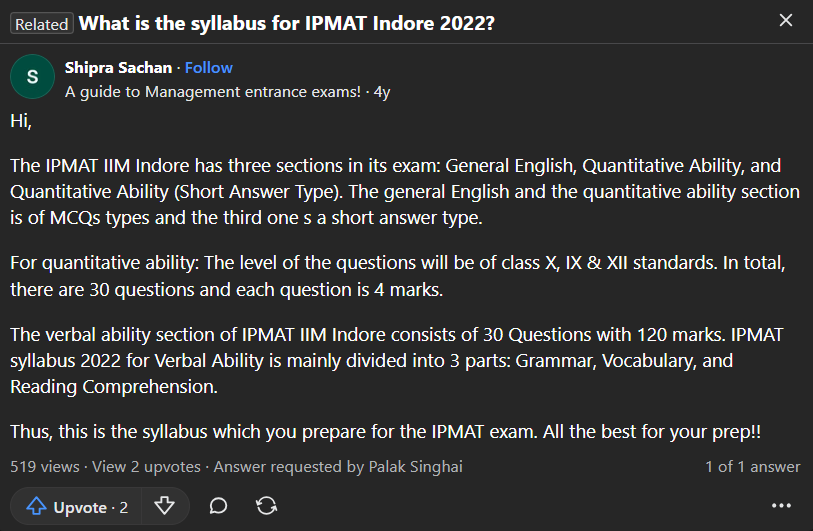
Source: Quora
IPMAT Exam Syllabus 2027 for Logical Reasoning (Only for IPMAT Rohtak)
In IPMAT Rohtak exam 2027, the Logical Reasoning section has 40 MCQs of total 160 marks.
IPMAT Indore exam does not have a separate Logical Reasoning section and some DI or arrangement based questions may appear under Quantitative Ability.
IPMAT Rohtak exam includes a dedicated Logical Reasoning section to test candidates' ability to analyse information and solve problems.
Category | Topics Covered |
|---|---|
Seating Arrangement | Linear Arrangement, Circular Arrangement, Matrix Arrangement, Floor-based Arrangement |
Puzzles | Scheduling Puzzles, Box Puzzles, Day/Month Puzzles, Designation Puzzles, Mixed Puzzles |
Blood Relations | Family Tree, Coded Blood Relations, Puzzle-based Blood Relations |
Direction Sense | Direction & Distance, Path-based questions |
Coding-Decoding | Letter Coding, Number Coding, Symbol Coding, Conditional Coding |
Series | Number Series, Letter Series, Alphanumeric Series, Mixed Series |
Syllogism | Basic Syllogism, Possibility cases, Coded Syllogism |
Data Sufficiency | Two-statement & Three-statement Data Sufficiency |
Input-Output | Machine Input-Output (Step-based) |
Ranking & Ordering | Ranking, Ordering, Comparison-based questions |
Clocks & Calendars | Clock angles, Calendar day calculations |
Critical Reasoning | Statement-Assumption, Statement-Conclusion, Cause-Effect, Course of Action |
Miscellaneous | Analogy, Odd One Out, Venn Diagrams, Cubes & Dice, Visual Reasoning |
IPMAT Exam Syllabus 2027: Topic-wise Weightage
IPMAT Indore 2027 may see 12–15 Reading Comprehension questions while IPMAT Rohtak 2027 may have 10–14 Vocabulary questions.
IPMAT Rohtak 2027 may include 8–12 Seating Arrangement and Puzzle questions while IPMAT Indore may have 4–6 Data Interpretation questions.
IPMAT Indore Exam Topic-wise Weightage
Section | Topic | Expected Questions | Approx. Weightage |
|---|---|---|---|
Quantitative Ability (Total 45 Questions: 15 SA + 30 MCQ) | Geometry & Mensuration | 6–8 | 15–18% |
Algebra (Equations, Inequalities, Functions) | 6–8 | 15–18% | |
Arithmetic | 5–7 | 11–16% | |
Logarithms & Surds | 3–4 | 7–9% | |
Progressions (AP/GP) | 2–3 | 4–7% | |
P&C + Probability | 3–4 | 7–9% | |
Number System | 2–3 | 4–7% | |
Matrices & Determinants | 1–2 | 2–4% | |
Data Interpretation / Sets | 4–6 | 9–13% | |
Verbal Ability (45 Questions) | Reading Comprehension | 12–15 | 27–33% |
Vocabulary (Synonyms, Antonyms, Idioms, Phrases) | 8–12 | 18–27% | |
Grammar / Sentence Correction | 5–7 | 11–16% | |
Para Jumbles | 4–6 | 9–13% | |
Para Completion / Fillers | 4–6 | 9–13% | |
Sentence Completion / Error Spotting | 4–6 | 9–13% |
IPMAT Rohtak Exam Topic-wise Weightage
Section | Topic | Expected Questions | Approx. Weightage |
|---|---|---|---|
Quantitative Ability (40 Questions) | Arithmetic | 15–20 | 38–50% |
Modern Math (P&C, Probability, Sets) | 6–8 | 15–20% | |
Algebra | 4–6 | 10–15% | |
Geometry & Mensuration | 3–5 | 8–13% | |
Number System | 3–4 | 8–10% | |
Data Interpretation | 4–6 | 10–15% | |
Logical Reasoning (40 Questions) | Seating Arrangement + Puzzles | 8–12 | 20–30% |
Coding-Decoding + Series | 5–7 | 13–18% | |
Blood Relations + Directions | 4–6 | 10–15% | |
Data Sufficiency | 3–5 | 8–13% | |
Syllogism / Critical Reasoning | 3–5 | 8–13% | |
Clocks, Calendars, Ranking | 3–5 | 8–13% | |
Miscellaneous | 3–5 | 8–13% | |
Verbal Ability (40 Questions) | Vocabulary (Synonyms, Antonyms, Idioms) | 10–14 | 25–35% |
Reading Comprehension | 10–12 | 25–30% | |
Grammar / Sentence Correction | 8–11 | 20–28% | |
Para Jumbles | 4–5 | 10–13% | |
Fillers / Para Completion | 3–5 | 8–13% |
Note: These weightages are based on trends from 2023–2026 papers and are expected to remain similar for IPMAT 2027.
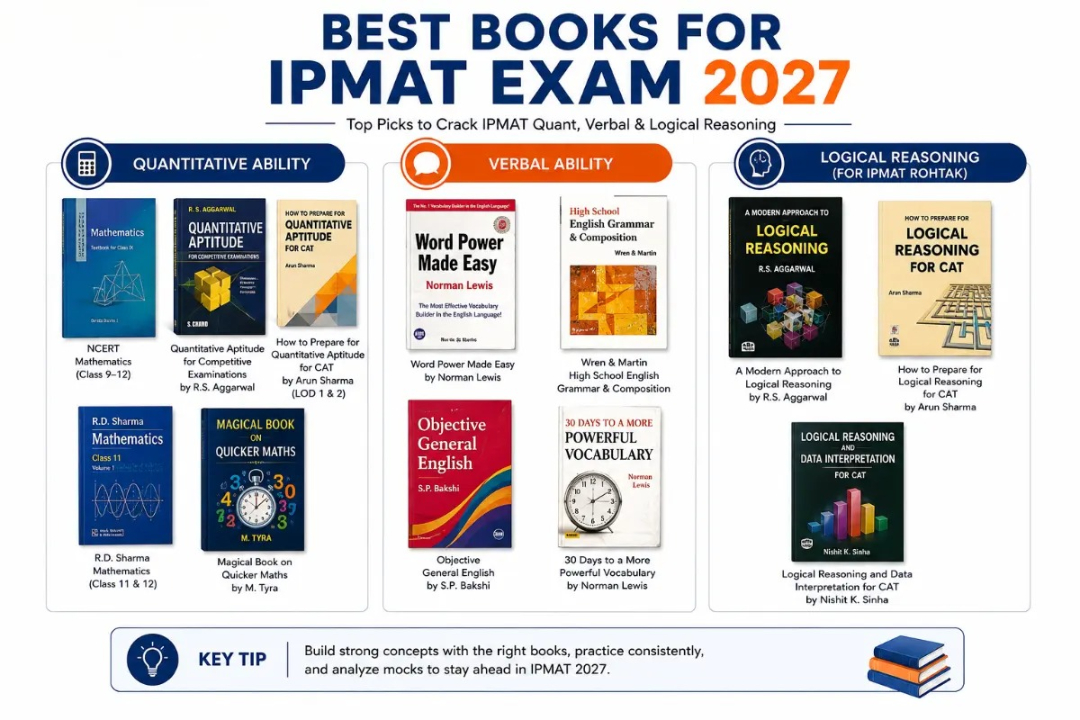
Best Books for IPMAT Exam 2027
NCERT Class 9–12 Maths builds the base for IPMAT Quant while Arun Sharma (LOD 1–2) and R.S. Aggarwal provide extensive practice.
Word Power Made Easy by Norman Lewis is a useful vocabulary book while Wren & Martin covers key grammar rules.
R.S. Aggarwal’s Modern Approach to Logical Reasoning is widely used for IPMAT Rohtak topics such as arrangements, puzzles, and coding-decoding.
Pearson Guide to IIM Indore IPM and R.D. Sharma Class 11–12 Maths help with higher-level QA-SA topics such as matrices, logarithms and functions.
IPMAT Exam 2027 Books for Quantitative Ability
Book Name | Author / Publisher | Why Recommended |
|---|---|---|
NCERT Mathematics (Class 9, 10, 11 & 12) | NCERT | Best for building strong fundamentals |
Quantitative Aptitude for Competitive Examinations | R.S. Aggarwal | Excellent for practice and concept clarity |
How to Prepare for Quantitative Aptitude for CAT | Arun Sharma | Best for advanced practice (focus on LOD 1 & 2) |
RD Sharma (Class 11 & 12) | R.D. Sharma | Strong for Algebra, Trigonometry, Matrices & higher maths (important for Indore) |
Magical Book on Quicker Maths | M. Tyra | Good for speed and shortcuts |
IPMAT Exam 2027 Books for Verbal Ability
Book Name | Author / Publisher | Why Recommended |
|---|---|---|
NCERT Mathematics (Class 9, 10, 11 & 12) | NCERT | Best for building strong fundamentals |
Quantitative Aptitude for Competitive Examinations | R.S. Aggarwal | Excellent for practice and concept clarity |
How to Prepare for Quantitative Aptitude for CAT | Arun Sharma | Best for advanced practice (focus on LOD 1 & 2) |
RD Sharma (Class 11 & 12) | R.D. Sharma | Strong for Algebra, Trigonometry, Matrices & higher maths (important for Indore) |
Magical Book on Quicker Maths | M. Tyra | Good for speed and shortcuts |
IPMAT Exam 2027 Books for Logical Reasoning (For IPMAT Rohtak)
Book Name | Author / Publisher | Why Recommended |
|---|---|---|
A Modern Approach to Logical Reasoning | R.S. Aggarwal | Best beginner to intermediate book |
How to Prepare for Logical Reasoning for CAT | Arun Sharma | Good for advanced LR practice |
Logical Reasoning and Data Interpretation for CAT | Nishit K. Sinha | Strong for puzzles and arrangement-based questions |
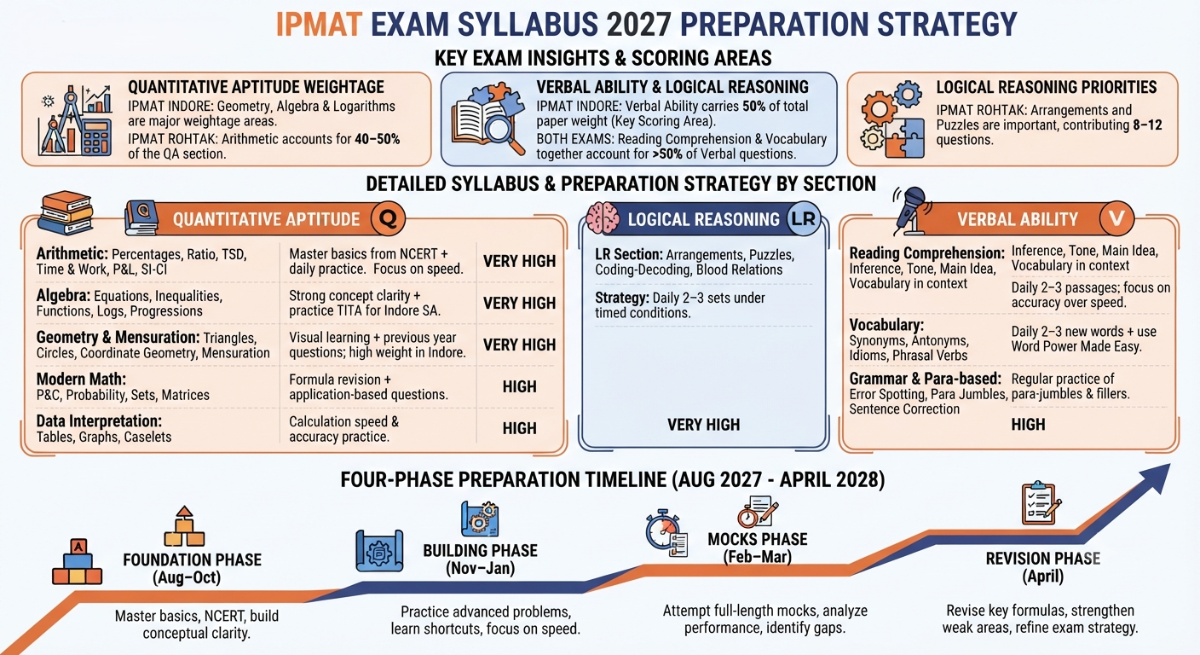
IPMAT Exam Syllabus 2027 Preparation Strategy
Geometry, Algebra and Logarithms carry major weight in IPMAT Indore Quant while Arithmetic makes up around 40–50% of Rohtak QA.
Reading Comprehension and Vocabulary together account for over 50% of Verbal questions across both IPMAT exams.
IPMAT Indore Verbal Ability carries 50% of the total paper weight which makes it key scoring area.
Arrangements and Puzzles are important areas in IPMAT Rohtak Logical Reasoning often contributing 8–12 questions.
A four phase plan covers Foundation (Aug–Oct), Building (Nov–Jan), Mocks (Feb–Mar) and Revision (April).
Section / Topic Area | AreaHigh-Weightage Topics (Expected) | Preparation Strategy | Priority |
|---|---|---|---|
Quant – Arithmetic | Percentages, Ratio, TSD, Time & Work, P&L, SI-CI | Master basics from NCERT + daily mixed practice sets; focus on speed | Very High |
Quant – Algebra | Equations, Inequalities, Functions, Logs, Progressions | Strong concept clarity + Arun Sharma LOD 1-2; practice TITA for Indore SA | Very High |
Quant – Geometry & Mensuration | Triangles, Circles, Coordinate Geometry, Mensuration | Visual learning + previous year questions; high weight in Indore | Very High |
Quant – Modern Math | P&C, Probability, Sets, Matrices | Formula revision + application-based questions | High |
Quant – Data Interpretation | Tables, Graphs, Caselets | Calculation speed + accuracy practice | High |
Logical Reasoning | Arrangements, Puzzles, Coding-Decoding, Blood Relations | Daily 2–3 sets under timed conditions | Very High |
Verbal – Reading Comprehension | Inference, Tone, Main Idea, Vocabulary in context | Daily 2–3 passages; focus on accuracy over speed | Very High |
Verbal – Vocabulary | Synonyms, Antonyms, Idioms, Phrasal Verbs | Word Power Made Easy + daily 20–30 new words | Very High |
Verbal – Grammar & Para-based | Error Spotting, Para Jumbles, Sentence Correction | Wren & Martin + regular practice of para jumbles & fillers | High |
Also Check: IPMAT Exam Preparation Tips for Class 12 Students
Ques. How can I start preparing for IPMAT?
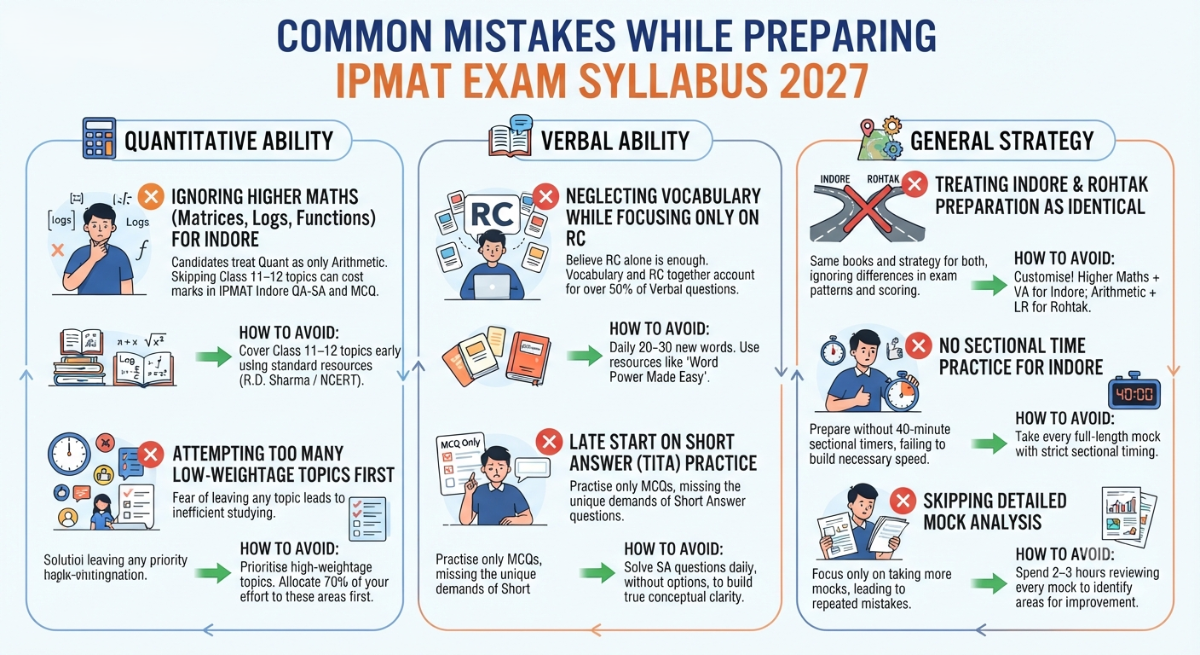
Common Mistakes While Preparing IPMAT Exam Syllabus 2027
Skipping Class 11–12 Maths topics such as Matrices, Logs and Functions can cost marks in IPMAT Indore QA-SA and MCQ.
Ignoring daily vocabulary practice can hurt scores as Vocabulary and RC together account for over 50% of Verbal questions.
Candidates should not follow the same strategy for IPMAT Indore and Rohtak as their exam patterns and scoring requirements differ.
Skipping detailed mock analysis can lead to repeated mistakes. Top scorers often spend 2–3 hours reviewing each mock.
Mistake | Why It Happens | How to Avoid |
|---|---|---|
Ignoring higher Maths (Matrices, Logs, Functions) for Indore | Candidates treat Quant as only Arithmetic | Cover Class 11-12 topics early with R.D. Sharma / NCERT |
Neglecting Vocabulary while focusing only on RC | Believe RC alone is enough for Verbal | Daily 20–30 new words + Word Power Made Easy |
Practising LR only from CAT-level books | Overestimate difficulty of Rohtak LR | Stick to R.S. Aggarwal + previous Rohtak papers |
No sectional time practice for Indore | Prepare without 40-minute sectional timers | Take every mock with strict sectional timing |
Attempting too many low-weightage topics first | Fear of leaving any topic | Prioritise high-weightage topics (70% effort) |
Skipping mock analysis | Focus only on taking more mocks | Spend 2–3 hours analysing every mock |
Treating Indore & Rohtak preparation as identical | Same books and strategy for both | Customise: Higher Maths + VA for Indore; Arithmetic + LR for Rohtak |
Late start on Short Answer (TITA) practice | Practise only MCQs | Solve SA questions daily without options |