


CBSE Class 12 Exam Pattern
Full pageCBSE Class 12 theory papers are mostly 3 hours long and carry 70 or 80 marks (or as specified for skill subjects), with the rest of the 100 marks coming from practicals or internal assessment. Questions increasingly test application and understanding rather than memory.
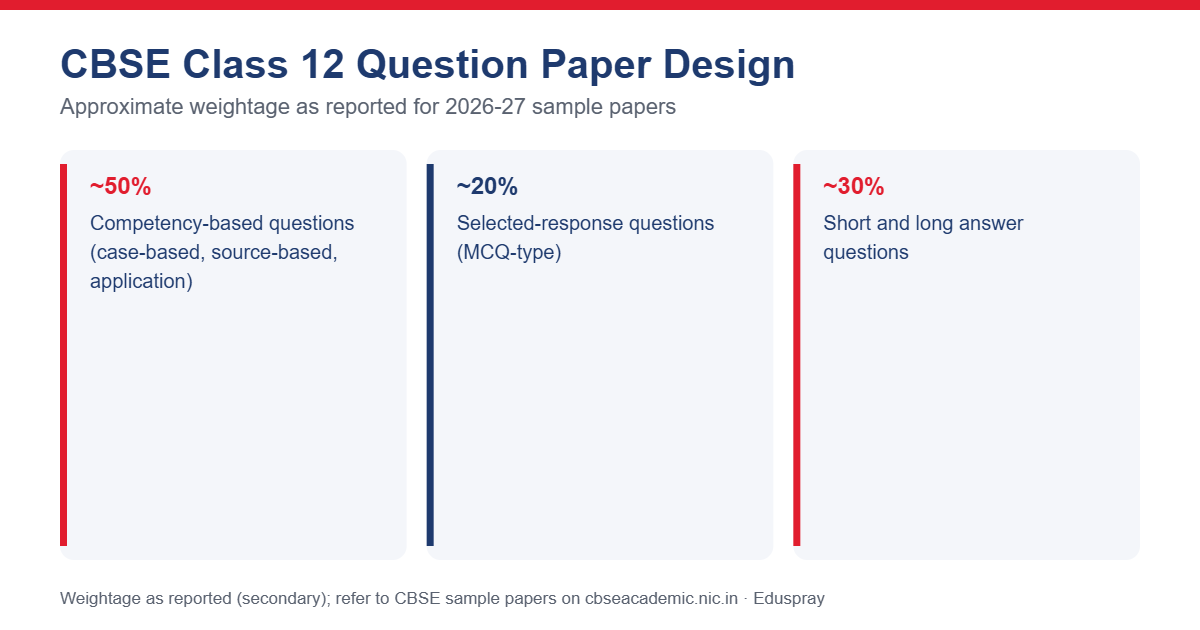
Question Types (2026-27, As Reported)
Type | Approximate share | What it means |
|---|---|---|
Competency-based questions | About 50% | Case-based, source-based and application questions, including MCQs on real-life situations |
Selected-response questions | About 20% | MCQs and similar objective questions |
Constructed-response questions | About 30% | Short and long answer questions |
The official CBSE curriculum says more questions will be based on real-life situations and directs students to the sample question papers and marking schemes on cbseacademic.nic.in for the exact design of each subject.
General Features
Pen-and-paper theory exam at CBSE-allotted centres.
Internal choice in some questions, as shown in the sample papers.
Separate marks for theory and practical/internal assessment — both must be passed.
Key Takeaways
About half the paper is competency-based (as reported).
Use CBSE sample papers for each subject’s exact pattern.
Theory and practical are marked separately.
Pro Tip: Solve the official CBSE sample paper for every subject at least twice under exam conditions — it shows the exact section-wise pattern and marking scheme.
Source: CBSE Curriculum 2026-27 (cbseacademic.nic.in); question-type shares as reported by Education Post (secondary)
Frequently Asked Questions
What is the CBSE Class 12 exam pattern for 2027?
Papers combine competency-based questions (about 50%, as reported), objective questions (about 20%) and short/long answers (about 30%).
How long is a CBSE Class 12 paper?
Most theory papers are 3 hours long.
Where can I find the official CBSE question paper design?
In the sample question papers and marking schemes on cbseacademic.nic.in.