


Overview
JEE Mains Phase 1
JEE Main 2027 Session 1 (Phase 1): Complete Guide
JEE Main 2027 Session 1, also commonly referred to as JEE Main Phase 1, is the first examination session of JEE Main 2027 conducted by the National Testing Agency (NTA).
For engineering aspirants, Session 1 is an important opportunity to assess their preparation, secure a strong percentile and improve their position for college admissions. Candidates who are eligible for another session can also use their subsequent attempt to improve their performance, subject to the rules announced by NTA.
This guide covers the important information related to JEE Main 2027 Phase 1, including exam dates, registration, eligibility, exam pattern, syllabus, preparation strategy, result, percentile, expected cutoff, and what students should do after Session 1.
JEE Main 2027 Session 1: Quick Overview
Particular | Details |
|---|---|
Examination | JEE Main 2027 Session 1 |
Also Known As | JEE Main Phase 1 |
Conducting Authority | National Testing Agency (NTA) |
Exam Level | National Level |
Main Paper | Paper 1 – B.E./B.Tech |
Subjects | Physics, Chemistry & Mathematics |
Exam Mode | Computer-Based Test |
Session | Session 1 |
Purpose | Engineering Entrance & Admission |
Major Institutes | NITs, IIITs, GFTIs and other participating institutes |
JEE Advanced Eligibility | Subject to applicable qualification criteria |
JEE Main 2027 Session 1 Exam Date
The JEE Main 2027 Session 1 exam date will be announced by NTA through the official examination notification.
Candidates should keep track of the complete Session 1 schedule, including registration, correction window, city intimation, admit card, examination and result.
JEE Main 2027 Phase 1 Important Dates
Event | Session 1 Schedule |
|---|---|
JEE Main 2027 Registration | To be announced |
Last Date to Submit Application | To be announced |
Application Correction | To be announced |
Exam City Intimation | To be announced |
Admit Card | To be announced |
JEE Main 2027 Phase 1 Exam | To be announced |
Session 1 Result | To be announced |
Session 2 Registration | To be announced |
Note: Candidates should verify all dates through the official NTA notification before relying on the schedule.
JEE Main 2027 Session 1 Registration
The JEE Main 2027 Session 1 application form will be available online through the official NTA examination portal.
Students should carefully enter their personal, academic and examination-related information and verify the details before submitting the application.
JEE Main Phase 1 Application Process
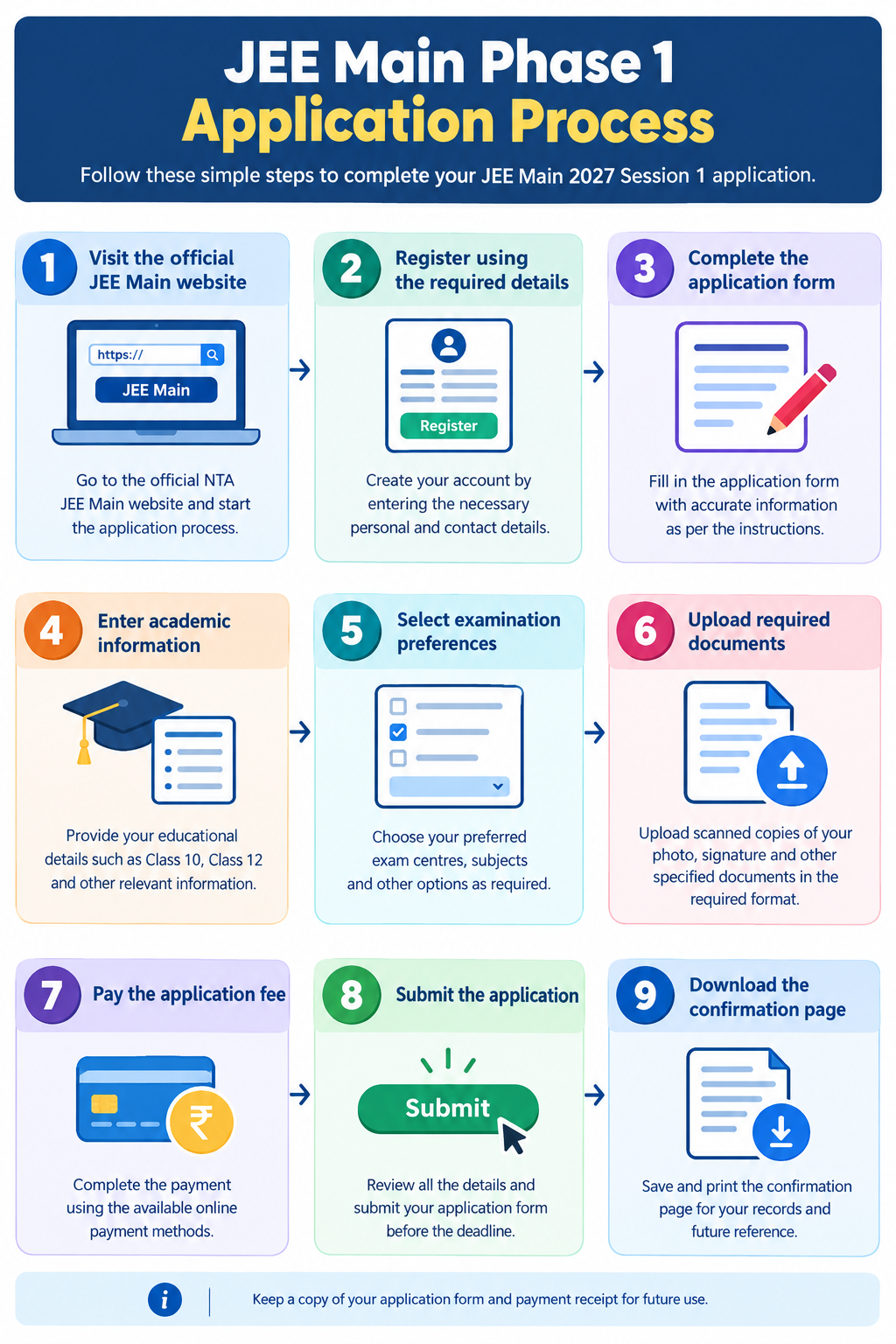
Candidates should retain a copy of their submitted application and payment confirmation for future reference.
JEE Main 2027 Session 1 Eligibility
Candidates appearing for JEE Main 2027 Phase 1 must satisfy the eligibility conditions prescribed by NTA.
The eligibility requirements may cover:
Qualifying examination
Year of passing Class 12
Required subjects
Number of attempts
Age-related conditions, if applicable
Institute-specific admission requirements
Educational Qualification
Candidates should have passed or be appearing for the qualifying examination in accordance with the conditions specified for JEE Main 2027.
Students applying for B.E./B.Tech admission should carefully check the required subject combination.
Age Requirement
Candidates should refer to the official JEE Main 2027 information bulletin for the applicable age-related provisions.
Attempts
The number of permitted attempts and session-specific rules should be checked in the official NTA notification.
JEE Main 2027 Session 1 Exam Pattern
Understanding the JEE Main Phase 1 exam pattern helps students plan their preparation and time management.
For Paper 1, the examination covers:
Physics
Chemistry
Mathematics
Feature | JEE Main Session 1 – Paper 1 |
|---|---|
Course | B.E. / B.Tech |
Subjects | Physics, Chemistry & Mathematics |
Mode | Computer-Based Test |
Question Format | MCQs and Numerical Value-Based Questions |
Duration | As specified by NTA |
Marking Scheme | As specified by NTA |
Negative Marking | As specified by NTA |
Language | As notified by NTA |
The final question distribution and marking scheme should be checked in the official JEE Main 2027 information bulletin.
JEE Main 2027 Phase 1 Syllabus
The JEE Main 2027 Session 1 syllabus covers Physics, Chemistry and Mathematics.
Students should prepare from the official syllabus and avoid relying solely on unofficial topic lists.
Physics
Important areas include:
Mechanics
Kinematics
Laws of Motion
Work, Energy and Power
Rotational Motion
Gravitation
Thermodynamics
Oscillations and Waves
Electrostatics
Current Electricity
Magnetism
Electromagnetic Induction
Optics
Modern Physics
Electronic Devices
Chemistry
Physical Chemistry
Mole Concept
Atomic Structure
Thermodynamics
Equilibrium
Electrochemistry
Chemical Kinetics
Solutions
Organic Chemistry
General Organic Chemistry
Hydrocarbons
Haloalkanes and Haloarenes
Alcohols, Phenols and Ethers
Aldehydes and Ketones
Carboxylic Acids
Amines
Biomolecules
Inorganic Chemistry
Periodic Classification
Chemical Bonding
Coordination Compounds
p-Block Elements
d- and f-Block Elements
Qualitative Analysis
Mathematics
Major preparation areas include:
Algebra
Complex Numbers
Quadratic Equations
Matrices and Determinants
Sequences and Series
Permutations and Combinations
Binomial Theorem
Trigonometry
Coordinate Geometry
Calculus
Vector Algebra
Three-Dimensional Geometry
Probability and Statistics
The official JEE Main 2027 syllabus should be treated as the final reference if any changes are announced.
JEE Main 2027 Session 1 Preparation Strategy
Preparing specifically for JEE Main Phase 1 requires a balance between completing the syllabus and developing exam-taking skills.
Build a Subject-Wise Plan
Divide the syllabus into:
Strong Topics
Topics that require regular revision and practice.
Moderate Topics
Topics where additional question practice is required.
Weak Topics
Topics that need focused conceptual preparation.
Solve Previous-Year Questions
Previous-year JEE Main questions can help identify:
Frequently tested concepts
Question patterns
Difficulty levels
Time-consuming topics
Common mistakes
Take Regular Mock Tests
Mock tests should be used to improve:
Speed
Accuracy
Time management
Question selection
Examination temperament
Analyse Your Mistakes
After every mock test, identify whether an incorrect answer resulted from:
Lack of conceptual understanding
Calculation error
Misreading the question
Guessing
Poor time management
JEE Main 2027 Phase 1: High-Priority Topics
Instead of attempting to predict exact questions, students should prioritise the official syllabus and topics that have consistently required strong conceptual and numerical preparation.
Subject | Important Areas |
|---|---|
Physics | Mechanics, Electrodynamics, Modern Physics, Optics, Thermodynamics |
Chemistry | Chemical Bonding, Organic Reactions, Coordination Chemistry, Physical Chemistry |
Mathematics | Calculus, Algebra, Coordinate Geometry, Vectors & 3D, Probability |
The importance of individual chapters can vary between examination shifts, so students should avoid completely ignoring syllabus areas.
JEE Main 2027 Session 1: Last-Month Preparation Strategy
The final month should focus more on revision, practice and performance improvement than on trying to learn the entire syllabus from scratch.
30 Days Before the Exam
Focus on:
Completing pending high-priority topics
Revising formulas
Solving previous-year questions
Taking regular mock tests
15 Days Before the Exam
Focus on:
Full-length mock tests
Weak-topic revision
Formula revision
Chemistry NCERT revision
Improving question selection
Final Week
Focus on:
Revision
Short notes
Important formulas
Previous mistakes
Mock-test analysis
Maintaining a consistent sleep schedule
Avoid making major changes to your preparation strategy during the final few days.
JEE Main 2027 Session 1 Admit Card
The JEE Main Session 1 admit card is an essential examination document.
Candidates should download it from the official NTA website once released and carefully check:
Candidate name
Photograph
Examination date
Examination centre
Reporting time
Examination instructions
Students should follow all instructions mentioned on the admit card and the official examination guidelines.
JEE Main 2027 Session 1 Result
The JEE Main 2027 Session 1 result will be released by NTA after the examination.
The result may provide important information such as the candidate's:
Percentile score
Subject-wise performance
Overall performance
Other result-related details specified by NTA
Students should download and preserve their result for counselling and admission purposes.
JEE Main 2027 Session 1 Marks vs Percentile
One of the most important questions after Phase 1 is:
"How many marks are required for a particular percentile?"
There is no single permanent marks-to-percentile conversion because JEE Main uses a normalization process across examination sessions.
The relationship can vary depending on:
Examination difficulty
Shift-wise performance
Number of candidates
Overall candidate performance
Therefore, marks-vs-percentile estimates should be treated as indicative rather than guaranteed.
JEE Main 2027 Session 1 Percentile vs Rank
Percentile and rank are different measures.
Your percentile represents your relative performance in the examination, while your rank is used for admission and counselling purposes.
The final rank depends on the result methodology and the overall candidate pool.
Students should use their official result and rank when making college decisions rather than relying only on online predictions.
JEE Main 2027 Session 1 Cutoff
The term JEE Main cutoff can refer to different admission-related benchmarks.
Qualifying Cutoff
A qualifying cutoff determines whether a candidate meets a particular eligibility requirement.
Admission Cutoff
An admission cutoff is generally associated with the closing rank or score for a particular college, branch, category and counselling round.
These should not be confused with each other.
JEE Main 2027 Phase 1 Cutoff: What Can Affect It?
The cutoff can vary every year based on:
Number of candidates
Difficulty level
Candidate performance
Category
Seat availability
Institute
Engineering branch
Counselling round
Previous-year cutoff data can help students understand trends but cannot guarantee a particular college or branch.
What Happens After JEE Main 2027 Session 1?
After Phase 1, students should evaluate their performance before making admission decisions.
If Your Performance Is Strong
You can begin researching colleges, branches and expected counselling options.
If Your Performance Is Below Expectations
Use the result to identify areas that need improvement and continue preparation for the next available opportunity, where applicable.
If You Are Unsure About Your College Options
Compare your expected rank with previous closing ranks and prepare a broad college and branch shortlist.
Should You Appear for JEE Main 2027 Session 2?
For students who are eligible for another JEE Main session, the decision should depend on their Session 1 performance and preparation status.
Factor | Consider Another Session | Reconsider Another Session |
|---|---|---|
Session 1 Score | Score is below your target | Score already meets your target |
Preparation | You can improve weak areas | Preparation is already complete |
Mock Performance | Mock scores show improvement potential | Scores are consistently strong |
Target College | You need a stronger rank | Your current rank is suitable |
Mental Readiness | You can prepare effectively | Additional preparation may affect performance |
Students should always follow the rules and schedule announced by NTA for the applicable session.
JEE Main 2027 Phase 1 College Options
Your Session 1 percentile or rank can help you estimate your college options, but admission depends on multiple factors.
Consider:
Rank
Category
Home State quota
Other State quota
Branch
Institute
Counselling round
Seat availability
Major College Categories
NITs
National Institutes of Technology offering a wide range of engineering programmes.
IIITs
Institutes with strong focus on information technology and related disciplines.
GFTIs
Government-funded technical institutions participating in the applicable admission process.
State & Other Institutes
Students can also explore engineering colleges through state-level and institution-specific admission processes where eligible.
JEE Main 2027 Phase 1 College & Branch Selection
A good JEE Main score does not automatically mean that the first college appearing in a search result is the best choice.
Compare:
College Factor | What to Check |
|---|---|
Branch | Curriculum and career relevance |
Fees | Tuition and additional costs |
Placements | Placement trends and opportunities |
Location | Accessibility and living costs |
Infrastructure | Labs, classrooms and facilities |
Internships | Industry exposure |
Hostel | Availability and cost |
Reputation | Academic and industry standing |
Students should create a preference list based on their own priorities rather than copying another student's list.
JEE Main 2027 Phase 1 Counselling
JEE Main Session 1 results are followed by the broader admission and counselling process.
For NITs, IIITs and GFTIs, eligible candidates can participate in the applicable JoSAA counselling process.
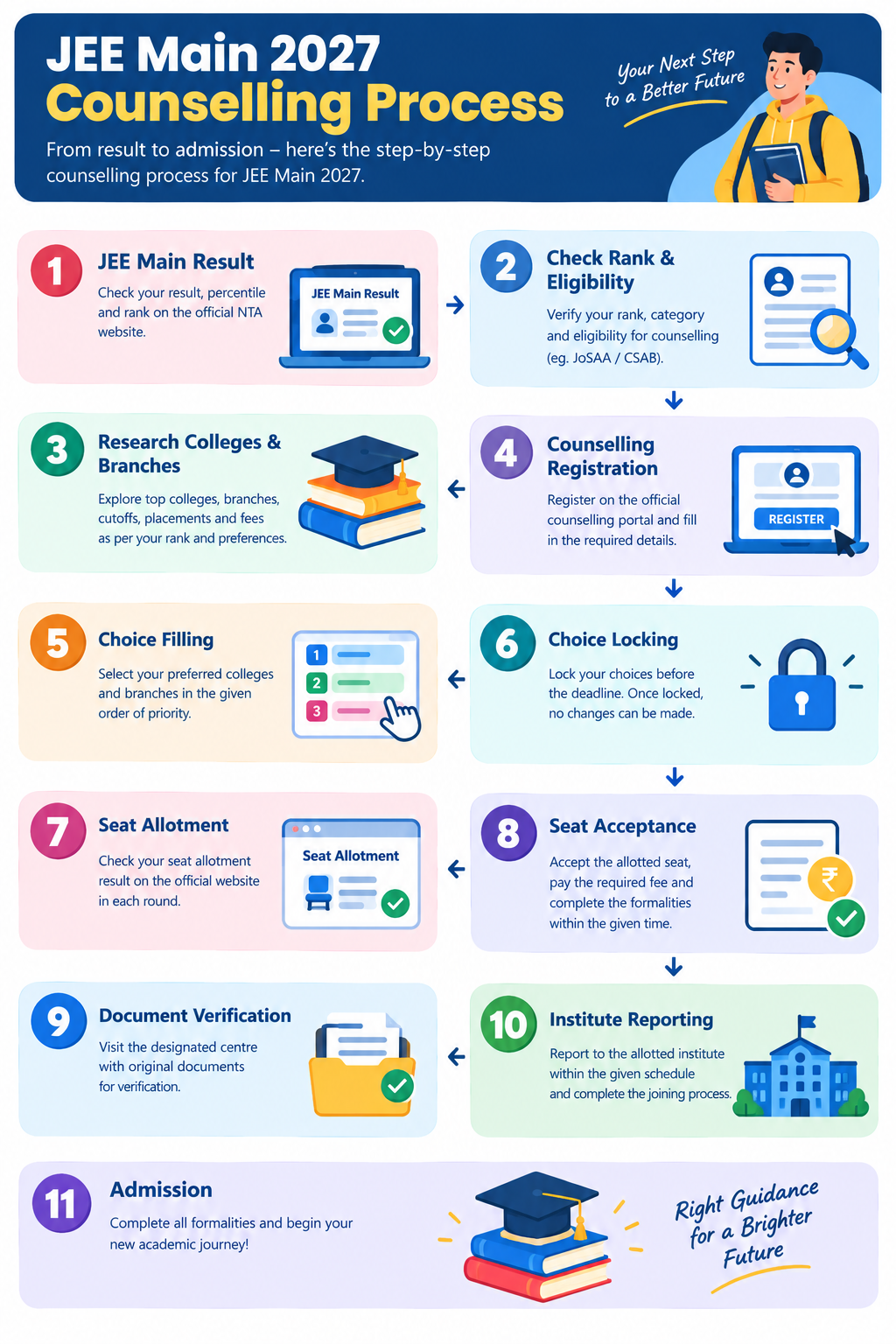
The exact counselling schedule and rules should be checked from the official counselling authority.
JEE Main 2027 Phase 1: Common Mistakes
Starting Without Understanding the Syllabus
A clear syllabus-based plan prevents students from spending too much time on low-priority areas.
Ignoring Previous-Year Questions
Past questions provide valuable insight into the type of preparation required.
Taking Mock Tests Without Analysis
The purpose of a mock test is not only to obtain a score but also to identify areas for improvement.
Spending Too Much Time on One Question
Time management is crucial in a competitive computer-based examination.
Ignoring Chemistry Revision
Regular revision is particularly important for factual and reaction-based areas of Chemistry.
Making College Decisions Only From Percentile
College options depend on rank, category, branch, quota and counselling trends.
JEE Main 2027 Session 1 FAQs
What is JEE Main 2027 Phase 1?
JEE Main 2027 Phase 1 is another commonly used term for JEE Main 2027 Session 1, the first examination session conducted by NTA.
When will JEE Main 2027 Session 1 be conducted?
The official Session 1 examination dates will be announced by NTA.
What is the syllabus for JEE Main 2027 Session 1?
The syllabus for Paper 1 covers Physics, Chemistry and Mathematics. Students should follow the official 2027 syllabus released by NTA.
Is JEE Main Phase 1 enough for admission?
JEE Main Session 1 can be important for a student's overall performance and college planning. Admission depends on the applicable rank, eligibility, counselling process and institute requirements.
Can I improve my JEE Main performance after Session 1?
Students who are eligible for another session can use the subsequent opportunity to improve their performance, subject to the rules announced by NTA.
How is JEE Main Session 1 percentile calculated?
Percentile is calculated using the examination's normalization methodology. It is not the same as raw marks.
Can I get an NIT through JEE Main Session 1?
Admission to NITs is based on JEE Main performance and the applicable eligibility and counselling requirements. Your college and branch options depend on factors such as rank, category, quota and seat availability.
What should I do after my JEE Main Phase 1 result?
Check your percentile and rank, assess your college and branch options, compare previous closing ranks and prepare for the applicable counselling process. If another examination opportunity is available to you, evaluate whether improving your score is worthwhile.
JEE Main 2027 Phase 1: Admission Guidance
A JEE Main Phase 1 result is more than just a percentile. It is the starting point for making important decisions about your college, branch and admission strategy.
Eduspray India can assist students with:
JEE Main college selection
Engineering branch selection
College and course comparison
Counselling guidance
Choice filling strategy
IPU engineering admission options
Document verification
Admission process guidance
Alternative college options based on rank