

Registration
Eligibility
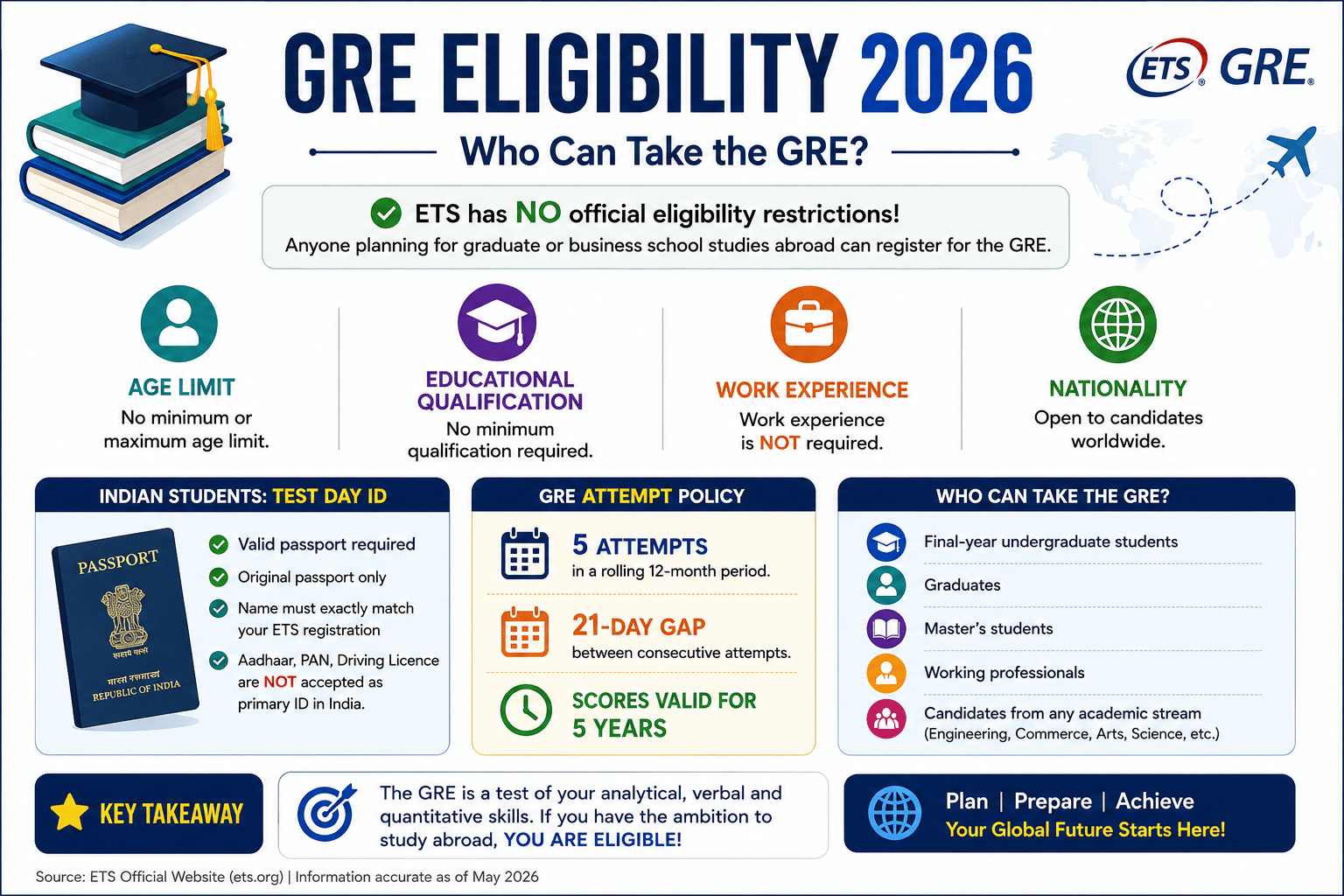
The ETS has set no age limit, no degree requirement, and no ID requirements for registration or eligibility. Anyone willing to take the GRE can take the exam. The rules that do exist are passport rules.
Key highlights of GRE eligibility criteria are:
ETS sets no age limit, no academic qualification, and no minimum marks for the GRE.
For Indians, the only hard requirement is a valid original passport with an exact name match.
The GRE fee in India is INR 22,550.
Final-year students can and should take it, keeping retake headroom before deadlines.
GRE Eligibility Quick Facts 2026
Applicants appearing for the GRE exam should know that ETS has set no specific eligibility criteria. There are no specific age or educational requirements. Applicants can check the other eligibility criteria from the table below:
Parameter | Detail |
|---|---|
Age limit | None set by ETS |
Education requirement | No degree, marks, or stream condition |
ID for Indians | Valid original passport, exact name match |
India fee | INR 22,550, plus service fee and GST at payment |
Fee change | Global fee rises to USD 249 (about INR 23,700) from August 1, 2026 |
Retake rule | Once every 21 days, 5 times in a rolling 12 months |
Score validity | 5 years from the test date |
USD 1 = INR 95 is used as the currency conversion throughout the article as of July 1, 2026.
What Are the GRE Eligibility Rules in 2026?
ETS has not set any specific eligibility criteria for its applicants. Anyone can register for the GRE General Test, provided they have a valid passport. The applicant's registered name and passport name should be the same.
No ETS restrictions: no age limit, no degree condition, no minimum percentage, no stream requirement and no attempt eligibility beyond the retake windows.
Passport-only ID for India: a valid, unexpired, original passport, since photocopies, digital scans, Aadhaar, PAN, driving licence and college ID are all refused at the centre.
Exact name match: the ETS account and registration name must match the passport letter for letter.
Two formats, same rules: the test centre and GRE at Home versions are identical in format, scoring and acceptance.
Universities set their own bars: ETS eligibility gets you a score, and each program decides whether it wants one and how high.
Key Insight: GRE eligibility and university eligibility are different gates, and mixing them up costs money in both directions. ETS will happily test a second-year student or a 40-year-old professional, while a university may still demand a completed bachelor's, minimum marks or no GRE at all. Clear ETS's gate with the passport, and clear the university's gate with its own checklist.
GRE Age Limit 2026
There is no minimum or maximum age for the GRE in 2026, and ETS publishes no age criterion at all. The typical taker profile is a choice, not a rule.
The table below breaks down who and when they can take the GRE test:
Profile | Can they take the GRE? | What matters instead |
|---|---|---|
Final-year and pre-final students | Yes, and it is the smart window | Retake headroom before deadlines |
Working professionals, any age | Yes, with no upper limit | The 5-year score validity clock |
School students | Technically yes, since no minimum exists | Scores serve graduate admissions, so timing is wasted early |
Career changers in their 30s and 40s | Yes, routinely | Program fit, not the test's door |
What the no-age rule covers and what it does not:
Covers: the right to register and test at any age, at a centre or at home.
Does not: university preferences, since programs weigh work experience, recency of study, and score validity their own way.
If your scores will be more than 5 years old by your intended intake, then the validity clock, not any age limit, is what forces a retake. That means older applicants should count backward from the application season, not from today.
GRE Educational Qualification Requirements 2026
ETS asks for no educational qualification: no completed degree, no minimum CGPA, no particular stream, and no proof of study at registration. The universities you apply to ask for all of that instead.
. How the education question really works:
No degree needed to test: ETS never asks for certificates, marksheets, or enrolment proof.
Final-year students are the classic takers: testing in the pre-final or final year leaves room for a retake before Fall deadlines.
Backlogs do not block the GRE: ETS neither asks about them nor sees them, though universities read them in your transcripts later.
Any stream can test: arts, commerce and science graduates all register identically, since the GRE measures verbal, quantitative and writing skills, not subject knowledge.
Subject Tests are separate: the GRE Subject Tests in specific disciplines carry the same open eligibility, with their own fee.
Important: A GRE score is necessary but never sufficient. The score reaches a university that then applies its own education bar, usually a completed bachelor's in the 10 plus 2 plus 3 or 4 structure, minimum marks, and sometimes prerequisites. Take the GRE whenever you like, but plan it so the score lands where your degree and documents can back it.
Common Mistakes Students Make Regarding GRE Eligibility 2026
Most of the applicants make a common mistake of not having a valid passport for GRE registration. It is the only mandatory requirement for the GRE. Applicants must have a valid passport. Here are some other common mistakes that can affect your GRE exam:
Name mismatch: registering with a spelling, initial, or surname order that differs from the passport, which voids entry on test day without refund.
Expired or absent passport: arriving with a photocopy, a digital scan, or an expired booklet, none of which is accepted.
Assuming Aadhaar or PAN works: Indian domestic IDs are refused at GRE centres, however valid elsewhere.
Waiting for the degree: postponing the test to after graduation, losing the final-year retake buffer for nothing, since no degree is needed.
Miscounting retake windows: booking inside the 21-day gap or as a sixth attempt in 12 months, which the system blocks, while cancelled scores still count as attempts.
Confusing the two gates: treating ETS's open door as university eligibility, then discovering a program's degree, marks, or test-policy bar after paying.
Key Insight: Fix the passport first and everything else follows. Apply for or renew the passport before you touch the ETS account, then copy the name into the registration character by character from the booklet, not from memory. One careful minute at signup protects INR 22,550 and a test day.
Tips and Suggestions for GRE Exam 2026
Applicants who are willing to register for GRE must do it before 1st August, as the exam fees are to rise after that. Book your test well in advance so that you have ample time to plan for a retake. Here are some tips for those appearing for the GRE:
Beat the fee rise where sensible: registrations from August 1, 2026 reflect the increased USD 249 fee, so students already prepared should book in July.
Plan 2 to 3 months before deadlines: the shorter GRE runs about 1 hour 58 minutes, and slots exist year-round, but retake gaps need calendar room.
Hold the free score reports: the 4 free reports are chosen at registration or on test day, so likely retakers should wait, since extra reports cost INR 2,900 each and ScoreSelect lets you send only your best attempt.
Choose centre or home by discipline: both versions are identical, so pick the environment you test better in and arrive 30 minutes early at centres.
Pay smart from India: UPI now works alongside internationally enabled cards, while domestic-only cards fail to process payments.
Know the safety valves: cancelling at least 4 days ahead gets a 50% refund; rescheduling costs about INR 5,000; and the AWA rescore window runs for 90 days.
Important: The ETS Fee Reduction Program's 50% voucher is built around US-based criteria, so most Indian applicants do not qualify, while paid third-party vouchers deserve scepticism. Budget the full fee, and treat any waiver at the university end, where GRE-optional policies genuinely save the entire amount.
GRE eligibility in 2026 stays what it has always been: open by design, guarded only by the passport. No age limit, no degree condition, and no marks bar sit on ETS's side, while the real bars, program requirements and score expectations, sit with the universities. Match the registration to the passport letter for letter, test in the final-year window with retake room, hold the free reports until the score is final, and mind the August 1 fee rise. Do that, and eligibility becomes the one part of the GRE you never think about again.